


In November of 2020, President Russell M. Nelson put out a video message calling for church members to “flood social media” with thanks.
The results of his call were miraculous.
Over the next month, church members did as he asked. Sure, some seemed to mistake bragging for gratitude. And some of the posts were pretty grating. But, in the midst of a bleak pandemic winter, there was a certain beauty in people highlighting the bright spots in their own lives. If nothing else, it was a remarkable example of people showing up and doing what the prophet asked.
And it turns out that this is not a singular occurrence. When church members talk about “following the prophet,” we generally take that responsibility seriously. It is no small thing, after all, that millions of people across virtually every time zone stop what they’re doing once every six months to listen to some part (or even all) of ten hours (now eight) of spoken discourse, largely to determine how to change their lives. This is a big deal.
And yet.
Even while honoring the willingness of Latter-day Saints to follow prophetic direction, we can still detect a sense that—for many interlocking reasons—we as church members may sometimes take individual bits of prophetic counsel literally . . . while still not taking the entire prophetic project seriously. Our understanding of prophetic counsel and the charge of following what the prophet says can inadvertently atomize what the prophet is telling us and focus us too much on the details of the most recent pronouncement.
With all of this, we run the risk of failing to engage seriously with the weightier matters of prophetic counsel over centuries and millennia. Our obedience may err on the side of surface exactness over considered depth. We run the risk of missing the forest for the trees precisely because we have made a change to our shared cultural vocabulary or are sporting a bracelet with the latest meme-ified prophetic slogan. If we’re not careful, we can allow superficial changes to blind us to the need to follow deeper, more consistent, and more holistic prophetic counsel.
If we can look past the slogans and hashtags, however, we can see an insistent harmony to the deeper substance of the prophetic project from Moses to Jesus to Joseph Smith to Dallin Oaks. While responding with Facebook posts and bracelets can help us fine-tune our thinking and actions, what is needed is a more wholesale attempt at asking: “What do prophets ask us to do?” and “What kind of people do prophets ask us to be?”
The prophetic project, seen across the larger canonical tapestry of dispensations, seems to me to be a call to become transformed. We are meant to live lives enlivened by our encounter with the divine. Prophets remind us that a godly fire is meant to alchemize who we are.
I find it telling that, in the book of Micah, through a prophet, the Lord tells his people what he needs from them: “What doth the Lord require of thee, but to do justly, and to love mercy, and to walk humbly with thy God?” (6:8, KJV). I am always struck when I read this verse by the demanding nature of the verb “love.” That Hebrew verb (transliterated ’a·hă·ḇaṯ) connotes a strong bond or connecting affection, as in Jeremiah 31:3: “The Lord hath appeared of old unto me, saying, Yea, I have loved thee with an everlasting love: therefore with lovingkindness have I drawn thee.”
The use of this verb in Micah tells us that what Jehovah requires of us is not just to show mercy, and it is certainly not to come to mercy begrudgingly. Rather, we are called by God to love mercy, even as God loves us. That is: God’s love binds the universe together, like gravity—and it is this same force of love we are meant to access and emulate.
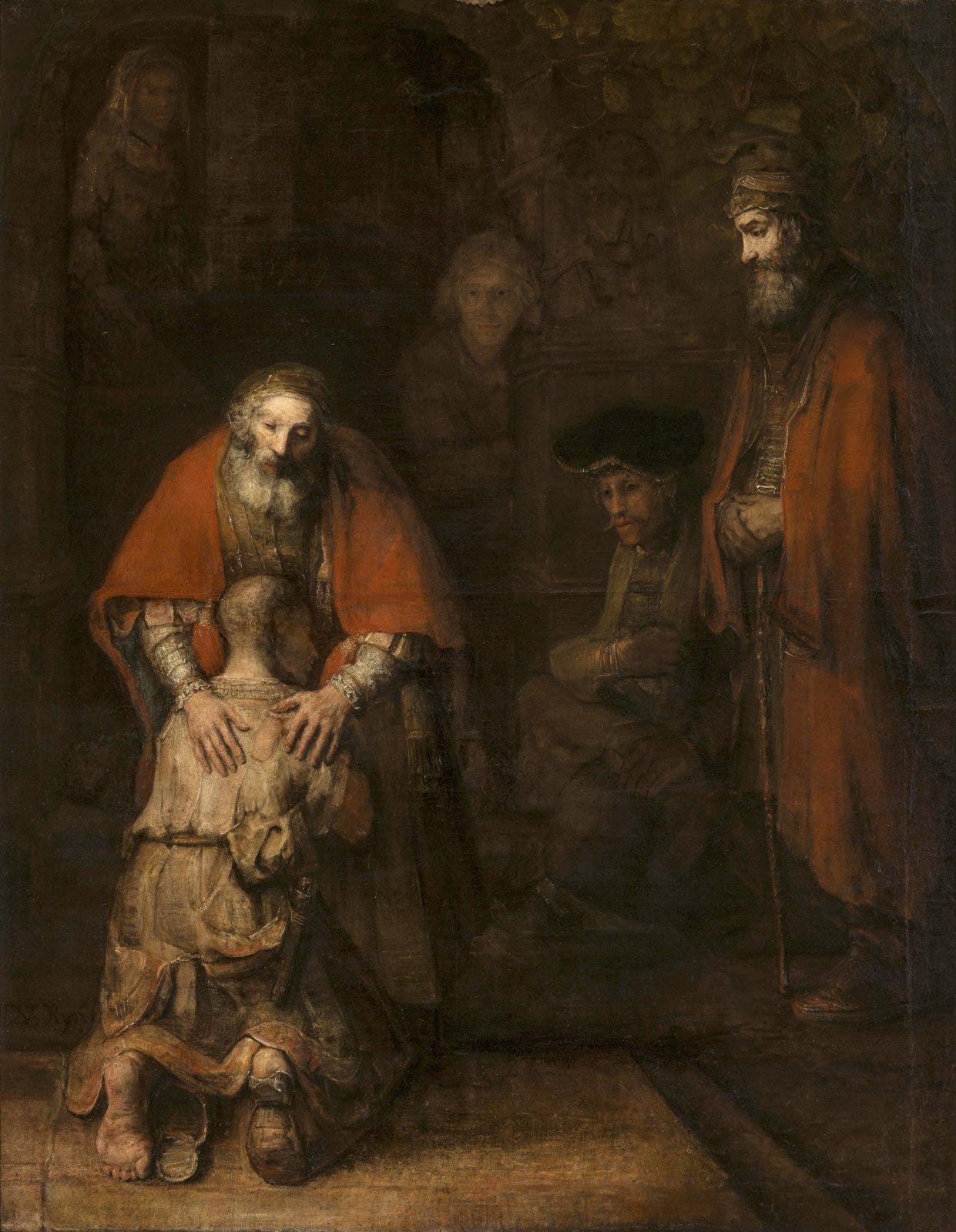
In a similar vein, Jesus implicitly invites us to show this love by becoming like the father of the prodigal son. We are not meant to hesitantly allow those who wrong us back into the circle of our love, but rather to stand at the gate of their departure, scanning the horizon, waiting anxiously and unendingly for their return. And when the speck of a silhouette appears on the horizon—though it be limned by the last rays of the setting sun, and though our legs may have grown old and frail in the waiting—we are meant to run to the returning prodigal, breathless, and to fall on his neck, showering him with kisses and enveloping him in the godly love that can come only as a gift of grace.
I worry that in living conference to conference, meme to meme, and quote to quote, we risk missing this more substantial prophetic call that comes to us with such burning urgency across the eons. And, really, what call could be more relevant in our hurly-burly, callous, distanced, and often disordered world? Prophets give day-to-day instructions—anciently about how to handle manna or recently what to post on Facebook—but those can only ever be small examples, daily instantiations, of the message they need us to hear. Ultimately, the epiphany the prophets keep asking us to understand is what King Benjamin will never let us unhear: that all the trappings of success we have built around ourselves are nothing, that we are beggars, and that life flows to us as unearned grace.
A gift.
And that we, seeing life for what it truly is, will forever see the world differently. Thus transformed, we will know that every beggar who confronts us is Jesus, disguised, and that we are meant to wear out our lives, bringing succor to those who suffer and peace to those with wounded hearts. Thus, the whole of the prophetic call is that we are bound together and that we covenant to: protect the defenseless, feed the hungry, lift the low, and minister to the marginalized and disregarded.
All of this can remind us that, at the end of the day, the entirety of the gospel boils down to how we treat those who are suffering or in need. It can hardly surprise us, in this context, that our response to suffering constitutes the most elemental substance of our covenant to become Christian disciples (see Mosiah 18).
Given all this, it can hardly surprise us that in his first church-wide address as prophet, President Oaks highlighted this very refrain and, tellingly, quoted both Jesus and Joseph Smith—as if to emphasize the very continuity that defines the core of the prophetic call:
The Prophet Joseph Smith taught that we should “pour forth love” to all people. Speaking of our Savior, the Apostle John wrote, “We love him, because he first loved us” (1 John 4:19). We can follow the example of Jesus Christ, who is our role model, by choosing to love others—even if they show little or no love toward us. He declared, “Blessed are the peacemakers: for they shall be called the children of God” (Matthew 5:9; see also 3 Nephi 12:9).
Tyler Johnson is a medical oncologist and associate editor at Wayfare. To subscribe to Tyler’s column, first subscribe to Wayfare, then click here to manage your subscription and turn on notifications for On the Road to Jericho.
Art by Rembrandt van Rijn (1606–1669). Hermitage Museum.