


As a woman who had to wait much longer than most to be a mother, I have always been fascinated by the number of Old Testament matriarchs whose situation was parallel to mine. When I found out I was pregnant, I, like Rachel, felt remembered by the Lord (Genesis 30:22–23, KJV). And like Sarah, I also felt cause to “laugh” or rejoice (Genesis 18:12). But of all these women who waited upon the Lord for the privilege of bearing a child, Hannah’s story of enduring prolonged infertility—only to give up a long-awaited son for temple service—is perhaps the most unique account. And it is probably my favorite one to explore as well.
Part of what makes Hannah’s story so compelling is her motivation to become a mother. In an age when childlessness often resulted in a depleted socioeconomic currency for women, Hannah was actually in an enviable position. Her husband, Elkenah, clearly loved her and demonstrated his devotion by giving her a double portion of the sacrificial meat prepared each year—twice as much as the portion given to his other wife, Peninnah, and her children. Sacrificial food was associated with prestige, and so Hannah’s place in society does not appear to be in jeopardy.1 For some women, having a husband who is “better to [her] than ten sons” would have been sufficient (1 Samuel 1:8).
So, when Hannah weeps and prays earnestly in the temple for a child, she does not do so to please her husband or raise her social status. Nor is she seeking to cease Peninnah’s tauntings, as Peninnah delights in “provok[ing] her sore” for her childlessness (1 Samuel 1:6). Rather, when Hannah vows to “give [a son] unto the Lord all the days of his life,” she sees motherhood beyond companionship, economic security, and even personal happiness (1 Samuel 1:11). Child-rearing, in her mind, is an opportunity to contribute to God’s higher purposes. When Samuel is born, she reaffirms her pledge: that she “lent him to the Lord; as long as he liveth he shall be lent to the Lord” (1 Samuel 1:28). The word “lent” in the King James Version may seem an odd word choice, as it could imply that she is allowing the Lord to “borrow” her son. But in later biblical translations, the word “lent” is replaced with “give” and “dedicate.” With these translations in mind, Hannah’s entrusting her son to God was intended to be a permanent arrangement.
As a mother, I feel particular pangs reading Hannah’s account; I wonder how she must have felt when she gave her small son to Eli. But Hannah seems to be at peace and even rejoices in the choice she has made, as depicted by her psalm in the subsequent chapter. As psalms are rarely credited to women in the Bible, Hannah’s lengthy song of praise after surrendering her child to temple service is a distinctive read, as she exultantly states: “My heart rejoiceth in the Lord, mine horn is exalted in the Lord” (1 Samuel 2:1). According to the LDS KJV footnote, “horn” is meant to reflect one’s capacity or power. Perhaps she felt the Lord’s endowment of additional strength, as she freely gave her child to the Lord for his purposes. Interestingly, she was given the experience of raising children in her home, as we learn that by the end of the story she had five more children.
Through a modern lens, Hannah’s account ostensibly feels out of touch: My covenant-keeping today is unlikely to require me to surrender custody of my child. But I want to believe that, like Hannah, I, too, may develop an attitude of trusting my child to God’s will and his higher purposes. But what does dedicating a child to the Lord look like now? And how do I achieve the same type of courageous attitude that this mother had many centuries ago?
Like Hannah preparing her child to serve God, I muse how I can demonstrate my desire to have God’s presence and guidance in my daughter’s life. In a few years, I will have the uncommon privilege of walking with my daughter to a temple that is just outside our neighborhood—a blessing that no doubt Hannah could not have imagined. But according to Doctrine and Covenants 93, the idea of worship is more than just the location itself—it is understanding who God is and believing that we, too, can actually become all that he is. The crux of the section occurs in D&C 93:19, stating that we “may know what you worship, that you may come unto the Father in my name, and in due time, receive of his fullness.” Suddenly, mortality is more than Plato’s cave, where we are only able to glimpse the shadows and flickers of a life beyond this one. Rather, worship is an act of unalloyed submission toward God because we know that he can thrust us to heights that our finite minds cannot imagine.
Hannah also has a firm grasp of God’s character and his transformative power. From her psalm, she clearly sees him as a being of knowledge, strength, and dependability (1 Samuel 2). While it is unclear whether she believed that we can become all that God is, she nonetheless views him as someone whose capacities in assisting his children are limitless, as she confidently states: “He raiseth up the poor out of the dust and lifteth up the beggar from the dunghill, to set them among princes, and to make them inherit the throne of glory” (1 Samuel 2:8). After all, she has personally received God’s miraculous intervention, as seen by her transition from childlessness to motherhood. Her astonishing ability to give her son to the temple, then, is rooted in her knowledge of who God is and all that he can do for his children. If he has the power to give beggars and the poor a throne of glory—as well as miraculously giving her a long-awaited son—surely, he could give Samuel a marvelous future ahead. Lending one’s child to the Lord, then, appears to be a surrendering attitude, and an acknowledgement that God himself can make more out of our children’s lives than even the most loving parent can. While at first read, Hannah’s story appears to be rooted in the temple, much of her narrative centers on this psalm of faith in God’s capacity, demonstrating the endowment of power that comes when one understands who God is and what he can do.
That appears to be my task in hand: cultivating the courage to believe that God is the ultimate designer of my daughter’s life, rather than myself. Knowing that God finds joy in preparing her for a glorious future should certainly act as a source of comfort for me (D&C 1:39). But as I look into my daughter’s pure little eyes, I also wonder what it truly means to surrender her future to God. She has already experienced two goose eggs on her head as part of her determination to walk, and, at times, I shudder to think of those “goose eggs” that mortality will clap on her as part of her quest for godhood. And am I sufficiently prepared to help her navigate bullying, depression, unrequited love, or any of the other thorny elements of this life that she may face?
Again, my mind turns to Hannah, as she turns over her child to the Lord. She may have felt a measure of trepidation as well. Perhaps, as she made the annual visit to the temple, she heard of or even witnessed Eli’s sons’ reprehensible misconduct. Perhaps she wondered if she had actually made the right choice. Perhaps she second-guessed her decision and worried how her son would fare growing up alongside these men and with their high priest father, who did little to prevent their heinous acts. But she also probably finds solace in the sanctity of her pledge to the Lord, as she confidently states in her psalm, “There is none holy as the Lord/for there is none beside me/neither is there any rock like our God” (1 Samuel 2:2).
In Marilynne Robinson’s Gilead, the narrator, John Ames, is in a position similar to Hannah’s: he recognizes his looming death and, consequently, must trust God to take care of his young son. To prepare for his end of mortality, the narrator writes a series of letters containing advice, family heritage, and wisdom gathered throughout the years for his son’s reference. In one of his letters, he recounts a past sermon he gave on Abraham:
I began my remarks by pointing out the similarity between the stories of Hagar and Ishmael sent off into the wilderness and Abraham going off with Isaac to sacrifice him, as he believes. My point was that Abraham is in effect called upon to sacrifice both his sons, and that the Lord in both instances sends angels to intervene at the critical moment to save the child. . . . I think . . . any father . . . must finally give his child up to the wilderness and trust to the providence of God. . . . Great faith is required to give the child up, trusting God to honor the parents’ love for him by assuring that there will indeed be angels in that wilderness.
There is something unspeakably precious about knowing that God can send angels to my child in those pivotal, urgent moments. Ames notes that it is not until Abraham is fully willing to sacrifice his two sons that the angels appear to make the necessary intervention. And after Hannah leaves Samuel with Eli, God’s voice is manifest to protect the child from corrupt influences that had seeped into his temple upbringing. The efficacy of this divine ministration is illustrated when Samuel is described as a God-fearing child, who did let none of [the Lord’s] words fall to the ground” (1 Samuel 3:19).
Similarly, I wonder if fully surrendering my will for my children to the Lord may further enable them to have those much needed divine interventions. Perhaps part of entrusting God with my daughter is to trust his timing and methods for her, allowing him and his angels, on either side of the veil, to work wonders on her behalf.
Still, I will not pretend that cultivating this attitude is always easy. I wish that I could wipe away any future tears and sorrows as easily as I clean her food-stained face. But fortunately, it appears that parents like me can receive that “horn” or added measure of power that Hannah sings about in the beginning of her psalm through taking comfort that God can fashion the life that my daughter most needs. And in her most harrowing experiences in the mortal wilderness, I can trust that angels will be close by when I cannot be.
As I seek to develop faith like Hannah’s, I also take comfort in Kahlil Gabran’s words, as he creates a stirring image of God’s role in parenting to that of an archer, and the parent to the bow:
You are the bows from which your children as living arrows are sent forth.
 The archer sees the mark upon the path of the infinite, and He bends you with His might that His arrows may go swift and far.
 Let your bending in the archer’s hand be for gladness;
 For even as He loves the arrow that flies, so He loves also the bow that is stable.
Certainly, the act of lending a child to the Lord requires a significant bend, or yielding on our part, as we cannot see the “mark of the infinite” as God does. But it gives me hope that just as God molded Samuel for his greater purposes, my child too, can go “swift and far” to the bullseye of her eternal destiny.
Sarah Shumway Day has an MA in English literature from Boston College and an MBA from Brigham Young University. She lives in Lehi, Utah with her husband and daughter.
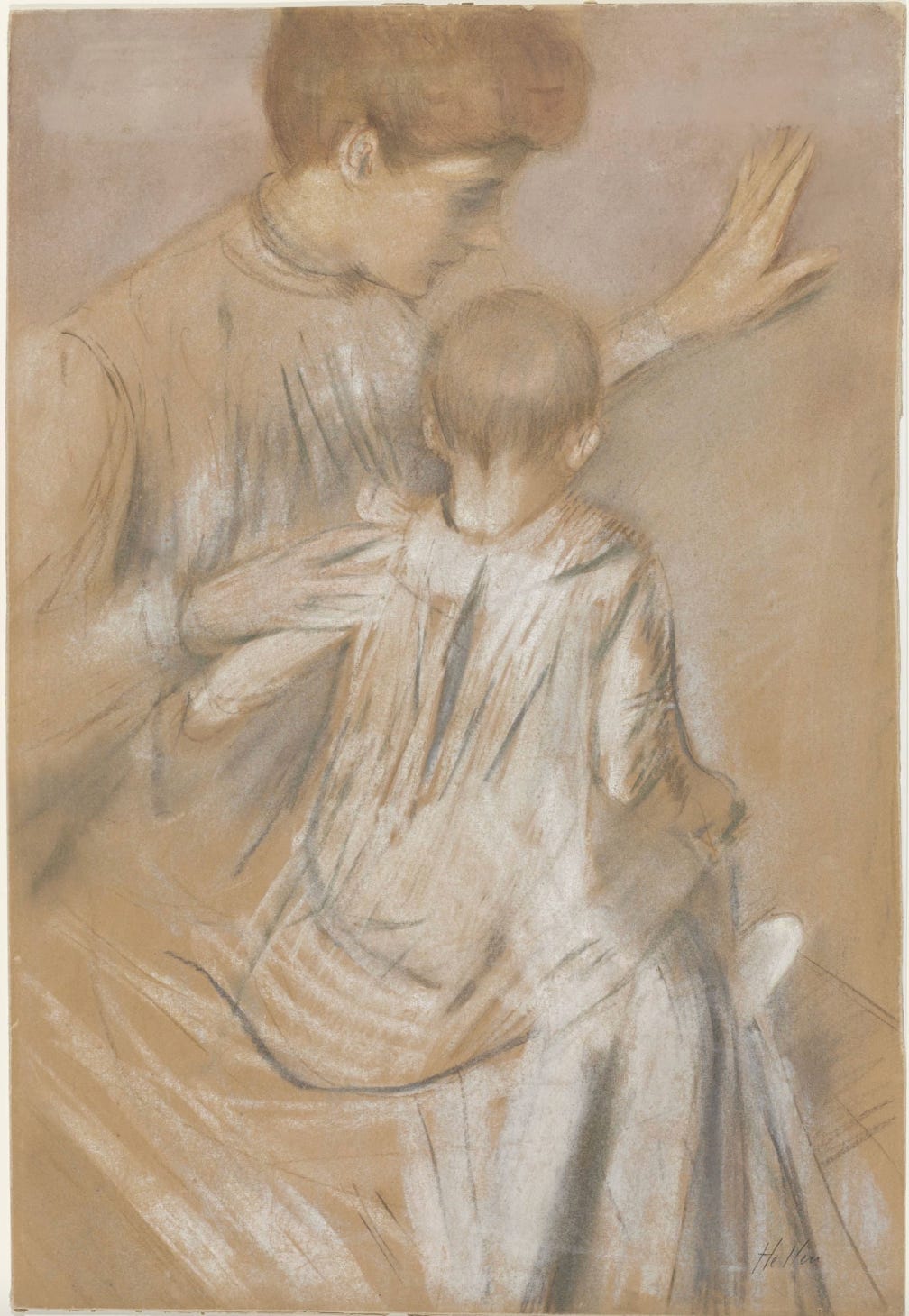
Art by Paul César Helleu (1859–1927).
David M. Calabro, “Disability and Social Justice in Ancient Israelite Culture,” in Covenant of Compassion: Caring for the Marginalized and Disadvantaged in the Old Testament, ed. Avram R. Shannon, Gaye Strathearn, George A Pierce, and Joshua M. Sears (Deseret Book), 383‒406.
