


Screams went off like a bomb in the bedroom. I sprung from my kitchen seat up the stairs to the top of the landing and tossed the door open. Entangled in sheets, his arms and legs flailing, my dad was on his back fending off attackers like an injured ant. But he was asleep, I quickly realized, and safe. Standing in the doorway, silent, motionless, I monitored his contortions and listened.
Suddenly, after a sequence of moans, yells, and shrieks, he shouted, “Yessir!” as he raised his hand to his forehead and saluted an officer in his dream. Then, as if taking his orders to the troops he commanded, he muttered that it’s time to “kill some fucking dinks.” Dad left the jungles of Vietnam in 1969, but that night, forty-three years later, he relived his combat from a pillow-top mattress in suburban Salt Lake City.
He’s not alone in this. Nine out of ten United States military veterans are men. A third of them served, like my father, in the Vietnam era or earlier, and since September 11th the US has added more than five million to the ranks. A majority of these post-9/11 veterans deployed overseas, and half of them were in combat. Of those with combat experience, half say they suffer from post-traumatic stress.
Many of our estimated eighteen million veterans say the American public has little awareness of the challenges they and their families face. I grew up not knowing the details of my father’s distress, in a faith community that valorizes military service but offers no direct means for veterans and their families to process the visible and invisible wounds of war.
The Impact of Killing
Combat trauma is not new. Soldier’s heart, shellshock, and combat fatigue were the “PTSD” of the American Civil War, World War I, and World War II. Even Roman general Gaius Marius, who died in 86 BC, suffered from night terrors and flashbacks and had to numb himself to sleep with alcohol near the end of his life. This condition has been around for as long as war itself.
Post-traumatic stress affects the brain’s limbic system and results in hyperarousal, a persistent fear of and need to be on guard for physical danger nearby. But there’s another dimension of combat trauma that is often present with post-traumatic stress. It’s called moral injury.
Moral injury occurs when someone sees or does something that violates their personal principles. It’s processed in the prefrontal cortex—the thinking brain—where reasoning takes place, and it tinges a soldier’s beliefs, values, and identity with guilt and shame. “Moral injury,” Reverend Rita Nakashima Brock says, “is an inner anguish that can lead to you feeling like you’re not a good person and if anybody ever figures that out, they’re never going to love you again.”
Moral injury amplifies fear and other symptoms of post-traumatic stress even when what one did or witnessed was warranted and unavoidable, when the call of duty entails harming others on the battlefield.
War is a minefield of moral wounding, and some situations set it off more than others: when a commanding officer gives an order that affects the survival of others, or a medic is unable to care for all who were harmed, or an enlisted soldier fails to report an unethical event. In each case an individual may second guess his decisions regardless of the moral bind he was in.
In Ken Burns’ documentary series The Vietnam War, John Musgrave, who served in the 1st Battalion 9th Marines, explained his experience with the moral complexities of combat. “I only killed one human being in Vietnam,” he said, talking about the first man he killed in the war. Beset with guilt, he thought he’d go insane if he had to keep it up for a year. When he saw a fellow Marine step on a land mine, he made a deal: “I will waste as many gooks . . . wax as many dinks . . . smoke as many zips as I can find,” he said. “But I ain’t gonna kill anybody.”
Soldiers have to dehumanize the enemy in order to cope with killing them.
Boots on the Ground
My father was twenty-five when he volunteered to go to war. In March 1968, he sat at his mom’s bedside in her hospital room as they discussed his impending deployment. “I believe, Billy, you’ll be protected,” she said. “I’m very close to my Father in Heaven.” She was forty-seven and terminal with cancer. The next day she went into a coma, and three days later she died.
He left for Vietnam after the funeral. It’d been two months since the North Vietnamese Army (NVA) and Viet Cong launched a coordinated series of surprise attacks on Lunar New Year. Although the Tet Offensive was winding down, American antiwar sentiment was increasing. Amid public disfavor and his own private doubts, President Johnson announced he would not seek reelection and declared a partial halt to the bombing of North Vietnam. “Our purpose,” he said, “is to permit the contending forces to move closer to a political settlement.”
But in late October, the South Vietnamese government withdrew from negotiations. Republican nominee Richard Nixon, fearing a diplomatic breakthrough would hurt his campaign, had promised them a better deal if he were elected.
Between the bombing halt and the election, U.S. troop levels rose to over half a million—the highest of the war—even as the country searched for a way out.
On December 9, as the commanding officer of Troop C in the 11th Armored Cavalry Regiment, my father received a call about a company-sized infantry unit in trouble in a rubber plantation west of An Lộc, about 30 kilometers south of his position in Lộc Ninh, near the Cambodian border. Because the 115 soldiers were so deep in the rubber, calling in air support or flying in reinforcements wasn’t an option.
Dad road-marched his cavalry troop down Highway 13 on a rescue mission. They blew through one ambush and, nearing the firefight, “smoked” another. Then they came upon the infantry soldiers, mired in hand-to-hand combat with the NVA. “It was difficult to distinguish between American and Vietnamese dead,” my dad recalls. “The only way you could really tell is that the Americans had their dog tags laced into their boots.”
Dad, who kept his Army-issued copy of Principles of the Gospel in the pocket of his jungle fatigues, assessed the situation and decided the only way to help was by laying down grazing fire a mere three or four feet off the ground across the entire area. He coordinated with the infantry company commander.
“We’re going to assault into the fight through your position,” he told him. “Tell your people to lie down.”
Then he gave the order. Machine guns swept back and forth, cutting down enemy soldiers, including those crouched or on one knee. An hour and a half later, the position was secure. The NVA had either been killed or had fled.
“That night we brought out fifty-four American dead and rolled them into ponchos and poncho liners,” Dad says. “It was a bad day.”
The Army awarded him a second Silver Star for his actions, the third-highest decoration for valor, after the Distinguished Service Cross and the Medal of Honor. From the citation:
“With complete disregard for his own safety, he exposed himself to the enemy volleys while coordinating mounted and dismounted elements with precise artillery and airstrikes. He made certain that firepower was increased until the hostile force was forced to withdraw. His aggressive actions and leadership turned the battle into a successful victory over the large North Vietnamese Army force, resulting in thirty enemy killed and no friendly casualties after Troop C arrived.”
The next morning he rode out from the scene atop his armored personnel carrier, or “track,” a nimble, tank-like vehicle. He was sitting in the rear hatch behind the .50-caliber gunner, flanked by M60 machine guns, when black smoke streaked toward him from the right. A rocket-propelled grenade struck the gun shield, ricocheted up into the air, and burst.
The explosion shredded his flak jacket and slammed him into the floor of the track, where metal ammunition cans cracked his ribs. A helicopter evacuated him to a field hospital before he was transferred to Cam Ranh Bay to recover. To this day he carries shards of shrapnel in his face and hand.
But scars and shrapnel are not all he brought home from his yearlong tour of duty.
Rules of Engagement
Vietnam strengthened my father’s testimony of the restored gospel. For my dad, war and religion are comfortable bedfellows. While watching Saints and Soldiers, a 2003 film featuring an LDS American soldier in World War II, he remarked that Mormons aren’t pacifists. The Book of Mormon backs him up.
The prophet Nephi, after describing his family’s departure into the wilderness, recounts his dilemma when he returns to Jerusalem and the Spirit prompts him to kill Laban to obtain the brass plates: “Never at any time have I shed the blood of man. I shrunk and would that I might not slay him” (1 Nephi 4:10).
But he resolves the dilemma, declaring, “Behold the Lord slayeth the wicked to bring forth his righteous purposes. It is better that one man should perish than that a nation should dwindle and perish in unbelief” (1 Nephi 4:13).
Nephi then cuts off Laban’s head, killing him with Laban’s own sword.
American members of The Church of Jesus Christ of Latter-day Saints are more likely than the general population to believe that military strength is the best way to ensure peace. But how often do we contemplate the cost of justifying those means to accomplish that end?
LDS soldiers returning from combat face a conundrum. Speak about their troubling experiences and risk being seen as critical of the military, or as weak, given traditional masculine values that discourage emotional vulnerability. They carry their burdens alone in silence when at least some ward members might be “willing to mourn with those that mourn; yea, and comfort those that stand in need of comfort” (Mosiah 18:9).
I grew up hearing my dad talk positively about his experience, telling stories around the campfire at Fathers and Sons campouts. Later I learned what he was keeping to himself.
Absence Without Leave
Unlike my father and grandfather, I’ve never worn a uniform. As a teenager I read in the Book of Mormon that “the preaching of the word had a . . . more powerful effect upon the minds of the people than the sword . . .” (Alma 31:5) and thought to myself, this is how Dad and I are different. Although I had a sense even then that I was more poet than warrior, and that my influence in the world would involve my love of language, it would be at least another decade or so before I set off on an adventure to uncover the values and worldview that are my own.
The night I watched my father flail in bed he woke me up several times screaming. After the fourth time I gave up on sleep, grabbed my tablet, and typed the keywords “ptsd vietnam retirement” into Google, finding evidence of a trend in veterans from his era seeking help for the first time for symptoms of post-traumatic stress. My dad had just retired from his career as an executive in the defense industry, and he, like many others, had fenced off his past with busyness and workaholism. But now a slower pace of life and fewer demands were leaving his psychological perimeter vulnerable to ambush.
The next morning I called my mom to tell her what had happened. “Oh, this started a few months ago,” she said. A day later she called to say they had spent the night in the ER. While thrashing in bed during another night terror, Dad had split his lip on the corner of a nightstand.
My dad and I started to drift apart. A month earlier I’d left behind a promising media career in New York City and my traditional religious faith. I was questioning my inherited model of masculinity: Why do we equate success with wealth? When is it no longer admirable to fend off feelings in order to press on? And what does it even mean to be a good man?
An Honorable Discharge
When Nephi laments, “O wretched man that I am!” (2 Nephi 4:17), we have to wonder if slaying Laban weighs on his heart. My dad remembers the first guy he killed, looking him in the eyes and shooting him. But that hasn’t troubled him as much as the day he ordered the grazing fire.
A few years ago, when he was turning eighty, Dad got up to bear his testimony in his ward. He recalled the events of that day, then revealed a fear he’d never openly acknowledged: Had his troops inadvertently killed any of the American soldiers they’d been sent to rescue? Nothing disturbed him more than the possibility that even one might have died by his own men’s fire. Although the Army commended his decision, he had ruminated on it for fifty-five years. Still, he downplayed the toll it took, brushing off labels like post-traumatic stress.
Six months ago, my dad went to the Salt Lake City VA hospital for congestive heart failure. When I arrived at his room in the telemetry ward, he was grimacing and unable to stand up from a chair or get into bed on his own. “Did I tell you about PTSD?” he asked me under the fluorescent lights. “I signed the paperwork to start the process.” A week before his scheduled stay, he had admitted—like an outlaw turning himself in after years of evading arrest—to suffering from post-traumatic stress. The next step would be an evaluation to qualify for increased benefits.
After a week, without consistent progress and high on painkillers, he was pensive and wondering whether he’s a good man. That’s when I did something I did not anticipate: I asked him if we could pray together. “I’d love that,” he said. We clasped hands and for the first time in thirteen years, I prayed aloud to our Heavenly Father. In that instant, the separation between me and God and Dad disappeared.
Drew Hansen is a writer based in Portland, Oregon. His work braids personal narrative, history, and reporting to explore place, memory, faith, and the creative life.
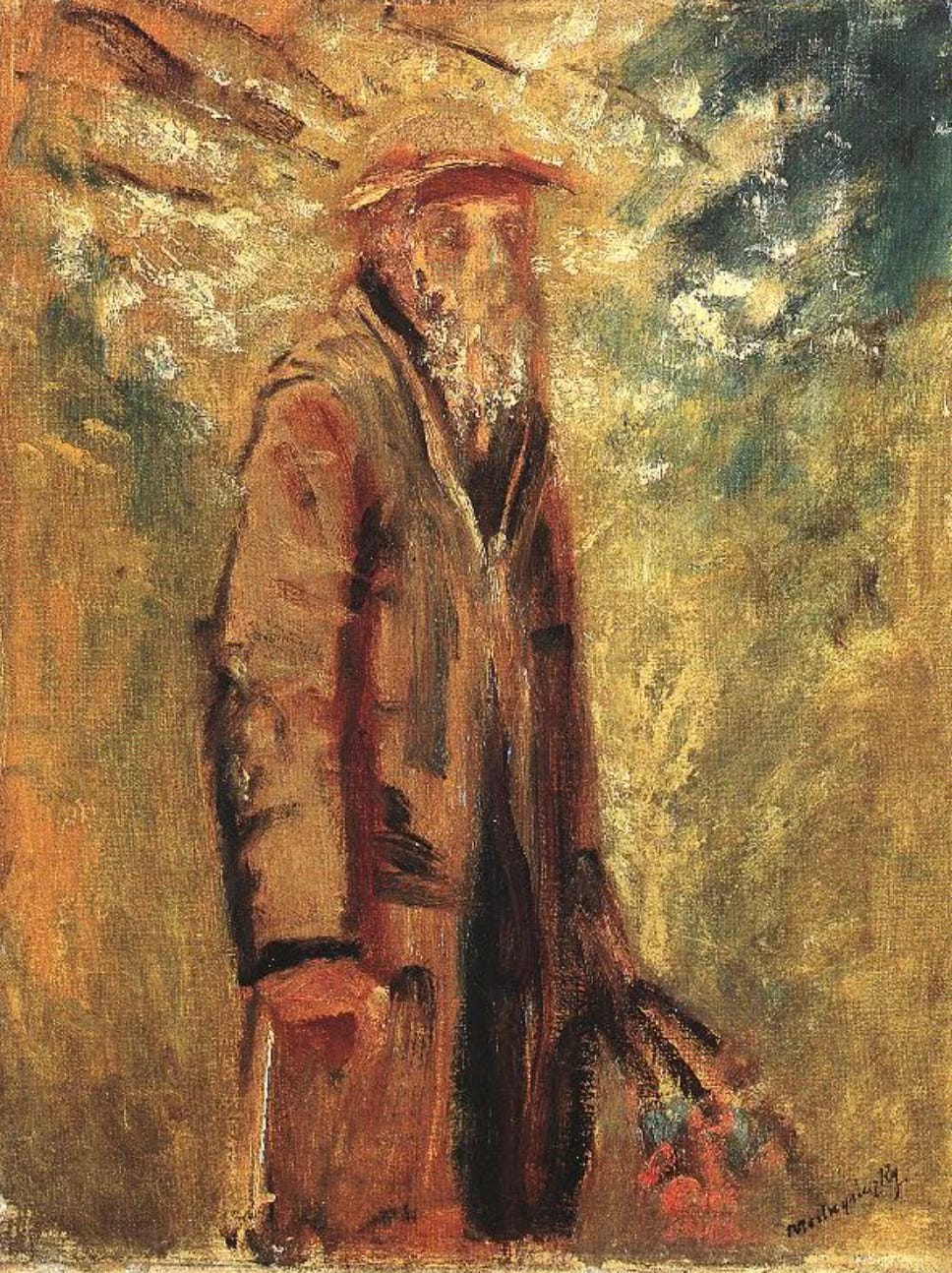
Art by László Mednyánszky (1852–1919).
Thanks for sharing. While I've always missed him, sometimes I wonder if my brother was lucky to have been killed there and escape all the trauma and illness veterans have endured.
Wow. Thanks for shining such a personal light on life, Drew. Feeling very impacted by this as my own dad’s brain health declines, revealing some longstanding patterns of psychological suffering.