


It will take longer to tell you the story than it took to live it.
It was a late October night, the kind where patches of fog rise from the ground and the moon hides behind clouds. The temperature was in the low thirties. The roads were shiny with hints of ice, but it hadn’t rained or snowed yet.
My husband and I were returning from Salt Lake City’s bright lights to our home deep in the Wasatch countryside. I don’t remember why I was driving. Perhaps I’d picked him up from the airport or he had some after-hours work to do on his phone—but there was some reason for me to be behind the wheel and not him.
He’d rather drive than ride. Always.
But this time I was driving.
Lulled by the familiar route and late hour, I was thinking only of getting home and the long list of things I wanted to accomplish before collapsing in bed. With the radio off and my husband busy on his phone, I sped through the darkness down the lonely rural road at about 43 mph, my typical three miles over the posted limit. I was cruising on autopilot, mentally checked out.
On a straight ribbon of road a quarter mile from our turn we hit another patch of ground fog. Blinded, I eased my foot off the gas and hovered over the brake, coasting through the fog like I’d done a million times before. I knew this patch—I’d be through it in a second or two, less time than it takes to sneeze or change the radio station.
Suddenly big, chunky tufts of bright green fluff rained down on the windshield, rolled across the hood, and billowed in the headlights.
“What—”
“Alfalfa,” my husband said through gritted teeth. “Watch for the truck.”
Somebody’s hay bales tumbled.
I squinted through the soup—no oncoming headlights, no red taillights in my lane. What little of the road I could see shimmered a bit, so I kept my foot off the brake.
As alfalfa fell like feathery green snow, I glanced to the right. Along the side of the road and through the haze was a hint of black tire and the edge of a trailer.
That’s where the people are.
Instinctively, I moved my hands to the left, away from the maybe-trailer and toward the center of the road.
Best give them space.
My hands turned the wheel to the left, but the car moved slightly to the right.
What? No!
I steered harder to the left.
The steering wheel rolled left, but the car didn’t budge. It stayed dead center in its lane.
That’s when I saw her.
She was standing in the middle of the road on the dashed yellow line, partial bales of green alfalfa tangled in orange twine dangling from her wrists. I only saw the white triangle of her throat framed by her dark, blunt-cut bob as wind blew it back and a bare strip of ankle peeking between her black pants and the ballet flats she wore—wasn’t she cold?—before we flashed past.
40 mph.
An inch or two away.
It was the rush of my car that blew her hair off her shoulders.
I swiveled in my seat, watching as the swirling mist swallowed her up. Panicked, I whipped my head forward, too stunned to utter a sound and terrified about what else lurked unseen.
Half a heartbeat later, we burst into the clear. A weak moon overhead illuminated a lone and broken hay bale on the far side of the road to the right. To the left, our house lights shone in the distance. The road ahead was as empty as the tomb on Easter morning.
Eventually, I remembered to breathe.
“Did you—” I asked.
“I did,” said my husband. “How? How did you miss her? When I saw the trailer I thought you were going to go left. Why didn’t you?”
“I did,” I said. “It was the car that didn’t.”
We sat in silence the rest of the way home.
I’ve thought a lot about that encounter.
At the edge of the fog bank and able to see oncoming lights in both directions, I’m certain she felt safe in the middle of the road. After picking up the bales, she must’ve seen my headlights coming, so she waited for me to pass before walking a dozen steps and throwing the broken bales back on the trailer. I bet she was relieved she’d gathered them before someone damaged their car. It’s likely she had no idea what almost happened, although the nearness of my side mirror and the rush of my passing would have given her pause.
Maniac, she might have thought. Slow down.
Veiled in fog as she was and wearing dark clothes, I hadn’t seen her, especially with my attention on the vague outline of a trailer to the right, the falling alfalfa, and possible ice on the road. To me, with no headlights coming the other direction, the safest place was away from the trailer and across the road’s centerline.
We were both so focused on our goals—mine of getting home, hers of clearing the road and reloading her hay—that we were both blind to the danger.
But other unseen forces were very aware and present that night. They physically intervened to prevent a terrible, horrible tragedy. It makes my stomach turn when I think about what might have happened.
Unfathomable.
Devastating.
But not unique. Accidents happen. Kids on bikes get hurt going to school, commuter trains derail, someone drowns in a swimming pool—the list is endless.
Why was this night different? What made us miracle-worthy?
I’m nobody special, a reliable back-bencher in Relief Society. I’m an easy phone call for a meal or ward cleanup assignment, but nobody looks to me for leadership or advice, let alone salvation. While we’ve never met, I suspect much the same about the woman in the road. We’re two salt-of-the-earth sisters, not the kind that merit miracles, especially when we’re taught through scripture that extraordinary intervention always serves a higher purpose.
That’s why God allows so many accidents to happen—or so the story goes.
However, the longer I live, the more clearly I see that interventions and miracles are not rare at all; we simply don’t recognize them most of the time. After all, nobody routinely prays not to hit someone with their car or to not die picking up a bale of hay.
Unlike angels and gods, humans only perceive what we pay attention to. We don’t notice the things that could happen but don’t, when small things don’t trip us up, when challenges just break our way, or when our luck is particularly good and the thing we feared doesn’t happen. How many times do we glide through the dark, through the foggy night, on autopilot, and never see the danger we miss or that misses us?
I don’t know why, when I turned my car to the left, it went right.
I just know that it did.
I’m eternally grateful.
And that, perhaps, is enough.
Kate Baxter writes and thinks about what it means to be a modern LDS woman of faith, hopes, and doubts.
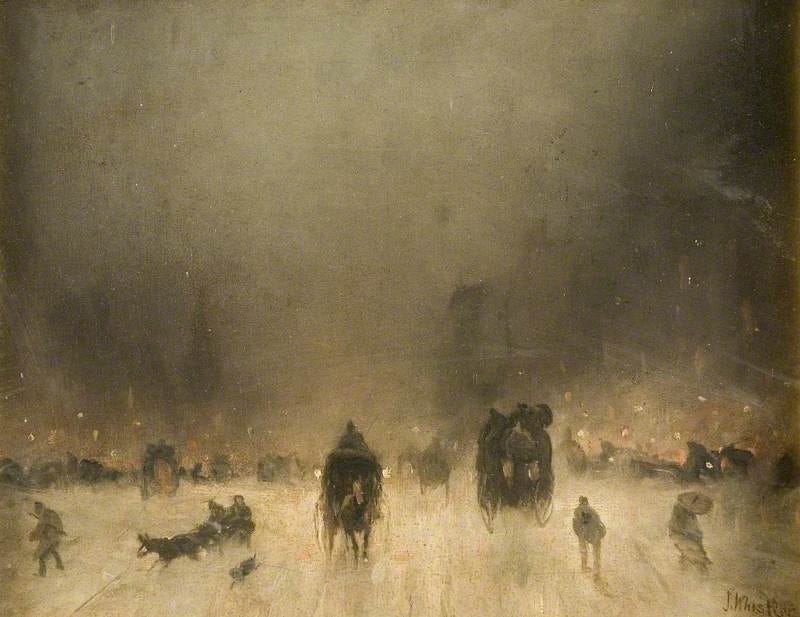
Art Credit: Foggy Night in London by James Abbott McNeill Whistler (1834–1903).

Wonderful insight! I have found as I look for God in my day, or at the end of the day, I see Them and their mercies more. Thank you.