


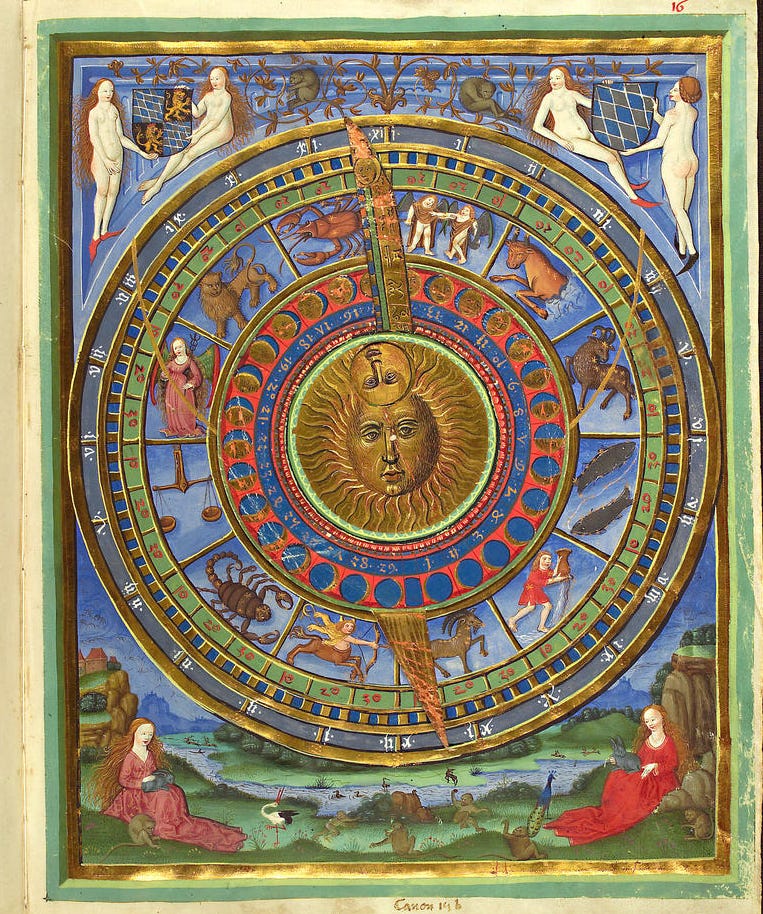
According to British theologian J. G. Davies, the development of Holy Week in the Christian tradition was all about a reconceptualization of time. This change coincided with the conversion of Constantine (d. 337) and the first Council of Nicaea (325).1 In the three centuries before Nicaea, the Christian attitude to time was shaped by their conviction that they were living “in the last times” (1 Peter 1:20). This belief was pervasive in the early Christian sources, fueled by persistent persecution and the minority status of Christians within the Roman Empire.2 Early Christians lived outside of time and in a state of love and fear. So says Ignatius of Antioch: “These are the last times. Henceforth let us have reverence; let us fear the long-suffering of God, lest it turn into a judgment against us. For either let us fear the wrath which is to come or let us love the grace which now is—the one or the other; provided only that we be found in Christ Jesus unto true life.”
After the conversion of Constantine, Christians began to live in time. Christianity was now in the world, and the story of Christianity quickly began to sacralize history, as seen in the Life of Constantine and Ecclesiastical History of Eusebius of Caesarea (d. 339). Christians not only made history sacred, but time itself. The year became a memorial of the life of Christ, divided into several seasons: Advent (the season leading up to Christmas); Christmas (beginning with the nativity of Christ); Epiphany (the appearance of Christ to the world, represented by the visit of the Magi); Lent (the preparation for Easter); Holy Week (from Palm Sunday to Easter Saturday); and Easter (from the Sunday of Resurrection to Pentecost). The year became a temporal temple, a school for learning of Christ, with Holy Week as the Holy of Holies. But Holy Week and the liturgical year were about more than remembering. “The purpose of Holy Week,” says Professor Davies, “was identical with that of the whole liturgical year: it was to enable the worshippers to live with Christ.”3
The liturgical year involves fasting and feasting, mourning and rejoicing, songs of joy and laments of sorrow. The scriptures are read and preached throughout the year, both the Old and the New Testaments, because the Old Testament was understood to be an extended prophecy of Christ. So, for example, during Holy Week, congregations might read the story of the Binding of Isaac and the story of Joseph because they were both understood to foreshadow the life of Christ: Gen. 22:1–19 (Good Friday or Holy Saturday); Gen. 37:1–36 (Maundy Thursday); Gen. 40:1–23 (Good Friday); Gen. 42:3–43:14 (Holy Saturday); Gen. 43:15–45:13 (Easter Day). Time was now sacred, oriented around the life and atoning mission of Jesus.
Latter-day Saints, like the earliest Christians, long remembered Christ’s atonement weekly through the sacrament of the Lord’s Supper.4 Easter, however, has recently become more central to our own liturgical year. What began as recognizing a holy week has now become the celebration of Holy Week.5 We Latter-day Saints now talk about, study, and commemorate “the events of Holy Week.”6 This is part of the ongoing restoration, as Elder Stevenson taught just last year:
Now let us contemplate the significance of Easter. In recent First Presidency messages concerning Easter, we have been challenged to “celebrate the Resurrection of our living Savior by studying His teachings and helping to establish Easter traditions in our society as a whole, especially within our own families.” In short, we have been encouraged to move to a higher and holier celebration of Easter.
I love continuing revelation concerning Easter and am gratified for your many efforts to make Easter a sacred and holy occasion. In addition to holding a one-hour sacrament meeting on Easter Sunday, other examples of worthy activities include ward and stake devotionals and activities on Palm Sunday as well as during Holy Week.7
We are, however, not simply adopting the Christian liturgical year. Elder Gong reminds us that the sacred time of the Atonement and Resurrection of Christ coincides with the sacred timing of the Restoration:
Each Easter spring season testifies that spiritual sequence and convergence are both part of the divine pattern of atonement, resurrection, and restoration through Jesus Christ. This sacred and symbolic convergence comes not by accident or coincidence. Palm Sunday, Holy Week, and Easter celebrate Christ’s Atonement and Resurrection. As today, every April 6 we commemorate the establishment and organization of The Church of Jesus Christ of Latter-day Saints.
Thus, embracing Holy Week is part of a distinctly Latter-day Saint theology of sacred time. Christ is still at the center, and his saving work is the object of our highest celebration. But that work continued when the Father and the Son appeared to the boy prophet in 1820 and again when the Church of Jesus Christ of Latter-day Saints was established in 1830. The restoration adds to sacred time, rather than subtracting from it. So, we can certainly benefit from following and learning about the liturgical year celebrated by our Christian brothers and sisters. But the yearly celebration of the work of salvation will surely continue to expand so long as we “believe all that God has revealed, all that He does now reveal, and we believe that He will yet reveal many great and important things pertaining to the Kingdom of God” (Articles of Faith 1:9).
Holy Week Study Resources
Holy Week Study Experience: https://www.churchofjesuschrist.org/study/manual/easter-plan?lang=eng
Invitation to Holy Week: https://www.churchofjesuschrist.org/welcome/easter?lang=eng
Come Unto Christ during Holy Week: https://www.churchofjesuschrist.org/comeuntochrist/easter/holy-week
HearHim this Holy Week: https://www.churchofjesuschrist.org/comeuntochrist/ph/holy-week
Kristian S. Heal is a Senior Research Fellow at the Neal A. Maxwell Institute for Religious Scholarship. His research focuses on the reception of the Hebrew Bible in early Christian literature and worship. He received a BA in Jewish History from University College London, an MSt in Syriac studies from the University of Oxford, and a PhD in Theology from the University of Birmingham. He is the author of Genesis 37 and 39 in the Early Syriac Tradition (Brill, 2023) and co-editor of Ancient Christians: An Introduction for Latter-day Saints, published by the Maxwell Institute. Kristian was also the resident scholar for the Maxwell Institute’s Abide podcast on the Old Testament (50 episodes).
Art from the Heidelberger Schicksalsbuch (c. 1490).
J. G. Davies, Holy Week: A Short History, 9.
Davies, Holy Week, 12–13.
J. G. Davies, “The Origins of Holy Week and Its Development in the Middle Ages” in C.P.E. Jones (ed.), A Manual for Holy Week (London: SPCK, 1967), 15.
“We often meet together and worship the Lord by singing, praying, and preaching, fasting, and communing with each other in the Sacrament of the Lord’s Supper.” Brigham Young, “Recreation. And the Proper Use of It,” March 4, 1852 (Journal of Discourses I.29).
See Elder Jeffrey R. Holland, “None Were With Him,” April 2009 general conference: “As we approach this holy week—Passover Thursday with its Paschal Lamb, atoning Friday with its cross, Resurrection Sunday with its empty tomb—may we declare ourselves to be more fully disciples of the Lord Jesus Christ.” See also, Elder W. Mark Bassett, “After the Fourth Day,” April 2023 general conference.
Elder D. Todd Christofferson, “One in Christ,” April 2023 general conference. Elder Gary E. Stevenson, “Bridging the Two Great Commandments,” April 2024 general conference, refers to the events that happened “during what we now call Holy Week.”
Elder Gary E. Stevenson, “And We Talk of Christ,” April 2025 general conference. Referring to “He Is Risen! A Special 2025 Easter Season Message from the First Presidency,” available at https://www.churchofjesuschrist.org/study/video/easter-videos/2025-he-is-risen-oaks?lang=eng. The introduction to this message says, “Let us strengthen our families, share our testimonies, and embrace traditions that reflect the true meaning of Easter.”
