


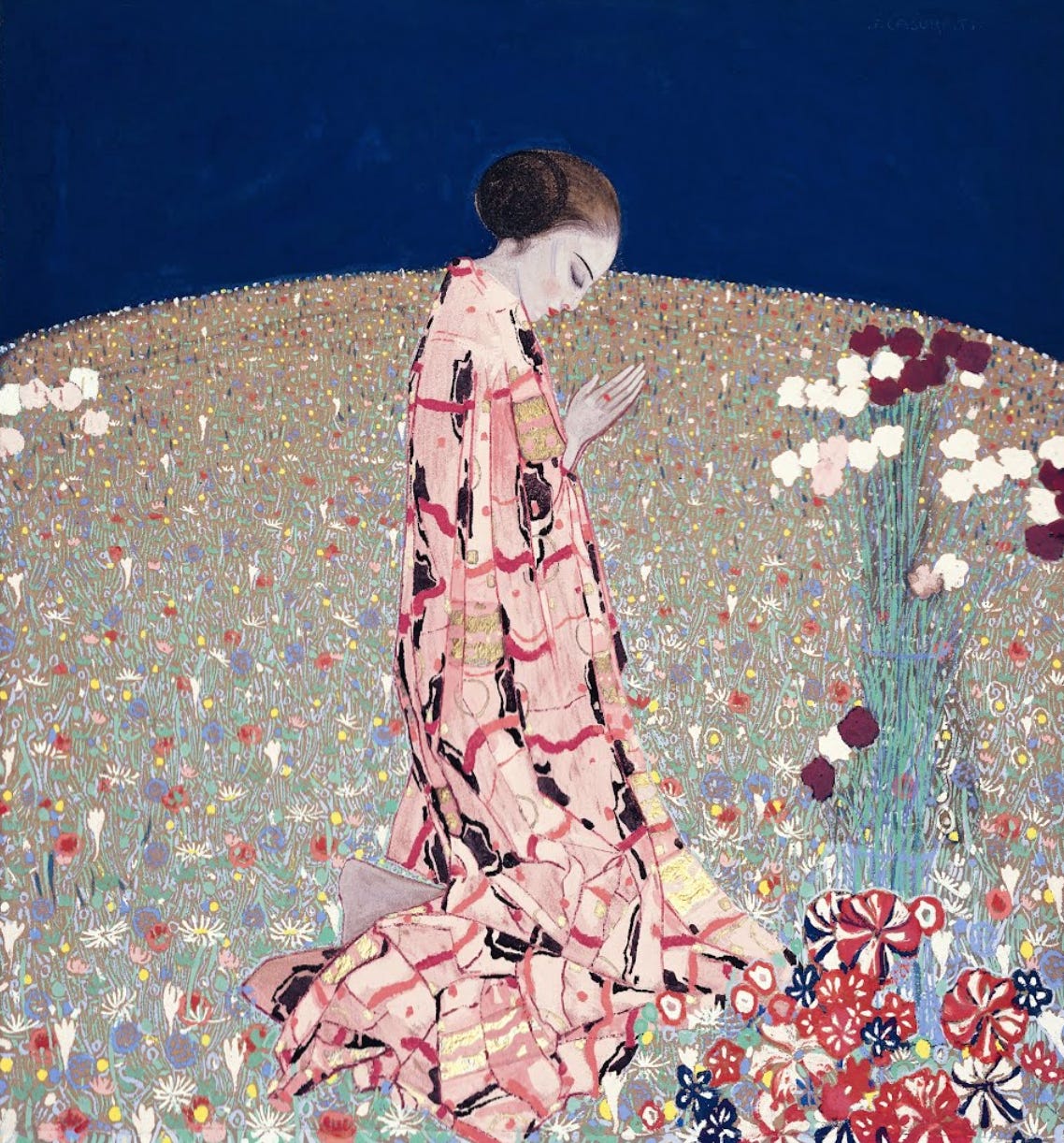
In this brief essay, I hope to make a simple argument: that the physical demonstrations we make while praying can serve as a powerful catalyst for religious devotion, especially in 2026. Specifically, the subtle physical manifestations of prayer can create a countercultural environment that facilitates communion and transcendence.
Those raised in the Church of Jesus Christ of Latter-day Saints are taught the form of our regular prayers when we are very young. It is striking that, even in a classroom filled with the youngest of children, a teacher can generally achieve brief unity and reverence if the children know someone is praying. By the same token, if you attend a Saturday night ward activity filled with boisterous conversation and happy chaos, you will be struck by how quickly almost every sound in the hall will cease as the crowd becomes aware someone is praying. Specifically, when members of the Church of Jesus Christ of Latter-day Saints pray, they (like many other religious adherents) generally observe three outward signs: we close our eyes; second, we fold our arms; and, third, we bow our heads.
For lifelong church members, these actions become so reflexive it is easy for them to become rote. I know that in my own life I long ago stopped thinking about them. After more than forty years of offering prayers of various kinds, these elements are now as natural as breathing. It was not until I started to teach my own children to pray—and, specifically, it was not until the daily struggle to get three often quarreling boys to observe these steps when we pray before eating—that I began to wonder if there was not something more to them.
For example, what does it really mean to clasp our hands in our laps as we pray? Of course, anyone who has ever taught a nursery class will know that, for small children, this can be a powerful protection against bothering your neighbor. If the only thing praying does is to get Timmy to stop poking Rachel, it may already be a success. Still, I would argue there is also more going on, especially against the backdrop of modernity. Perhaps part of the reason we still our hands as we pray is precisely because stilling our hands has become such a profoundly countercultural, almost iconoclastic, act. How often do we prevent our hands from engaging with our cell phones, if nothing else?
In my own case, I use my hands almost constantly. If I am not using them to peck on my cell phone, then I am using them to type out an e-mail on my laptop. If not that, then I am using them to examine a patient, or to whip up dinner, or to guide my bike as I ride into work, or to throw the football as my children bounce on the trampoline. To be clear, the activities for which I use my hands fall along a spectrum of goodness. Engagement with my cell phone is at best superfluous and at worst corrosive. Throwing the football to my boys or palpating the edge of the liver of one of my patients can be beautiful, constructive, and substantive.
But whatever the details, as I move through my day, I am forever using my hands to do something. In this regard, the act of interlacing my own fingers and putting my hands in my lap reminds me of a dictum I often hear from palliative care doctors. These doctors, trained in the arts of communication and symptom control, will often tell me, “Don’t just do something, sit there.” This refrain reflects as well the Taoist principle of wu wei—the idea that sometimes the cultivation of mindfulness and presence requires a conscientious, willful, and chosen inaction. To clasp my hands while I pray is to choose not to engage with all the other things my hands could be doing; it is to choose a purposeful way of clearing the spiritual and intellectual space needed to allow openness to communication from the divine.
Closing our eyes can have a similar effect. While humans are blessed with five senses, most of us look first to the visual realm to get our bearings and to understand how to move through the world. There is a reason the operative verb in the last sentence is “look,” rather than “hear,” “smell,” or “taste.” We are, most instinctively, visual creatures. Thus, closing our eyes has to do with shutting out the overwhelm of immediate visual perception, making room for the sensory input we too often neglect and ignore.
At the same time, perhaps we close our eyes not just to empower our four other physical senses in the absence of sight, but also to remind us that sensory input does not monopolize what matters in life. In our heavily digitized and technologically saturated culture, it can often feel as though bits, bytes, and information are all that matter. We have often come to accept the idea, for example, that the version of life contained in our “feeds”—think Instagram, Facebook, TikTok, and Snapchat—comprise all that’s really needed. What strikes me about this idea, however, is that these experiences are largely visual, with some corollary aural information thrown in. It is as if we believe we can watch the pictures and videos that flit by on our devices and somehow thereby arrive at happiness, meaning, or both.
But as we still our hands and close our eyes during prayer, we are reminded that some of life’s most magnificent truths cannot be articulated. The ineffable will always remain irreplaceable; many of the things that matter most can only be understood, as the Little Prince once reminded us, as matters of the heart. Even if our hope is to make meaning of the information that flows into us unendingly from the digital world around us, we must make space away from those incessant inputs if we are to have hope of finding truth or meaning. Especially in a world where attention has been commodified, balkanized, and monetized, closing my eyes can represent a powerful and purposeful declaration that not all of my attention is for sale. Some sacred precincts of my heart and soul cannot be bought or sold on the open digital market; some private inner sanctum remains available only to me and to God.
And that brings us, finally, to bowing my head (and, at times, kneeling). Traditionally, to bow is to demonstrate humility and deference. I bow to one whom I consider to be my superior or my elder, whom I take to have wisdom, experience, and virtue that exceed my own. Of course, humility is not a very popular virtue in contemporary culture. We talk a great deal about independence, resilience, grit, and even courage, but humility is a lonely, almost forgotten, virtue, seen as weak, suspicious, or anachronistic. Especially in the United States, we are liable to fancy ourselves as rugged individualists. We may no longer have much use for the Hollywood westerns of the past, yet most of us still imagine ourselves as cowboys and cowgirls of a modern-day digital Wild West. We imagine, for example, that social media is a parade ground where all of us are simultaneously showcasing our individuality and ingenuity together.
The irony in all of this is that human beings have never before so effectively and comprehensively subjugated themselves to invisible masters. We imagine ourselves to be stubborn individualists, and yet the majority of us pass untold hours scrolling feeds on social media that are ruled entirely by algorithms over which we have no control and of which most of us are only vaguely, if at all, aware. It is as if the content of the books, magazines, and newspapers of yesteryear have been alchemized into an intravenous solution. Now, instead of going to a library and selecting a book to read, we flock to a strange sort of digital medical clinic. We sit ourselves down in chairs, stick out an arm, and ask to be hooked up to an IV. We have neither control over nor much knowledge about what is included in the solution that trickles into our veins, and yet we sit there with blithe faith that whatever infuses into our bodies, hearts, and minds will be to our good.
In this sense, we have now become idolaters. We no longer bow down before golden calves; instead we worship—without realizing it—the glowing gods of our smartphones and, even more so, the algorithms that control our digital feeds. In this context, the act of bowing my head during prayer is a radical act of choosing the object of my devotion. Even if I can only glimpse the character of the divinity I worship, yet this is a God I can actively seek and to whom I choose to be devoted. Unlike the nameless and faceless algorithms that rule the digital universe, the God I seek to worship is a pair of Heavenly Parents who are infinitely defined by mercy, justice, hope, benevolence, and love. Thus, choosing to bow my head in deference to this definition of divinity is both a symbol of my humility before God’s love and also a manifestation of my commitment to become more loving.
I wonder if a miracle of substance and symbolism is not hiding in plain sight. When I sit down at our kitchen table for dinner, and I work myself hoarse trying to lasso those three boys into some semblance of the physical manifestations of reverence, perhaps there is more going on than meets the eye. Perhaps this is not merely a way of enforcing some rote uniformity but, instead, a powerful and countercultural choice to lean into a visceral reminder of presence, mindfulness, beauty, humility, and the ineffable. Perhaps praying is an opportunity when, as Wordsworth once reminded us, “the world is too much with us,” to step away from the many ways in which the world infringes on our deepest selves and to resolutely reclaim a portion of our individual spiritual essence that can bring us closest to God.
Tyler Johnson is a medical oncologist and associate editor at Wayfare. To subscribe to Tyler’s column, first subscribe to Wayfare, then click here to manage your subscription and turn on notifications for On the Road to Jericho.
Art by Felice Casorati (1883–1963).
Thank you for devoting your hands, eyes and head to offer this inspiring reflection on the power of small countercultural acts of worship.
More and more I am struck by how powerful seemingly simple practices can be for helping us connect with the divine and our deeper Selves—and what you’ve written here feels like another wonderful example of how the simple physical acts of prayer provides us with some of the shifts we most need in the noisy, distracting world-physical movements to help us be still, turn inward, and lean into humility.
As a therapist, I’m blown away by how powerful choosing to change one’s surroundings to a natural setting, or selecting a few minutes of intentional breathing or movement, or pausing to meditate or pray can offer such rich rewards as we layer each small practice, each repetition day by day or week by week.