


This essay appeared in Wayfare issue 7.
1.
Our attention has fractured. Consider three recent books: Johann Hari’s Stolen Focus: Why You Can’t Pay Attention—and How to Think Deeply Again (2023), Jennie Odell’s How to Do Nothing: Resisting the Attention Economy (2020), and Cal Newport’s Deep Work: Rules for Focused Success in a Distracted World (2016). All of them agree that smartphones and digital media have done serious damage to our ability to sustain attention, hurting our productivity, creativity, and relationships. These experts offer advice on how to reclaim our attention: get more sleep, put away smartphones, set limits on social media, go on long walks. This advice tends to underscore fractured attention as resulting from lost capacity and a lack of discipline. They treat attention like a muscle that we build up through sustained, consistent exertion.
But fractured attention is not only an intellectual problem with economic consequences; it is also a bodily problem with spiritual consequences. In a beautiful essay for Wayfare, Michael Austin describes attention as a sacrament, writing that “in a culture whose most valuable resource is attention, concentrating wholly on God requires . . . sacrifice. Where your attention is, there will your heart be also.” The poet Mary Oliver sums it up beautifully in her declaration, “Attention is the beginning of devotion.”
Lance Larsen’s poem “In a Room with Seventeen Rembrandts”1 frames the spiritual problem of attention in compelling terms:
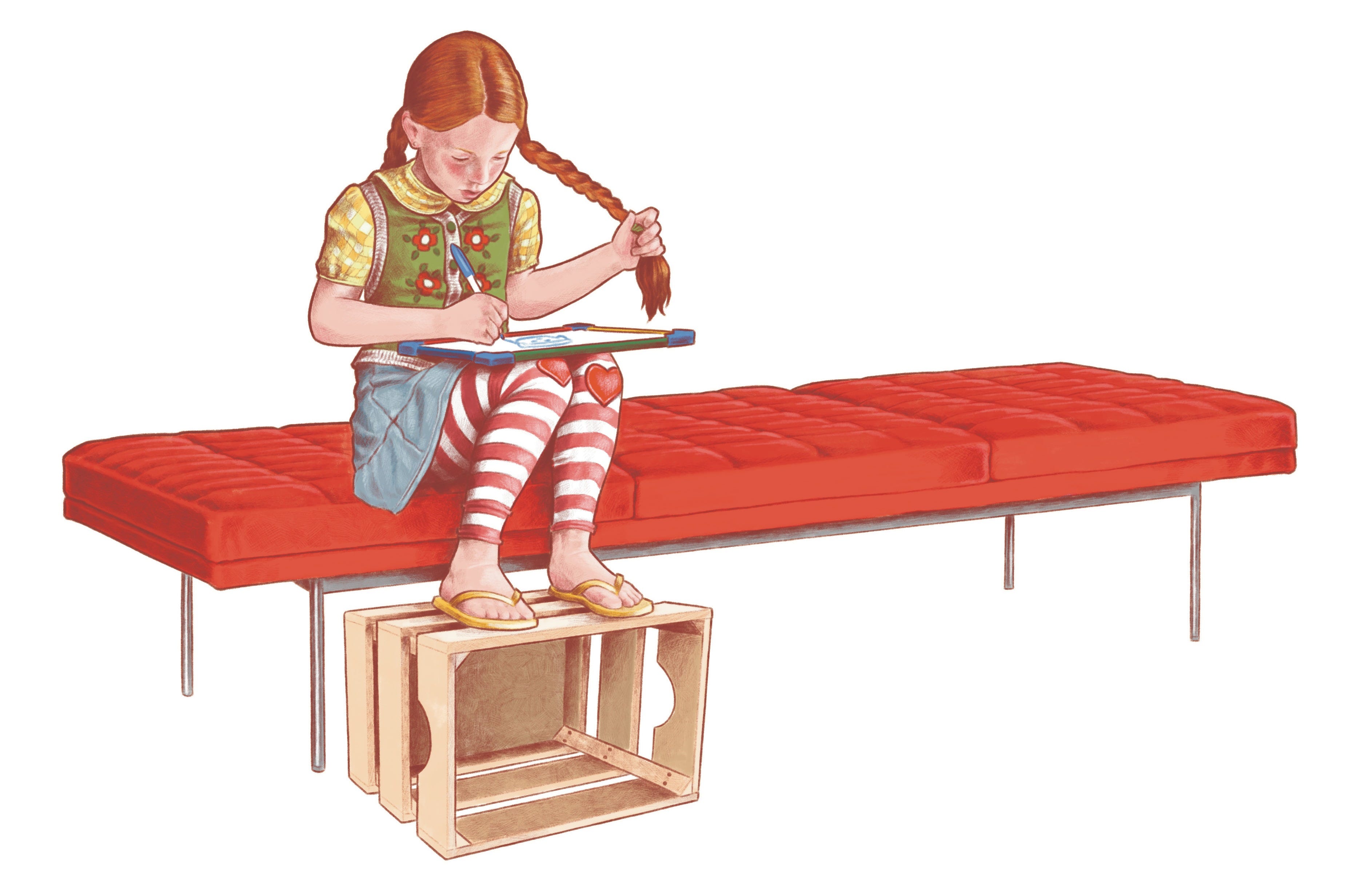
Look at her, a seven-year-old sketching herself—on a portable whiteboard, in the Louvre. Lacking a mirror, she touches her ear then draws, pulls at a braided pigtail as if straightening a snake, lays down three twisted lines. Now her eyes, now the freckled paradox of her nose. A demanding operation, taking her face apart in three dimensions and reassembling it in two, until even her crooked mouth disappears into art.
She adds crocodile tears and the word BORED to her picture, then both visages of despair make a circuit of the room. Three patrons look away in French, one ignores in Italian, one clicks by wafting a Dutchy perfume. How can my American nod of encouragement make any difference? Still, I offer it up. I have traveled half a planet and a case of jet lag to fall into Renaissance luminosity. Yet what pins me to this moment is an erasable face. And little girl feet, squirming, as if she had to pee, as if we all did, as if our sentence, even in the most storied of European cities, remains unchanged: keep the body happy.
But how? We build salons to store the destruction of time, then pretend to float above it all. Some days beauty wears me out. I’d prefer to hoist Scraggly Girl to my shoulders, waltz this mustachioed guard into the garden, kiss all protesting moms on their blind mouths. Smile at the sketch, Scraggly Girl smiles back. Smile at her straight on, she looks away, surveying the room for the quickest face to lose herself in—one of those dime-a-dozen Rembrandts hanging on the wall.
“Look at her,” the poem begins, as if to say, “pay attention.” The imperative to look is immediately complemented by the description of the girl’s looking, her attentive drawing. But this attention turns out itself to be distraction, we learn, when the girl scrawls “BORED” on her drawing. And the poet’s attention to her distraction, which is also our attention to her distraction, turns out also to be distraction—for him, if not for us—in the sense that the poet has been “pinned to the moment” in a way that prevents him from “falling into the luminosity” of the Renaissance art he has come to the Louvre to witness.
In Larsen’s poem, the attention poses two paradoxes—first, that the more we try to pay attention, the more we get in the way of paying attention to anything but our own attention; and second, that attention, which seems like an act of will, often comes to us by grace, a divine gift of opening our eyes to something in the world we did not perceive clearly before.
2.
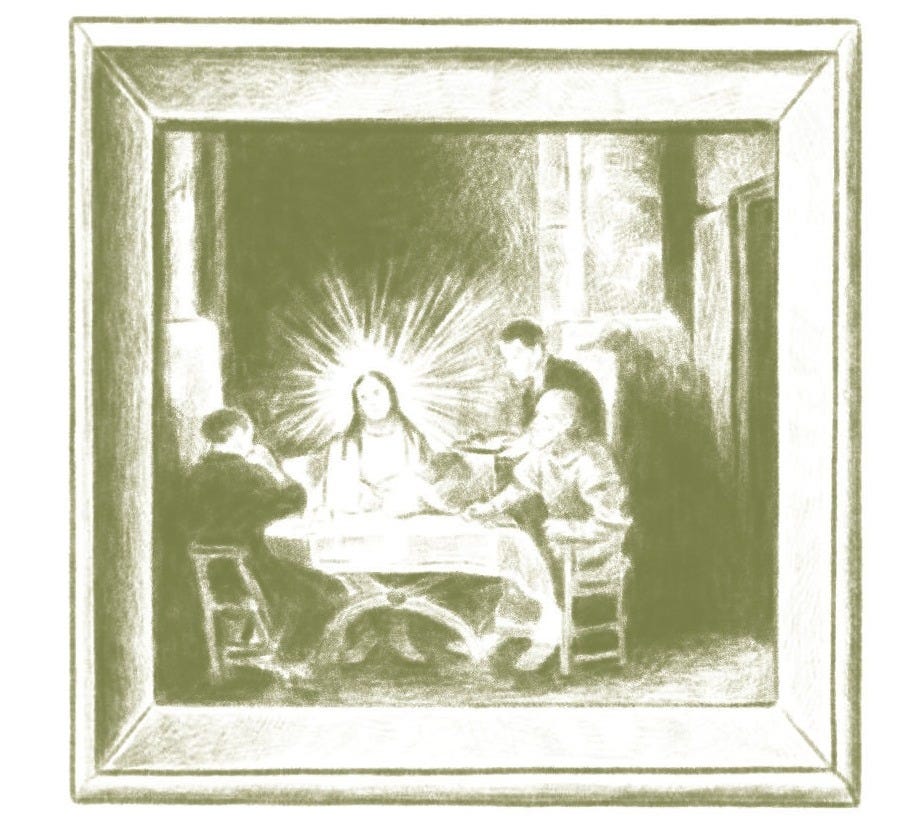
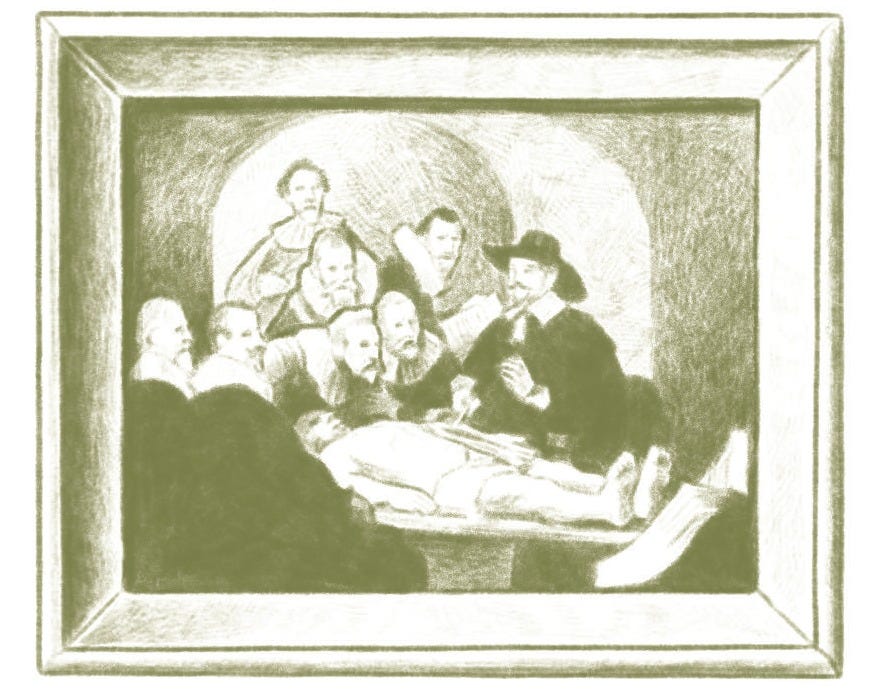
One of the striking aspects of Larsen’s poem is that despite the title, it doesn’t describe a single Rembrandt. We might come to a poem entitled “In a Room with Seventeen Rembrandts” expecting ekphrasis in the tradition of Keats’s “Ode on a Grecian Urn” or Auden’s “Musée des Beaux Arts.” What we get instead is a poem centering on the poet’s distraction from the art he has come to see. But this misdirection may turn out to be precisely what we have come for, a felicitous fulfillment of our expectations. The poem, in other words, attunes us to attention through its portrait of distraction.
What even is attention? The Oxford English Dictionary offers a wonderfully circular formulation as its first definition of the term: “the action, fact, or state of attending or giving heed,” adding the clarification that this entails “earnest direction of the mind, consideration, or regard.” But that “earnest direction” can lead to the first paradox I described before, which is the possibility that we will pay more attention to our efforts to pay attention than to the putative object of our attention. Larsen’s poem arguably performs this difficulty, as the poet becomes increasingly caught up in the girl’s boredom, which leads him further and further away from Rembrandt.
Literature scholar David Marno describes a version of this problem in relation to prayer in his book Death Be Not Proud: The Art of Holy Attention (2016). Christian thinkers throughout the Middle Ages and up to the Early Modern period debated whether vocal prayer was superior to mental prayer in achieving a state of holy attention, which is undistracted openness to divine communion. Vocal prayer promises to help the mind focus on its object, but as Marno puts it, “Vocal prayer’s challenge is that the very words it contains threaten to scatter the attention that may have existed in the original intention to pray.” We begin to pray but find ourselves paying more attention to the words we’re saying than to the putative object of our prayer. “Our Father who art in heaven,” we say, and begin wondering, where is heaven? What is heaven? Is it right in this moment to be calling on God as our father? Scattered in this manner, we may never even arrive at the petition for daily bread.
“In a Room with Seventeen Rembrandts” shows similar self-consciousness, though displaced onto the girl that the poet beholds sketching herself. On the one hand, the girl is in an art museum and has dedicated herself to art, and portraiture is entirely fitting for the Rembrandt room. Yet the girl cannot focus her attention on the Renaissance painter; her circuit of the room is not to admire the art but instead to display the word bored that she uses to title her self-portrait. To be bored, of course, means to feel a sense of ennui because a situation lacks interest. It is a curious combination of lethargy and restlessness, of wanting but lacking a worthy object of attention. The irony throughout the poem is that the girl should see all around her something worthy of her attention, but then again, so should the poet. That failure of attention compounds itself as the girl fixates more and more on her boredom and as the poet fixates more and more on the girl’s fixation on her boredom.
Then again, maybe it’s not merely a failure. To call it a failure would mean understanding attention as a matter of will. A strong mind should be able to direct its focus with intention and resolve, or at least, this is a prevalent theory of the mind in the modern era. As Charles Taylor has shown, the history of philosophy from Augustine through Descartes and Locke to Kant has led to a conception of the self in which the mind takes priority over the body. That mind-body dualism has its roots in Christian spirit-body dualism, though the spirit falls away under the pressure of Enlightenment secularism. We locate attention in the mind, of course, so that failures of attention can be seen as failures to properly exercise the capacity of instrumental reason to discipline the body.
But Larsen’s poem turns what looks like failure into something else—a mischievous, joyful, almost ecstatic encounter. The turn happens in the syntactically complex sentence that ends the second strophe: “And little girl feet, squirming, as if she had to pee, as if we all did, as if our sentence, even in the most storied of European cities, remains unchanged: keep the body happy.” The sentence is actually a fragment, an extended object for the previous sentence: “Yet what pins me to this moment is an erasable face.” In addition to the erasable face, then, little girl feet pin the poet to the moment, and not just the feet, but their squirming, as if she had to pee. But here the sentence takes an unexpected turn, with the phrase as if we all did. It’s a strange simile. What sense does it make to say that the little girl’s feet are squirming as if we all had to pee?
This moment is important because it distinguishes how the poem frames the problem of attention. What begins as a problem of the mind suddenly becomes a problem of the body, not just for the girl or the poet, but for all of us. No matter how badly we may want to “float above it all,” as the poem puts it, in a mind-ful, perhaps even spirit-ual regard for beauty, we cannot deny the basic facts of embodiment: fatigue, hunger, and yes, digestion and excretion. As a resolution to the problem, instrumental reason has clear limits.
3.
The poem’s turn to embodiment also suggests another important idea about attention, which is that attention may be as much a gift of grace as an act of will. Literature scholar Gary Ettari notes that Latter-day Saint theology possesses unique resources in the idea of the weeping God and the radical empathy at the heart of atonement theory. These theological ideas about “embodied empathy” find their way into Mormon aesthetics, since art depends on “the notion that the body is deeply involved in processing, perceiving, and apprehending any object that its senses can perceive.” This is certainly true of Larsen’s poem, both thematically in its description of the squirming girl, which invites us to imagine an embodied experience, and formally in such phrases as “erasable face,” in which the sonic pleasure of the internal rhyme only fully surfaces through the embodied act of reading aloud. It’s important to recognize where this embodiment leads—away from Rembrandt, yes, but also toward a serendipitous, ecstatic encounter, one powerful enough to reduce Rembrandt to mere “dime-a-dozen” background art.
The poem thus stages what happens when we open our attention to unforeseen possibility. “Look at her,” the poem begins, but it could just as easily have begun, “Ignore her. Focus on the paintings.” The paintings are what the poet is there for, after all. Why should he turn his attention to anything else? Well, for one thing, because despite his best intentions, his ineluctable embodiment might stand in the way of focusing on a single object. But also because in allowing his attention to open up, he might find something of startling beauty and greater worth than what he set out to see.
This might even stand as an argument for reading poetry in general, since poetry often works through misdirection, invention, and surprise to show some aspect of experience in a different light. Marno invites us to understand John Donne’s poems as practices of grace, akin to prayer, “actions that admit a space in which agency is truncated in order to allow the event that completes them to occur. In fact, actions that seek grace do not only admit this space but cultivate it and ascribe to it centrality and privilege; the impossibility of action becomes a norm of action.” In prayer, agency is truncated at the frontier of communion. The spirit, like the wind, “bloweth where it listeth,” beyond our ability to command or control (John 3:8, KJV). Every prayer requires us to open ourselves, hopefully, to the grace of spiritual communion.

