


A few days after I was kidnapped and driven upstate by my friends for my bachelor party, I took a walk with my father. It was July 8, 2016. We had just eaten at the Mohonk Mountain house, a sprawling resort perched by a lake in the Shawangunk mountains. A stone tower honoring the resort’s Quaker founders loomed in front of us. The sounds of lapping water on rowboats rose from below. As the summer darkness deepened, we finished our beer, started up the Victorian trails that wound through the hills, rounded a corner, and were enveloped by a rhapsody of valleys, mountains, and blazing sunset out of a Bierstadt painting. The landscape, at once overwhelming and elevating, mirrored the effect that my father had had on me since I was a boy: of bringing a child who wept in closets out of anxiety and shame into a world of learning, beauty, and public life. A world where I could feel safe and equal and valuable and beloved. Summoned to the situation’s pitch, I recalled Whitman’s By Blue Ontario’s Shore, and declared the faith that my father had breathed into me.
I will confront these shows of the day and night!
I will know if I am to be less than they!
I will see if I am not as majestic as they!
I will see if I am not as subtle and real as they!
I will see if I am to be less generous than they!
I will see if I have no meaning, while the houses and
 ships have meaning!
I will see if the fishes and birds are to be enough for
 themselves, and I am not to be enough for myself.
Five months later, as the election returns came in, I called my father. He did not sound worried. Yes, things seemed close. But the great American public, the Great Community of Copland’s dreaming, would awaken. For all our flaws, the majority of Americans would pull back from suspicion and fear.
We know what happened. As I woke the next day I knew that my father’s great heart would be broken. But I also grieved for myself. For if my father was wrong about the worth in this country and the possibilities of an empathetic democratic bildung, perhaps he was also wrong about the worth and possibilities of me.
My father died in 2023. He had bequeathed to me a framework that had brought together Bernstein, Dewey, Robert Putnam, and William Morris into an integrated framework of personal validation and political action. Even before he died, I had begun shedding much of this inheritance as my politics had become more hard-edged and disillusioned.
But nothing truly replaced it. And as I recognized the loneliness and shame I felt as a child as defining features of the twenty-first-century’s structure of feeling, I kept feeling, burning in my chest, that my father’s “naive” humanism could still, somehow, be of some redemptive value. But how I could apply them without illusions? I was not sure.
At his funeral, my rabbi sister led us in a chant: We shall not forsake you. But what would that mean? How do I honor a politics that seems so needed in the world, yet so insufficient?
My father’s early life resembled an Arthur Miller play. He was born in Bensonhurst Brooklyn with Yiddish and the smells of chicken soup filling his tenement hallways. As a child his family moved to a modern garden apartment in Queens, where his own father, a traveling salesman, died in front of him from a heart attack at 42. His wife, bipolar and a family pariah, moved out of this suburban misery and back to a hardscrabble life in the tenements. My father distinctly remembered how, at the end of his bar mitzvah party, his mother opened the envelopes given by guests one by one, took out the checks and cash, and handed them directly to the catering hall’s management.
For relief from these private misfortunes, my father turned to public life. For outside the emptiness of suburban exile and the intimate disappointments of domestic life was The City. Here was a metropolis of parks and concert halls, of crowds and causes, a city where the civic romanticism of Bernstein and Copland rang through the streets, a city where my father’s ebullience and cravings for acceptance could be embraced, echoed, amplified. And even when he left the metropolis, my father manifested the city’s plurality as he continued to blossom as an actor, a novelist, a community organizer, a judge—and a father.
Unlike my father, I was not confident in my own capacities. At school I saw people who knew how to function in the world, who knew how to engage in conversation, who knew how to make friends and plan for college and not interrupt. And I couldn’t. I would look at these people and my brain would scream why didn’t I know the secret, why was I so broken and deficient and different.
But my father took my hand, removed me from the intimate cruelties of suburban schools, and took me into the Metropolis across the river. Here I was safe. Here were the Great Museums where my father and I could wander in anonymity and silence, until my father stopped to draw my attention to a particular incident of beauty. “Look at that!” Here were the Great Concert Halls where my mind could rest in peace, until a shiver of beauty awoke a glance between my father and I. Here were the rows of ornamented skyscrapers and brownstones, their mute stones accepting my loving gaze. Here I could expose my appreciations and loves openly without needing to read someone’s eyes for judgement. Slowly, the particular shape of my soul began to express itself and become visible. I needn’t feel shame.
By my early twenties, I developed a deeper interest in the history that produced such a city, such spaces, and what good they might do for the world. And one day, reading John Dewey’s The Public and Its Problems under the vaulted ceilings of the New York Public Library, I finally found it.
All of us are sanctified with unique perspectives. Public space is where we can meet, share our perspectives, and gain a greater understanding of our shared reality. These spaces, linked into a broader public sphere, allowed us to identify shared concerns and address them. The state, the embodiment of the Great Community formed through these deliberations, would consecrate this solidarity through policy. And the direction of those policies would be debated and sustained, in turn, in the never-ending swirl of public life assembled in the metropolis.
But laying at the core of this vision was the most basic precept: respect for each person’s sanctity, for their limits and gifts, for their wounds. A world that denied this respect would deny that person’s potential and, by extension, our collective potential. But to create a world where people felt free to share their passions and perspectives, where those expressions were validated through art and politics and ordinary virtues, would ensure a better politics and the achievement of our potential.
Here was a vision that not only integrated my political beliefs but whose promise of acceptance, community and growth was precisely what I sought myself. Here was a path towards toleration and friendship that could be opened through accepting, valuing, and working with what appeared to be broken and different—and for someone who often thought of themself as broken and different, this was a compelling vision. Here the sunset at Mohonk, the symphonies of Bernstein, the mobilizations of the popular front could be all held together in a single vision of truth and power.
It was with this vision in mind that I entered grad school. Partly, I was interested in the era of the early twentieth century, when all my loves (progressive politics, Deweyan pragmatism, urbanization, beaux-art architecture) somehow seemed to cross-pollinate. If I could learn how this happened, how a positive social order had emerged from this public culture, perhaps we could recreate it today. But I was also interested in grad school because, quite simply, it was one of the few places where I could feel validated (at least in the classroom, not so much in the dining hall). The idea that I could devote my life to spreading the Gospel of Dewey seemed so obvious, so right, so clear, so attainable.
Disillusionment took many forms.
The collapse of the values and institutions I believed in due to external assault (whether in the form of museum purges or university cutbacks or Republican ascendancy) was easy enough to accept: Liberalism had been on its back foot before.
More troubling was rot within these systems, a rot which seemed to betray the values I had sought to learn within them. Lisa Ruddick has written all that needs to be read about what this is like: I’ll just add that when my colleagues mocked the “naivety” and “complicity” of humanism, all I could think of was this: They are mocking my father. I seethed and burned in my seminar chair, carrying my convictions in my heart like samizdat.
Politics and urban space were similarly being corrupted. The promise of Obama’s 2008 election, so full of civic engagement (my father and I had trudged through the snow of Easton, PA to knock on doors), appeared like a cruel joke by the end of his administration. New York’s public spaces were becoming militarized shopping malls. When Occupy Wall Street momentarily revived the urban agora, I joined its town planning committee and got a taste of New York’s old Yawp—until our gloriously pragmatic mayor happily dismantled it.
But beyond their corruption and weakness was their sheer ineffectiveness. As much as I soared whenever I read the potential and promise of the Great Community, I simply could not “prove” that the things I loved—public space, an open public sphere, art, etc—were decisively responsible for the political outcomes I loved. I simply couldn’t find evidence that Dewey’s framework had been the key explanation behind the political movements I admired: the civil rights movement, the progressive era, the new deal. What mattered instead was agonism, political economy, the summoning and mobilization of hatreds, the separation of ends and means, of people doing the right thing for the wrong reasons. Like it or not, this was the motor of history.
And so it was with a sense of relief that I released my old agenda. I moved into the economic/solidarity economy space, joined DSA and other advocacy brooks, and wrote a book about the material interests afflicting my city and the material mobilizations that will be necessary to undo them. While I could convince myself that there was continuity in my interests (I was, like William Morris in his later years, turning to politics as a way of ultimately building a world safe for the great community), I no longer felt the arts of that community were important for building that world. Yes, I burned whenever I read Marshall Berman or saw Robert Putnam talk or even, David Harvey forgive me, listened to On Being. But I simply could no longer Yawp, full throated, as I did under vault of the New York Public Library. Like Rorty in his essay Trotsky and His Wild Orchids, I would keep my pet morals and beliefs safe and alive in my heart until after the thaw.
But there would be no thaw.
In 2023 my father died. We buried his ashes by the Shawangunk mountains. As we gathered, we repeated lines—we shall not forsake you. His gravesite, by a hill he was planning for a garden, read “Ross D. London. Beloved Father, brother, ecstatic lover of life, tireless warrior for justice.” On his memorial card was his face, with an inscription. “Look at that!”


The following year, Trump was elected, again. By then I was out of grad school and living in the suburbs I had so despised. A career in academia, the path I had pursued for more than twenty years, seemed impossible. I was, and still am, adrift.
But in trying to find my bearing, I am reminded of William James’ old dictum: “of looking away from first things, principles, ‘categories,’ supposed necessities; and of looking forward towards last things, fruits, consequences, facts.” I know, from my research and experience in advocacy settings, many of the brutal facts of how desirable political change has taken place. But I also know other facts from my own life: the fact of feeling beloved; the fact of being taken out of my fear through the magic of assembled people in space; the fact of feeling catharsis from an artwork; the fact of seeing anxious young people, so much like I had been, awaken to their power and perspective in my classroom.
I don’t know how to apply these facts of my faith. I don’t know how much realpolitik is needed to realize humanistic ideals, or how much humanistic ideals are needed to realize a better world, or what ratio of realpolitik to idealism is needed. But I know, in a world increasingly lonely and disconnected, that both are needed. I know I need, somehow, to help this happen. And to do this, I must, at the very least, build upwards from the personal but no less real truths of those trips with my father, broadcast those truths, hoping that they find purchase with others, seeing if and how politics could be built from them.
Ceaselessly musing, venturing, throwing, seeking the spheres to connect them,
Till the bridge you will need be form’d, till the ductile anchor hold,
Till the gossamer thread you fling catch somewhere, O my soul.
Daniel Wortel-London in a visiting professor of history at Bard College. His latest book, The Menace of Prosperity, is available from the University of Chicago Press. He has also written for Jacobin, The Washington Post, Dissent, and The Nation. www.publicspaced.com
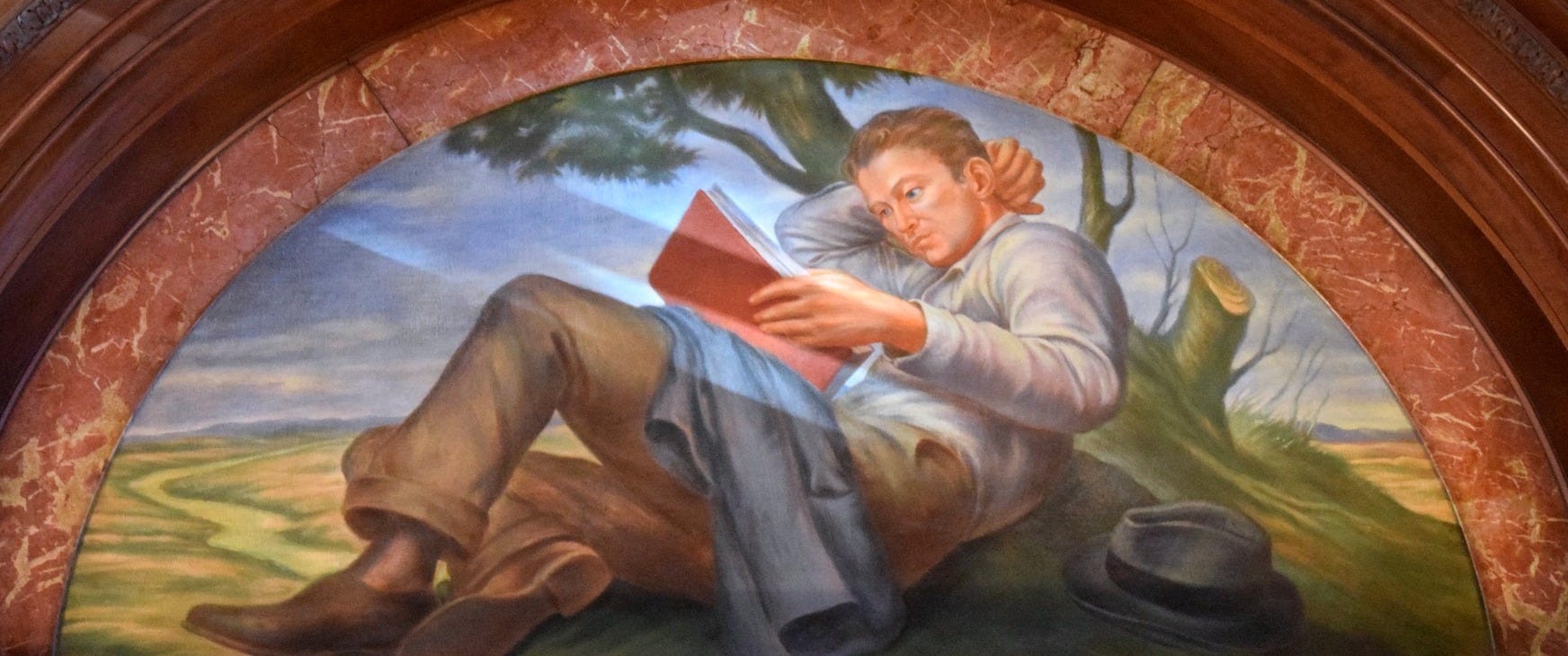
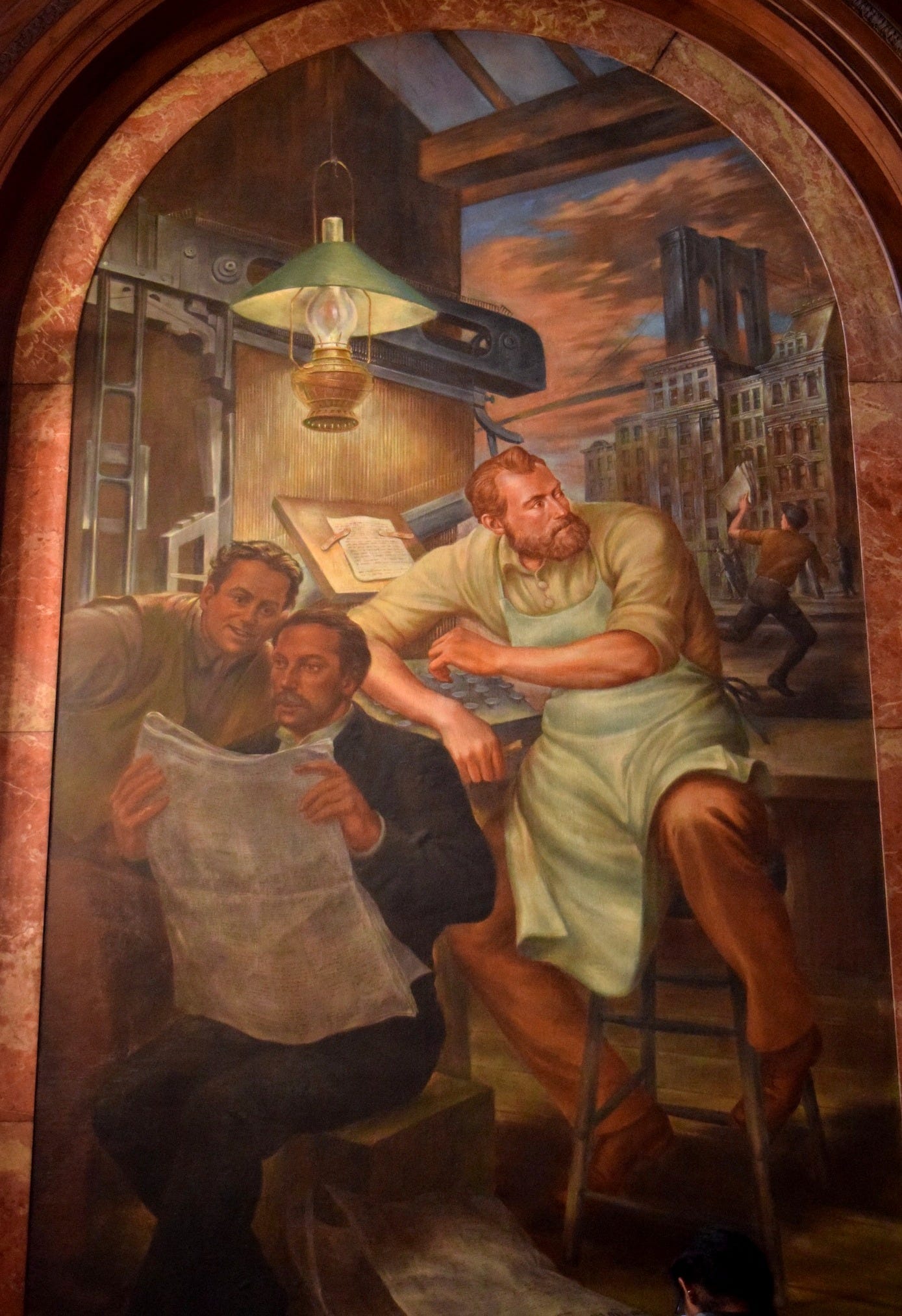
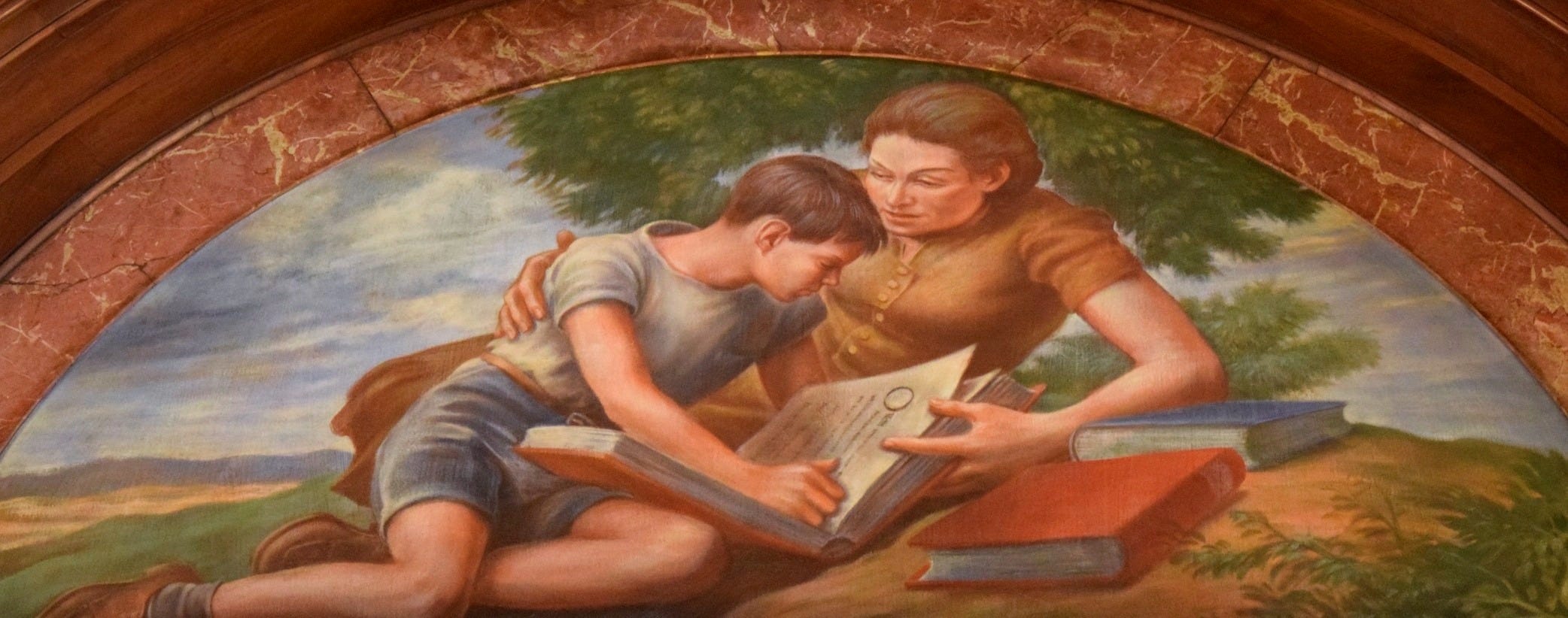
Art by Edward Laning and commissioned by the Works Progress Administration, displayed in the New York Public Library.
KEEP READING:
Fathers, In Medias Res

In honor of Father’s Day we present a collection of essays that explores the sacredness and complexity of fatherhood. We invite you to read and consider them, allowing their stories and ideas to challenge and expand the way you view the fathers in your life.
