


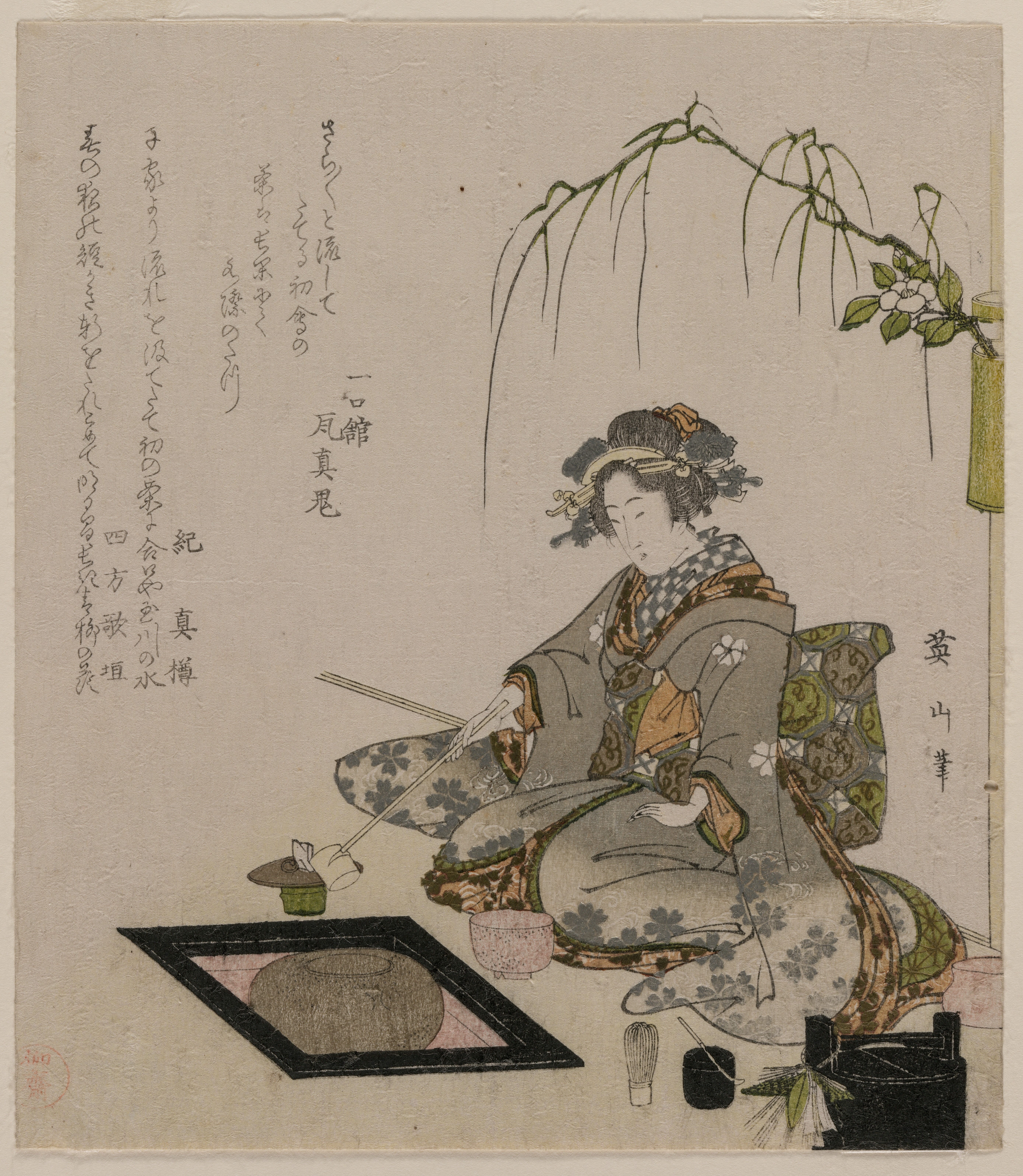
Cha-no-yu, or the way of tea, is a deeply meaningful and sacred ritual that has been practiced in Japan for about 450 years. It is much more than a drink of tea. Each aspect of the ceremony is intended to cleanse the heart and mind. What follows is a portrayal of a typical classic tea ceremony.
In preparation, the host carries water to a stone basin, which is set low on the ground outside the tea hut in a stance of humility. Here, the arriving guest pauses to wash.
     When you hear the splash
     Of the water drops that fall
     Into the stone bowl
     You will feel that all the dust
     Of your mind is washed away
     —Sen no Rikyu (1522–1591)
Swords and other weapons are left outside. The guest then stoops and crawls humbly through an intentionally small door and enters the tea hut. Having cleared the mind of ill feelings, he or she kneels on a tatami mat, barefooted, to remain for the rest of the ritual. In the corner, there is often a vase with a small single modest flower to remind one of beauty that is transient, and to cleanse one’s sense of smell. The room is uncluttered. Wood is unpainted, light is subdued, and simplicity is everywhere. Things are quiet and unspoken. Mindfulness is at the heart.
Water is heated in a small cast-iron teapot over charcoal, making quiet sounds that cleanse the ears. Finely powdered green tea, Camellia sinensis, is spooned into the handmade tea bowl, which has subtle flaws as a gentle reminder that perfection is always somewhat out of reach. Hot water is added and then mixed with a small bamboo whisk. Only a few sounds are present: the water as it heats, the bowl placed on the floor, the whisk. Otherwise, there is silence. The guest picks up the bowl with two hands, cleansing the sense of touch. Then he or she tastes, drinks the tea, and cleanses the mouth. The tea is often followed by a small confectionery that is mildly sweet.
Attention is directed to the present moment. Although the ceremony is precise and detailed, it is also quiet and simple. The tea hut itself represents a sanctuary or escape from the stress of everyday life. Central to the ritual are four spiritual aspirations that help guide the host and guest to orient their lives toward a higher level: harmony, reverence, purity, and tranquility. Each aspect of the tea ceremony is directed toward these four elements and imbued with a spirit of gentle hospitality that seeks to connect heaven with an earth and a people that are always imperfect, yet possessed of unique and incomparable beauty.

As a missionary in Japan in the 1980s, I had no direct experience with the tea ceremony, mostly, I suppose, because green tea and the Word of Wisdom were at odds with each other. Otherwise, I might have been an occasional participant myself. Instead, I worked to convince people to quit drinking their tea, and, by extension, to step aside from the tea ceremony as well. I have a slight uneasiness about this now—my unknowingness, and the losses entailed with the tradeoffs that were required. Nonetheless, in a more gentle and generous-spirited place later in life, I have found myself looking again at the tea ceremony and seeking to understand what it brings to people. Earlier this year, after almost forty years away, I was able to return to Japan and this time participate in a tea ceremony. In so doing, it occurred to me that there are a number of significant connections between this ritual and that of the sacrament.
Tea and sacrament both aim to provide a moment of escape from the worries of the world, a quiet and peaceful respite where we are able to reflect on life and on the present moment. A humble attitude is inherent in both practices. So is being cleansed, and also directing our lives toward a higher place. Simple means are used—whether a bit of bread, water, or confectionery—to engage the senses of touch and taste and help us focus on the ritual, making the spiritual aspirations more concrete. In both practices, there is a host who interacts with participants. The rituals aim to calm the mind, and as mentioned above, to move us deeper into harmony, reverence, purity, and tranquility. Other connections could be described.
On the other hand, there are certainly ways the tea ceremony and sacrament can be differentiated. At the time of my mission, my mind was more drawn toward differences than similarities, along the lines of the scientific method, western inquiry, and left-brained thinking. There is value in that approach, but I think it can also lead us to discount some of the sturdy and beautiful threads that run through different cultures, even among spiritual practices that developed hundreds of years and thousands of miles apart. I’ve often thought of the other sheep mentioned in John 10, and again in 3 Nephi 16, and the ties that might exist between us. This leads me to wonder, inescapably, if the common and shared threads might actually be some of the most important ones and less peripheral than I once supposed, notwithstanding our American and sometimes-layered religious focus on individuality and uniqueness and distinction. Then I think about what I believe and hope, the “all things” spoken of in Article of Faith 13, and I find myself being led, slowly but persistently, into the work of joinery.
Sources:
Okakura Kakuzo, The Book of Tea, 1956
Daisetz Suzuki, Zen and Japanese Culture, 1959
A.L. Sadler, The Japanese Tea Ceremony, 2008
John Franson is a practicing physician in rural Idaho, where he lives with his family and working horses. His poetry collection, All Things, was published in fall 2025.
Art by Kikukawa Eizan (1787–1867).
