


The following piece responds to Tyler Johnson’s parable, “The Keepers of the Well.”
In Tyler’s parable, a desert city has forgotten that its existence depends on a well and its life-giving waters. The well’s guardian instructs his daughters in how to tend the well and keep its waters pure; he teaches them about the oracle with second sight who found the well, around which a cathedral and eventually their city was built.
Despite their family’s charge to look after the well, each daughter chooses her own path. The first daughter finds her place in life among the city’s merchants and material splendors. The second daughter, weary with the city’s pride and opulence, leaves the city and finds a new well of water. The third daughter attempts the same feat but is not led to water and finds only heat, sand, and scorching sun. The fourth daughter remains in the city and carries on the work of her father.
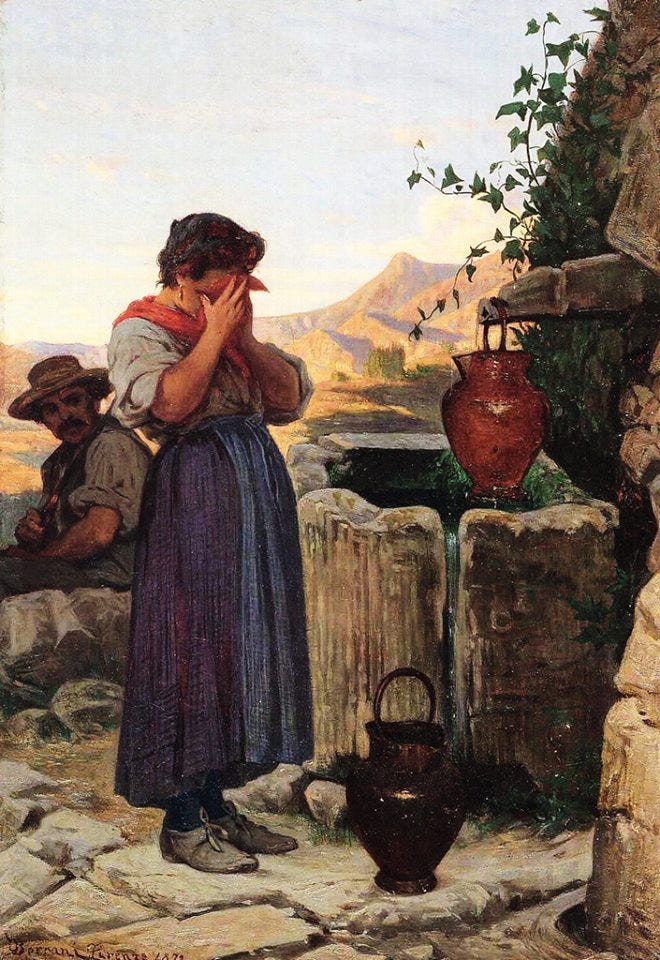
The land was plagued by drought. In the height of summer, the winds would blow fires across the brushy desert. The lakes and rivers turned to dry, cracked earth.
The most direct way to have enough to drink, was to live in one of the few cities. In these cities, water bubbled up from the earth in the center of town, and residents could fill their cups, pitchers, and bottles multiple times each day. Each of these cities was built around an artesian well at the center, and the culture was shaped by the well’s presence.
For example, each city had a list of habits and rules surrounding the well, and in order to live in the city, residents had to promise to follow the rules, which specified the rituals required to approach the well and fill a water container, how to treat the earth of the city, what to grow in the gardens of the city, and what fertilizers to use. In some cities there were even rules about what to eat and drink and how to properly dispose of trash.
Because of these traditions, and other cultural differences between the well-cities and the drier cities of the wider-world, the citizens of the well-cities were seen as strange. They acted peculiar. They wore peculiar clothing, made peculiar music. They were a bit isolationist and—to some—off putting.
And the well-cities did have problems. Some of their citizens struggled to make it to the well and didn’t have anyone to go for them. They found themselves often thirsty even when they lived only a short distance from fresh water. While some people saw beauty in the rituals, there were others who saw them only as a burden. Some chafed under the culture of the well-cities and found themselves visiting the well less and less often.
Those who stopped visiting the well usually decided to leave the well-cities for other cities, cities with different water-based economies.
And there really were so many ways to get water. Scientists had built great machines that pulled water from the air. These atmospheric water generators were loud, and the water they collected was distilled, void of the healing minerals of the artesian wells, but it had the advantage of being available in bottles at markets. No rituals were required to obtain it, only money.
Instead of the central well, these cities—which were built on trade routes or in the hills of mountains—were often organized around vast and sprawling markets, all competing for the attention, and money, of their thirsty populace.
Those who didn’t like the hustle and noise of the markets sometimes bought their own, smaller machines that captured dew in the mornings or desalinated water from the oceans. Others wore suits that recycled the water released from their breath or sweat or urine for use later.
And yet others invested their efforts into gaining so much wealth that they could send for water without going to the markets at all. They would take honest-to-goodness baths in their houses, and go to water retreats where they would swim in great pools of crystal clear distilled water until their fingers and toes were wrinkled in ways they had never thought possible. They spread tales of the wonders of such extravagant weekends and their healing benefits.
And then there were those who skipped water altogether. They drank milk, juice, hard cider or rare wines. They sometimes relied on vinegar or coconut milk, choosing to forgo the waters of the generators for something more exciting, more full of flavor.
In cities far from the well-cities, stories would be told of a magical place where water came out of the ground—water rich with healing minerals and more refreshing than the coolest, purest water available in the marketplace. Some thought it was just a fairy story. Others thought it was true but only in history, not in the present. When people would meet someone from a well-city and have the truth confirmed, there were a variety of responses. They may seek out the rituals to apply them to their own water or wine. They may ask to hear the stories again and again, to find hope in them.
Or, rarely, after hearing about the artesian wells in far cities, they would travel through familiar and unfamiliar cities, through fire and storm and over parched earth, until they finally approached one of the cities themselves. Then, at the gate, they would take off their shoes and promise to follow the rules and rituals before being led to the well, to taste the water for themselves.
Chanel Earl is a writer—mostly of fiction—who currently teaches writing at Brigham Young University.
Art by Odoardo Borrani (1833–1905).
