



What would it be like to perceive like God: to exercise an intimate awareness of the cellular structure of each blade of grass, of the spinning, birthing cosmos; of each unfathomable human being? Over a decade ago, I stumbled onto a podcast about contemplative prayer and became an earnest, if clumsy, student of contemplation in order to behold the world, myself, and especially the Divine, anew. I’ve always found the theophany of Moses 1 to be among the most compelling Restoration texts, in part because of how it treats this question through its persistent use of the verb behold. I think it gives a remarkable account of what contemplative perception—a grace-infused beholding—might look like and require of us.
What does it mean to behold? We often equate behold with looking, gazing, or a command to look upon. But if we consider the etymology, at least in the Germanic roots of our English word behold, there are two parts: first, the intensifier be, which means to encompass, to be on all sides, or to be thorough and complete. Second, there is the action being intensified, which in this word is hold, which means to keep, possess, carry, cherish, tend. Behold is thus participative, direct, and embodied; it means to tend from all directions. To gaze, by contrast, is to leverage our most distant sense. I can extend my sight to an object at a greater distance than any of my other senses can perceive. Behold collapses that distance: to behold is to touch, to carry.
Indeed, even though references to beholding in Moses mention beholding “by the spirit” (verses 11, 27–28), I think spiritual beholding is actually deeply embodied. In Ezekiel 36:26, the Lord says: “A new heart also will I give you, and a new spirit will I put within you: and I will take away the stony heart out of your flesh, and I will give you a heart of flesh.” Spirit is equated with or accompanied by fleshliness, the heart. So if I were to combine these scriptures, to behold by the spirit is to see with eyes of flesh rather than eyes of stone. To behold is to take in and drink up with our entire soul, our body, and our spirit instead of guarding, filtering out, shutting down, and narrowing. To behold by the spirit is to behold everything.
How can we behold in this direct, full-souled way? And what does it do to us to behold in this way? How does it transform us?
I’m invested in this question because we in the modern West have inherited an Enlightenment legacy of excarnation, a term philosopher Charles Taylor uses to describe the cultural shift from identifying ourselves with an embodied soul to identifying, instead, with the disembodied mind. As a result, faith became a matter of propositions about God’s nature, rather than participation in it. And even if our own Latter-day Saint theology and culture is richly, radically material and embodied, we can’t help swimming in the water. We risk losing contact with these embodied, spiritual-perceptual capacities that are needed to transform us, to build the kingdom, to do the work of healing we covenant to do as disciples of Christ and children of our heavenly parents.
I’m sure you can taste what this perceptual capacity of beholding is like if you close your eyes for a moment and think of someone you see daily, someone who crosses your visual field each morning or evening. Maybe it’s a child, a roommate, a parent, a spouse. Can you recall their image? Good. You’re seeing them. But what is it like to behold them? To drink them in, take them up, and be altered in that experience?
Moses 1 illustrates a progressive arc in which he is initiated into new ways of beholding—at least four, by my count. I’ll elaborate on these with the hope that we can practice a different kind of perception in everyday life. For even though Moses may take us to lofty heights, this spiritual-perceptual practice serves our discipleship in the mundane.
The first behold is in verse three: “Behold, I am the Lord God Almighty and endless is my name.” So our first question is, how do we behold God? And the next verse: “Behold, thou art my son.” How do we behold ourselves? Then a couple verses after being commanded to do so, Moses beholds the world. How do we behold creation? And in that same verse, he also beheld all the children of men. How do we behold each other? Moses’s experience reveals that such perception requires the spanning of polarities, the proving of contraries, a dynamic scaling up and scaling down, in and out. It involves effort and grace, a willingness to experience death and rebirth.

Beholding God
The scriptures give us different ways to behold God—not just by what they say or what they prescribe, but what they do. Scriptures act on us; they can open up our perceptual capacities in powerful ways. One common way scriptures invite us to behold God is through what theologians call the “cataphatic,” or the way of naming. Another is called the “apophatic,” or the way of un-naming. Both are present in scripture, and both share the same function: to invite a participative, rather than propositional, engagement with God. While the apophatic is more dominant in Moses, it may be less familiar to the average Latter-day Saint reader. So let’s first consider examples of the “cataphatic,” or the different ways God names or is named in scripture—for example, through metaphors.
There are dozens of metaphors for God in the scriptures, especially in the book of Isaiah and the Psalms. God is a fortress, a shepherd, a midwife, a mother hen, a light, a fire, a king. They pile up so thickly that trying to conceptually hold them all together will not work. We are propelled out of a conceptual approach to God and thrust into a more direct and participative relational mode. We are not so much seeing God “as” something, so much as we are seeing God “from somewhere.” My own prayer practice has changed as I have focused less on my words and more on situating myself before God from these various relational modes, letting them act on me—softening me, strengthening me, perplexing me, simplifying me. And many times, I resist their invitation. This, too, is a prayer; this, too, can be an offering of honesty and humility.
What is it like in prayer or in daily life to behold God as a “mother who comforts her child?” “So will I comfort you,” God says in Isaiah 66:13. When I have beheld God in this way, I have encountered a depth of rest and trust that anchors me in wordlessly soothing, nourishing love.
What is it like to behold God as a “bridegroom who rejoices over his bride?” In 62:5, Isaiah proclaims: “So will thy God rejoice over thee.” Christians have long deployed such metaphors to draw upon our most vivid experiences of being longed for and delighted in to capture something of God’s intense desire for communion with us. Imagining myself to be desired, to take seriously that God first loves us, opens my heart to new ways of perceiving and trusting God’s delight and devotion to creation, to Zion, of which I am a part.
What is it like to behold God as our potter and ourselves as clay? “Thou [art] our potter; and we all are the work of thy hand,” as Isaiah proclaims in 64:8. When I behold God in this way, something in me relaxes, consenting to the pain of transformation or the difficulties of life, trusting that something beautiful is being created.
And on the other hand, I can also behold God as my rock, my fortress, my protector, my buckler and the horn of my salvation, my high tower (Psalm 18:2). God not only shapes me—God can protect me, upholding my integrity and my personhood. Whereas beholding God as my potter encourages me to soften and submit, beholding God as my fortress encourages me to gather myself and assert.
All of these modes of being are ahead of us, ready for us to step into, inhabit, speak from, and live from.1 They are not merely ways to conceptually determine what God is like; they are postures we can take on that deeply transform us.
Now let’s explore the apophatic, the “saying away” of God, remembering that both modes fulfill the same purpose: to gather our heart, mind, and body into the simple immediacy of experiential encounter. The apophatic often takes the form of paradoxical extremes, pairing the saying and unsaying into a complementary rhythm that drums out our conceptual calculations and invites us to behold God in the dark as well as in the light. This is a dialectical strategy; it is not a blanket assertion of God’s complete, impenetrable Otherness that forbids us from saying anything at all. Duns Scotus, a medieval theologian well acquainted with this dialectic, clarified that the apophatic on its own is inadequate, for we cannot love “a mere postponement.”2 We cannot love a not-this.
So why the not-this? What does this do to us? I believe this unnaming keeps us open, prying us from our words, descriptions, and even our experiences so that we are beholding the face of God and not just portraits of God, as Saint Teresa of Avila would remind her nuns. As beautiful as those portraits may be, we eventually want to put them down and behold the real face, even if we can but feel it in the dark.
Let’s see how the account of Moses uses these apophatic paradoxes, these namings and unnamings. First, God introduces himself to Moses as the “Lord God Almighty, and Endless is my name; . . . my works are without end, and also my words, for they never cease” (Moses 1:3–4). We are swept up into infinity and vastness. But before we lose our sense of the particular and the singular, he restores them back again: “I have a work for you.” Infinity juxtaposes and thus transforms, rather than annihilates, the particular.
Likewise, Moses depicts the knowability and mystery of God. When Moses surveys creation and asks God why he has created these things, we should pause before jumping to the well-known words of verse 39 and first consider verse 31: “For mine own purpose have I made these things. Here is wisdom and it remaineth in me.” There are things God refuses to, or cannot, reveal—something that is not accessible in our beholding of God; and yet, there is something: “Behold, this is my work and my glory—to bring to pass the immortality and eternal life of man” (verse 39). I don’t think God is changing his mind; he is asking us to behold both the divine mystery, the shadowed incomprehensibility, as well as the loving and lightsome self-disclosure. Perhaps for similar reasons, he assures Moses that “[a]ll things are present with me, for I know them all” (verse 6), even though just a few verses later, “The presence of God withdrew from Moses” (verse 9). God is everywhere, in everything, without beginning or end, yet we also experience the goneness of God. Such beholding teaches us to let ourselves be grasped by God, rather than trying to grasp God.
Indeed, we learn we cannot conceptually grasp or control the God who proclaims to Moses in the burning bush, “I AM THAT I AM,” or, “I will be who I will be” (Exodus 3:14)—the most unequivocal apophatic text. God is locatable and unlocatable, self-disclosed and undisclosed, named and unnameable; the incarnate, dialectic present and future tense.
What do apophatic scriptures do to us? In my experience, they prepare me to be surprised. If I could add a fruit of the spirit to Galatians alongside longsuffering and meekness, I would add this quality. Some of my most precious and transformative encounters with God have shattered everything I thought I understood about God. Yet, as much as I treasure them, this unnaming strategy urges me to be willing to give them up. Otherwise, I risk idolatrizing experience, obstructing the new revelation, the new encounter, the new presence. I can surrender these precious experiences to the dark, if need be, so that God can set a new bush ablaze.
The apophatic and cataphatic dialectic frees us to behold God in the light and in the dark, the known and unknown, with trust. This is faith at its most transformative, unlike its excarnated relative, belief.
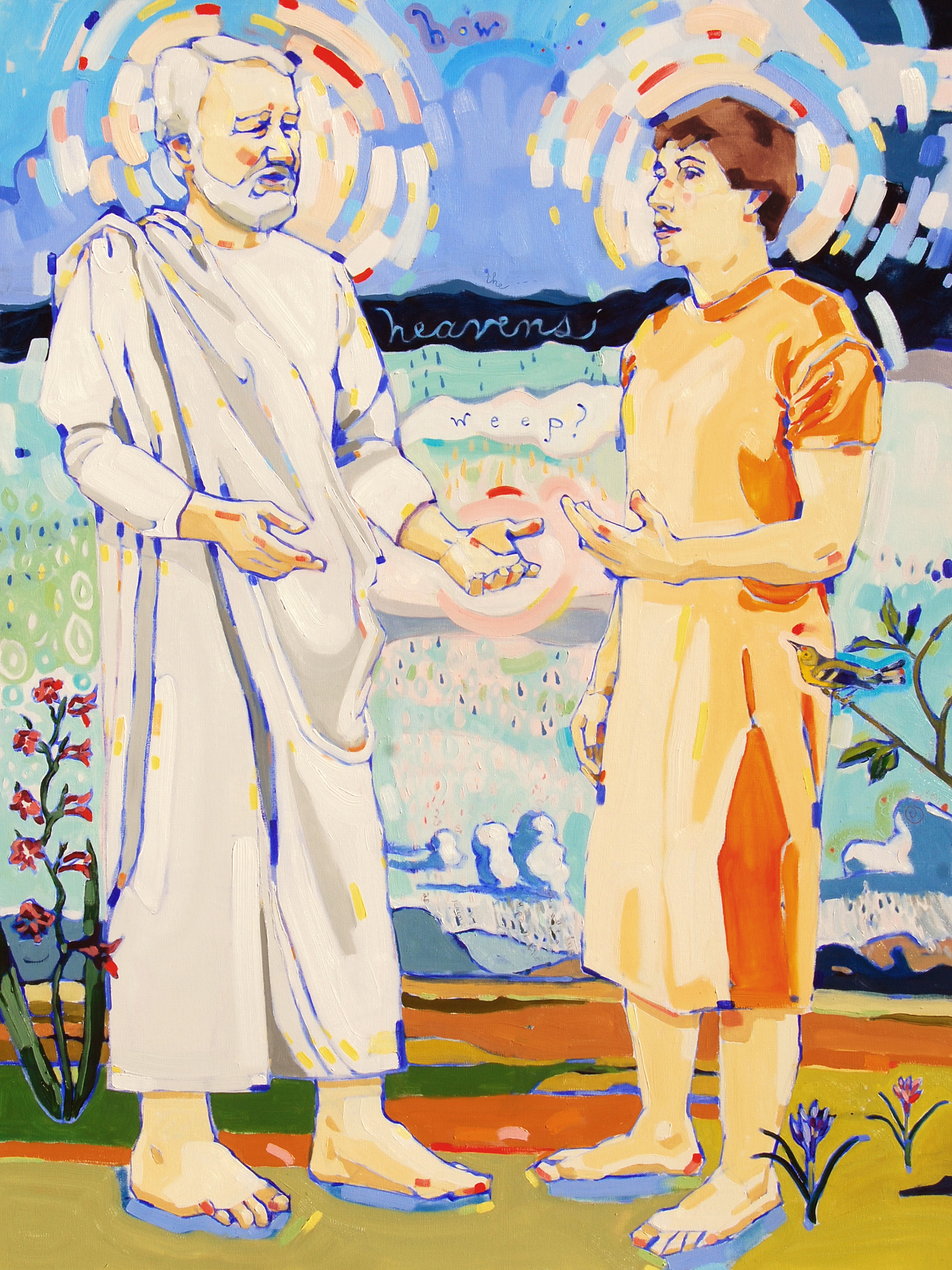
Beholding Ourselves
While Paul reminds us that a full, comprehensive self-beholding is not available to us now, for we see in a glass but darkly, Moses 1 reveals the glimpses that are possible. And key to this self-beholding is, again, the pairing of seeming opposites. Consider what Moses says after he beholds creation and the children of men: “For this cause, I know that man is nothing, which thing I had never supposed” (verse 10). Haven’t we all experienced this before? Whether standing in front of an ocean at night or seeing the speck of our galaxy in the satellite-photographed cosmos, you almost can’t feel yourself, you’re so small.3 But while there might be a relative insignificance to Moses, he is reassured that in God’s eyes, he is numbered. He is named. He is known: “There are many [worlds] that now stand, and innumerable they are unto man; but all things are numbered unto me, for they are mine and I know them. . . . The heavens, they are many, and they cannot be numbered unto man; but they are numbered unto me, for they are mine” (Moses 1:35, 37). So what does it do to us to behold our undeniable relative insignificance and the absolute assurance that we are known?
The effect can be startlingly intense, such that it is quite easy for me to lose hold of both ends of the I-Thou relationship with God: that I am both a marvelous creation of God as well as a near nothing in God’s cosmos. Both of these belong to what it means to stand in and then behold ourselves in relationship with God. If I lose this polarity, I can indulge in the narcissism of using the conviction, I am God’s work! I am known! I am his child! to make me the center of the universe. But I can also slip just as easily into the other side: I am nothing. Nothing I do matters. What’s this all for? And as I am learning to hold those two together, my posture before God has changed from an anxious, unceasing wrestle—I’m trying! Am I enough?—to a deep rest: I am known and numbered. This changes the way I pray. My back is straighter. My head is bowed. My chest is light. I try to carry that posture into life.
But return again to verse 4. After introducing himself, God immediately says to Moses: Thou art my son. And I—who have probably spent too much time in the smallness, in what I thought was a kind of mature self-effacement before God—almost can’t bear the searing intimacy of these words, the swift subsuming of my insignificance into a filial I-Thou.
Perhaps God knows this intimacy might be too intense, the being known too overwhelming, for God adds, in what I always thought until now was an odd digression (and echoing the temporality of Ether 3), “And you are in the similitude of mine Only Begotten.” Why does it matter to see our true nature as intrinsically, deeply, from the beginning, Christ-imaged? Not a nature we must only develop or prove, but what we also ineradicably are. Perhaps we discover this by answering first, who is Christ? Christ works, Christ creates (verse 8). Recognizing my Christ-imaged nature empowers me out of my self-dramas of Who am I? to I have work to do. This self-beholding, then, paradoxically decenters me and thus also frees me to discern what is needful and act in confidence through the image I bear.
