


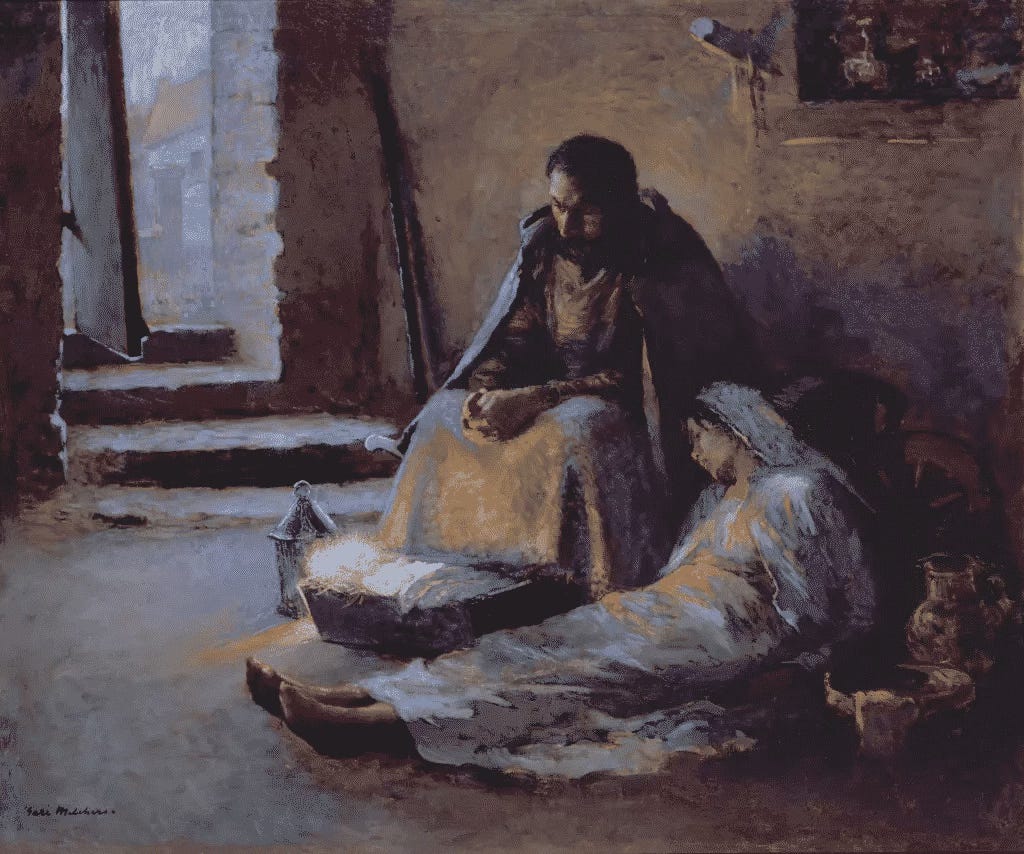
Imagine, as we begin, a weary Mary and Joseph, now finally resting in an animal stall, a midwife likely beside them. Outside, dawn is growing closer but has not yet begun to break; the world is still suffused with darkness. Mary’s contractions have been strengthening, growing closer together. The midwife knows delivery is near.
0:00—The entire choir enters with hushed intensity, on a chord that suggests weariness, tenuousness, trepidation, struggle, and even fear.
0:25—A cello enters, almost inaudible at first. The cello’s first three notes constitute a lament, a groan, a cry for help. Mary’s contractions deepen. An enveloping pain tautens every muscle—from those in her forehead to those at her toes—together. The fourth and fifth notes suggest a temporary surrender—this contraction subsides. As the cello obligato continues, we can hear an insistent goodness pushing back against an encroaching pain, an obstinate light worn weary against the shrouding darkness.
1:22—The light begins to grow, but remains tremulous, fragile.
Mary’s tired body continues to prepare for the coming forth of a new life. Surrounded by pressure and unfamiliar aching, the passage to Mary’s womb begins to change, the opening slowly stretching and thinning until it is finally wider than her own fist, clenched hard against the pain that rolls over her in waves.
The long hours pass, and the waves begin to come faster, with greater intensity.
The midwife meets each surging contraction with olive oil and pressure, massaging the taut muscles of Mary’s back. The pelvic bones rearrange themselves in preparation for the baby’s delivery from the shelter of the womb to the cold of the waiting world. We sense hope dawning just beyond the horizon.
2:02—The cello leans into a high “E.” The baby is crowning, Mary gasps into the dawn, the hay at her feet drenched in crimson. Soon, the intensity of the pain begins to recede, but suffering lingers.
2:30—A full pause in all parts.
2:10—Immediately, hope begins to grow. The sun has peeked above the horizon. Light waxes, expands, and sunbeams paint a sky that begins to glow. The tonal colors shimmer, an almost unbearable tension grips the air, we hunger for resolution and release until:
3:00—The newborn baby’s first exultant cry into the brightening world. The King of Kings is born. Mary breathes. Her muscles, strained to exhaustion, relax into blessed rest. The bleeding ebbs. The placenta comes. Mary reaches for her freshly cleaned baby and lays his warm weight against her bare breast. He is here, and he is real. Together Mother and Child are wrapped in linens. The shepherds and animals look on in wonder. Joseph, overcome, sinks onto the ground.
3:30—But as soon as the moment of transcendent resolution arrives, it has vanished. A breath. A pause. Again, melancholy chords perfuse the air. The cello laments. The baby, no longer a passive bucolic presence, begins to wail into the brightening dawn. An empty infant stomach will need filling. The afterbirth must be attended to. Reality immediately begins to encroach on the idyllic scene.
4:22—The piece begins its coda. The parts shrink toward pianissimo again, the choir will take another 46 seconds to fully arrive at silence. The shepherds depart. The animals return to their feed. The birth has ended. Mary begins to feed the child at her breast. A weary world returns to its passing concerns.
Gjeilo’s setting reminds us that the notes of exultation don’t even arrive until three minutes into a song that lasts just more than five. And when that transcendent chord finally arrives, it derives its meaning from the labor, melancholy, and dissonance that came before. What’s more, it lasts for only two measures—eight counts—before it immediately begins degrading, transforming, and falling back toward a more complicated and melancholy rest.
To hear Christmas sung in carols and to see it depicted in art, one would imagine that Mary and Joseph were transported, gleaming and dewy-skinned, to an immaculate stable without a dab of dirt or a hint of sweat. And that the baby was delivered, already wrapped in glistening linens, smiling and cooing— “no cry did he make.”
But to depict the birth of God’s Son as sanitized and easy is untrue in the deepest sense. Jesus was not born to live a sanitized and easy life. That ride on a donkey—with a near-term mother-to-be over dusty primitive roads—must have been grimy, sweaty, dirty, and uncomfortable. Likewise, the stable likely smelled of dung and was uncomfortable in the extreme. There was, of course, no anesthetic to take away the pain, and Mary birthed Jesus in an era when infant mortality likely hovered around 50 percent. Maternal mortality was also high, meaning that the very prospect of bringing a baby into the world was, by definition, an experience freighted with existential angst. And, finally, birth itself is an event which, in any day and any age, can only be fully understood by those who have groaned, wept, and endured their way through it.
The rest of us can only look on in admiration and wonder.
But all of this is why Gjeilo’s setting matters so much. Like the journey of Mary and Joseph, and most especially like Mary’s labor, life includes precious moments of transcendence, beauty, harmony, and resolution, yes, but also, and often more persistently, entire pages of dissonance, difficulty, and pain. When Lehi teaches his sons that there “must needs be an opposition in all things,” he seems to be acknowledging that life, for many of us and much of the time, remains deeply hard.
Of course, our longing for a sanitized nativity is understandable. In our moments of deepest need, we long to know that, as Elder Holland once promised, “for the faithful, things will turn out right in the end.” When we are in the dark, we want to believe in Light. When we are in doubt, we yearn for Truth. When we are lost, we search for the Way.
But if we define our happy ending as unsullied perfection, we can feel both robbed and guilty when our lives do not currently look beautiful. We may ask: “Have I done something to miss my chance at happiness?” Or “Has God left his promises unfulfilled?”
But, in fact, a transcendent truth is woven into the warp and woof of our theology: opposition, pain, and even suffering are components of the universe as eternal, immutable, and indestructible as time. Our Heavenly Parents—whose image we bear and whose nature we strive to emulate—live a life suffused with suffering, having filled the seven oceans with their tears.
As Mary could not bear her child without pain, so we cannot encounter God without experiencing opposition. Yes, Mary likely cooed to a slumbering and swaddled baby—but only after the danger and difficulty of his birth.
It seems that Jesus came into the world not to end suffering but, rather, to answer it with love.
This is my testimony on Christmas Eve: Faith in Jesus will not make life easy, but when I commit whole-heartedly, faith will teach me to face the world’s suffering with candor and grace. When I am weary and saddened, then I am gifted the love only Jesus can give.
Thus, as we take a moment this night, before the riotous joy of wrapping paper and festive foods that will come tomorrow, let us savor the silence and the glow of lights on Christmas Eve. Let us listen to O Magnum one more time. Let us imagine the laboring, exhausted, sweating, tearful Mary and let us remember that the meaning of Jesus’ birth is not that He takes from us our suffering, but that in the midst of our suffering, He teaches us how to truly love.
From all of us at Wayfare, Merry Christmas Eve.
Tyler Johnson is a Wayfare contributing editor and an oncologist and Clinical Assistant Professor at Stanford University.
Music by The Choir of King’s College, Cambridge.
Art: The Nativity, by Gari Melchers.
This piece is included in our special Advent print issue of Wayfare. To receive a copy in the mail in time for Advent this year, become a paid Wayfare subscriber or place an order here by October 31. To read more from this issue, click here!


I’m reminded of the words of John: “We love Him because He loved us first”.
Love can truly help us to bear even the unbearable.
Thank you for such a wonderful, powerful message!
I am deeply touched by this. Thank you.