



On August 27, 2025, Fania Fainer passed away in Toronto at the age of 100. Fania was a Holocaust survivor, a woman of quiet strength, warmth, and resourcefulness, who transformed the shadows of her unimaginable past into a radiant life of love and enduring legacy.
Fania was born in Bialystok, Poland in 1924, a middle child between an older brother and a younger sister. At sixteen, while walking down the street, she was identified as a Jew and imprisoned. She never saw her parents, her two siblings, or any relative from her extended family of about ninety people again. She was first deported to the Stutthof forced labor camp and then, in 1943, she was transferred to Auschwitz-Birkenau, where she toiled in the Union Werke munitions factory.
At a table with nineteen other women, she sat in enforced silence, manufacturing bullets for the German army. In an act of subtle resistance, instead of packing the bullets with powder, she and the other prisoners would surreptitiously gather dirt from the floor and insert it, rendering the ammunition useless. As one of the women later reflected, the Nazis could strip them of everything, but they could not take away their ability to think.
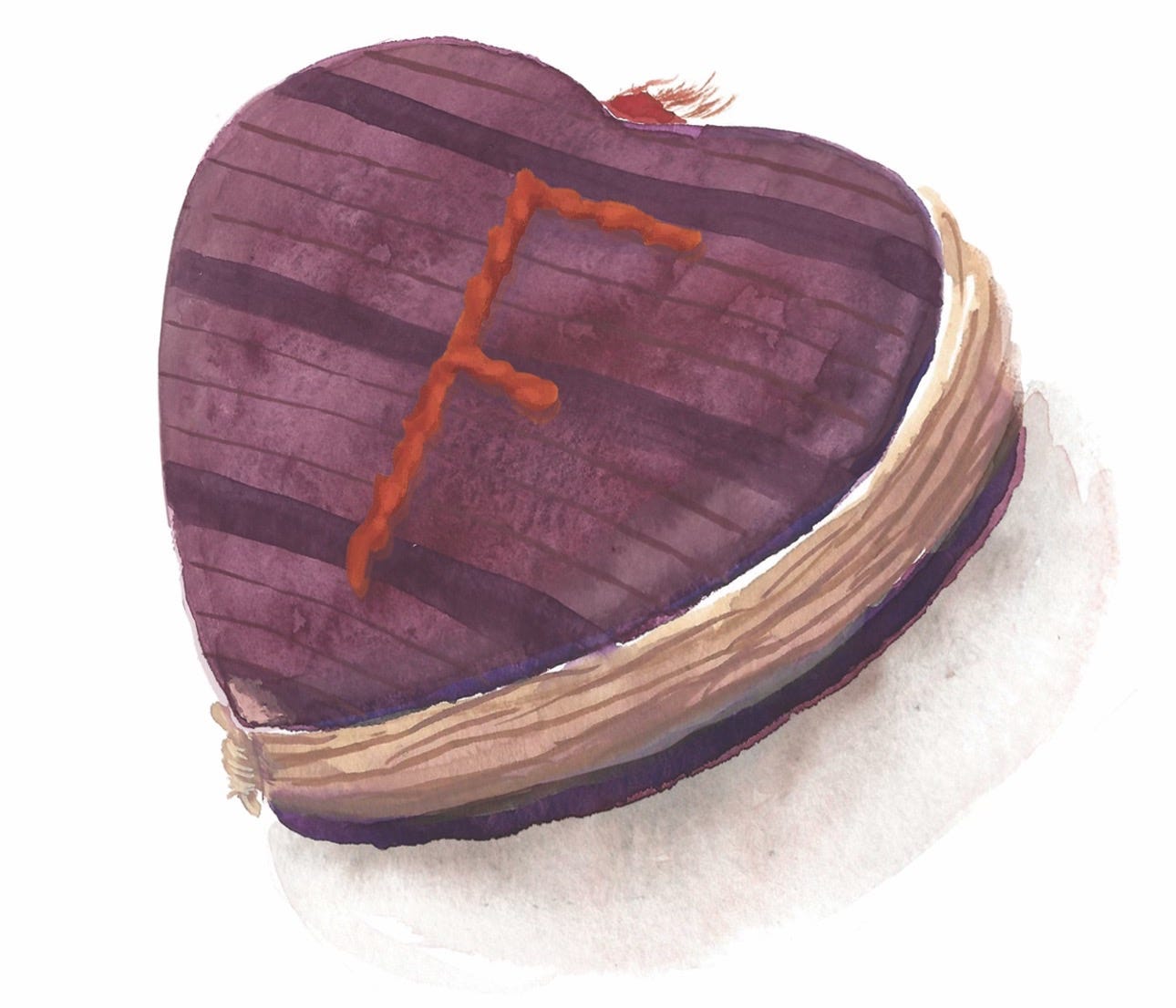
At that table, Fania met Zlatka Pitluk and they became friends. When Fania turned twenty, Zlatka was determined they would celebrate. Remarkably, Zlatka persuaded the women to surrender tiny portions of their daily bread rations so she could fashion a small, round birthday “cake,” iced with butter and marmalade. Zlatka also wanted Fania to have a lasting souvenir. She had always loved handicrafts and managed to scavenge bits and pieces with the goal of creating a heart-shaped origami birthday card with the other women at the table.
This incredible feat was accomplished without talking or moving, as the kapos were constantly vigilant. The women risked their lives with every element required to craft the card: the paper, scissors, pencils, glue, and the needlepoint F stitched on the cover. They even cut fabric from their own clothing to form the book’s cover. The defiance was worth the peril. “Life and death were the same,” Zlatka said in her testimony. “No one knew if they would survive to see the next day, but we were alive in that moment and resolved to celebrate our friend.”
On the day of her twentieth birthday, Fania sat down at her narrow bench to work. There, waiting for her, was the gift. “I looked at the book,” she recalled, “and it had my name on it—Fania Landau. It was for me. Someone remembered my birthday. In hell.”
She opened up the card which unfolded into a beautiful origami flower. Inside were messages inscribed by all the women in Polish, German, Yiddish and Hebrew:
“Happy Birthday, dear Fania.”
“Those who live through this—win.”
“Don’t cry when you suffer.”
“May your life be long and sweet.”
“When you are old, put on your glasses and remember what we went through.”
And finally: “Freedom, Freedom, Freedom!”
The messages were signed with their names: Hanka, Mania, Mazal, Hanka W, Berta, Fela, Mala, Ruth, Helene (Lena), Rachela, Eva Pany, Bronia, Cesia, Irena, Mina, Tonia, Gusia (Guta) [and] Giza.
Fania cried softly reading the messages, remembering her parents, her brother and her sister. The Nazis had taken everything away from her. She had no reason to live. But this card reminded her that there was still love and beauty left in the world. It gave her strength to survive another day. So she held onto it. She kept it hidden while she was in the camp, slipping it under a rip in the bunk bed above or in the straw on the floor below. Somehow, she even preserved it during the death march, tucking it beneath her armpit as she walked.
The heart survived.
Today, that heart-shaped card is one of the central artifacts of the Montreal Holocaust Memorial Museum. It is the subject of a documentary film, The Heart of Auschwitz, and the inspiration for the award-winning children’s book Fania’s Heart. It anchors school curricula and educational programs across continents.
When we think of heroism and nobility, it is not just Fania who comes to mind. It is the nineteen young women, many of them teenagers, who risked their lives to create a secret birthday card in the depths of Auschwitz. Their courage was not forged on a battlefield or proclaimed in speeches. It took the form of a quiet, perilous act of kindness: a refusal to let friendship die.
Their story holds a mirror to our own lives. We may never be tested as they were, but their example asks us: Are we capable of choosing selflessness over survival, compassion over indifference, sacrifice over fear? Would love, courage, and friendship endure within us if the world around us collapsed into darkness?
In a magnificent general conference talk given in October 2000, President Dallin H. Oaks sought to answer this question. In his talk “The Challenge to Become,” he emphasized that faith isn’t simply about acquiring knowledge or holding testimony. It is a call to become; to have our nature, desires, thoughts, and actions changed, rather than simply add information.
“It is not enough for anyone just to go through the motions. The commandments, ordinances, and covenants of the gospel are not a list of deposits required to be made in some heavenly account. The gospel of Jesus Christ is a plan that shows us how to become what our Heavenly Father desires us to become.”
This transformative vision is also found at the heart of Judaism. The third-century Babylonian sage Rav taught: “The commandments were given only to refine people through them. After all, why should the Holy One, Blessed Be He, care whether one slaughters an animal from the throat or from the nape? Thus, we learn that the commandments were given only to refine people through them.”
This teaching addresses a question I hear often as a rabbi: Why is Judaism so exacting? Why does God specify the precise method of slaughter or prohibit certain foods while permitting others? Rav’s response is profound and liberating. God doesn’t micromanage these details out of capricious preference. Instead, the commandments are designed to refine us. By adhering to these laws, we cultivate discipline, mindfulness, and empathy. We learn to pause before acting, to consider the impact of our choices, and to align our will with a higher purpose.
This sobering truth challenges the notion that we can simply “go through the motions” of religious life, reciting prayers without feeling, giving charity without empathy, or observing the Sabbath day without inner rest. We reject such superficiality; ours are not religions of heavenly bookkeeping, where commandments are deposits in a cosmic account. Instead, the commandments form a divine roadmap, guiding us toward our highest potential. They are the blueprint for refining our essence, polishing away impurities like selfishness, anger, or indifference, until we shine with the light of holiness.
The Vilna Gaon, one of Judaism’s greatest minds, explained as follows: “The prime purpose of man’s life is to constantly strive to break his bad traits.” It echoes Deuteronomy’s call: “Now, O Israel, what does the Lord your God ask of you? Only that you should fear the Lord your God, to walk in all of His ways, to love Him, and to serve the Lord your God with all your heart and all your soul” (Deut. 10:12).
To walk in God’s ways is an invitation to emulation. The Talmud illustrates this vividly: “Just as He clothes the naked, so too should you clothe the naked. Just as He visits the sick, so too should you visit the sick. Just as He comforts the mourner, so too should you comfort the mourner.”
Emulation unfolds in the quiet, everyday moments. It’s comforting a tearful child, forgiving a minor slight, extending a kind word amidst the chaos of busyness, or simply acknowledging a friend’s birthday with genuine warmth, as those brave women did in Auschwitz amid unimaginable peril. Each good deed serves as a sacred training ground: the dietary laws instill discipline and mindfulness; observing the Sabbath imparts the art of rest and mindful presence; giving charity nurtures a spirit of generosity and empathy. Through these practices, we forge ourselves into beings who embody truth even when it demands great sacrifice, compassion even toward the undeserving, honesty even in the shadows of solitude, and nobility even when it imperils our very lives.


