


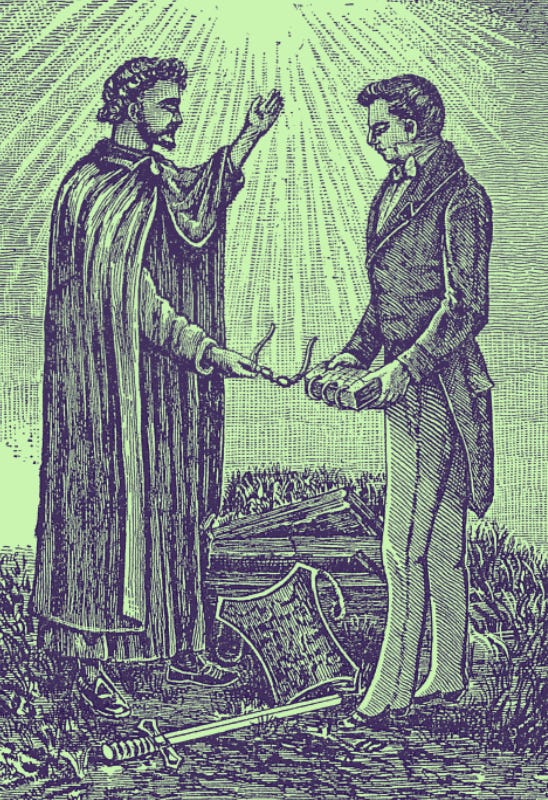
“I am not ashamed, afraid, or averse to tell you what ought to be told: that I am under the direction of messengers from Heaven, daily and nightly…”
Prologue
1
A time and times and half were dead and rose,
Since my advance with grief was ere beheld.
I fell into a wand’ring as befit
The bloom and fall from whence I had been drawn.
By maidens’ speech bewrayed and thrice a’crowed
Belief took hold of me, one night usurped,
And treasure in the womb of earth, for which
A spirit walked, was visioned to my mind.
2
With darksome air aglow beyond the noon
By far-seen vesture white as ought be sought,
The form and rich habiliments of one,
Whose countenance gave semblance to the sun,
Poised with an angel’s ease in middle air.
With signs and words and hands my guide took hold,
And spake to me of wherewith I could look,
And cause the word ensepulchered to rise.
3
T’was next I heard of messengers to come:
Of one in temple and of one without.
And men, as stems bear rods, by gods begot
To draw thereto of remnants long cast out.
Then One to come to whom all must give ear
Before the undestroyed will be cut off.
At last upon us all a pouring out:
To dream and speak of blood and fire and smoke.
4
At length the vision closes and I lay
And muse upon this single solemn scene.
T’would take me long to tell you all he spake,
How many times he came, and all I saw;
But should I tell the whole the telling would
Exceed the spreading cosmos I suppose.
I, going to the hill envisioned me,
Will show you how with ease it may be climbed.
ὁ ἄγγελος
5
I left behind the sylvan τέμενος
To search within a rise consider’ble.
Upon its occident a mindful tomb,
O’er covered by a thick and rounding stone,
Where was a Messenger from Mercy’s seat.
With fixed levant obtained for leavening
The Messenger and I with faces toward
Spread winged speech o’er top the word ‘ngraved.
6
“I come not of myself,” he recommenced,
“But sent by Heaven’s Lady as a guide.
Yea She who ‘ccompanies a fire unquenched,
Which flame ascending up She shadows o’er
To cleave thy glossal organ so to grasp
The Word which I Her Messenger would speak.”
No longer was I from the Word enveiled;
My tongue a molten thing seraphic’lly.
7
Condemned in consequence of temptation,
My lips unclean with guilty levity,
Now covered o’er and well-departed from,
He spake to me as I to thee would speak:
“’Gainst those who see and seeing do not know
Shalt thou transgress athwart necessity;
‘Midst these by whom to see and know is had,
There are no castings by but givings to.”
8
Desirous of instruction to receive,
And knowledge great and greater to possess,
And coveting to know the mysteries,
If one or many gods there be I knew;
How we may as they are become I sought.
“Thy name,” he said, “to have as well to speak,
Shall means become for man as god to be,
For godhood is to know he will increase.”
9
“By whose increase,” said I, “does knowing come?”
“’Tis one,” said he, “whose godly mingling ye
Will come to know when it is given thee.
‘Ere then see thou wherewith to know begins.
About the soul’s divinity observe:
That ev’ry human soul shall ever last
As ev’ry thing first moving’s ever last;
To rest from motion is from life to rest.
10
To generate or be destroyed entire
Is not to motion givèn or to time.
Intelligence, unmade and increate,
And independently ensphered as man,
Is one of two composing all there is;
Thus all is things to act and acted on.
A body solely moved by force without
Perforce remains a body without soul.”
11
And I, “As God Himself does self-exist—
You say that this accounts for man as well.
The human mind is coequal with God’s?
Th’ intelligence of spirit’s immortal,
It lacks beginning, thus it hath no end?
If God ne’er had the pow’r a mind to make,
No more than He His mind did self-create,
Then spirits uncreated may enlarge?”
12
Then to my questioning he gave response:
“That gods there are to thee was manifest;
So keep thou in thy speech from absolutes.
Most think creation’s history commenced
With God ‘in the beginning’ to create
But when בׇרׇא ’tis rightly rendered thus:
‘The head one of the Gods brought forth the Gods.’”
To me still indifferent he luminates:
13
“The great majorities don’t comprehend
The is or was or will of the divine.
For one to comprehend the character
Of God means comprehension of the self.
And so thy self must go and Other come
To give thee sight of self as Other hath.
In truth, to know thy self as Other doth
Is no more than all gods have done ‘ere thee.”
14
With this I saw that man’s intelligence,
His spirit, mind, his everlasting self,
Like God, and with Him too, has always been.
And so to know the self from Other’s view
Is looking on a god in embryo.
Hence man like God is most divine and prized,
And thus we see that comprehending God
Means comprehending self, to think of thought.
15
Material is thinking self-begot
And thought to things thought on identical,
For thought thinks in concert with things thought on.
Insep’rable’s material from mind,
And these the two composing all there is,
For all is things to act and acted on.
And ‘tis the possible, which is desire,
That moves the actors on the acted on.
16
So understood, the Messenger conveyed:
“As said by them of old on continents
Three hundred four and forty days apart,
That faith means hoping after the unseen,
By means of ἐλπίς πίστις leads to sight.
The former is the latter’s self expressed
And represents the movement of the will
Unto th’unseen until arrived upon.”
17
To this I gave response, or rather tried:
“So faith is will and hope is will en route,
Which moves one toward a thing at first unseen
But, sight obtained, at last that thing is known?
Still, how can mind eternal, as you say,
Arrive upon a thing eternal too?
T’arrive is ending that which once began,
A thing eternity can’t understand.”
18
Then he, as if from house-top claiming forth:
“Th’immortal soul in worlds unseen hath dwelt,
‘Midst all souls, glory, and the Twofold One.
Be not amazed that things eternal meet;
When happens this to men ‘tis memory.
Intelligence cleaveth unto itself,
Thus is the light which lightens in thine eyes
The very same that quickens from without.”
19
So that I might regain to know aright,
I asked and heard of wither I should look:
“Learn thou from holy men ye know not of,
Yea men and women wise in things divine.
Unfust thyself, thou godlike ratio,
And comprehend beyond eat, drink, and sleep.
There is a discourse large and godly giv’n
And ‘tis humanitas to exercise.”
20
For such is human life, I understood,
An exercise humane, a dialogue.
O measure, weigh, and circumscribe the world,
Embrace all truth revealed and unrevealed.
A grand and fundamental principle
Is to receive the truth where’er its whence.
Believe and claim all good, for it is thine.
As with ten tongues and brazen lungs he spake:
21
“Some things expedient to understand:
Of things in heav’n and earth and under earth;
What has, is, and will shortly come to pass;
Of nations, wars, and of perplexities;
Of countries and of kingdoms must thou know.
As faith is will and is not had by all,
Seek ye, which is to choose, the choicest books,
For learning is to choose and nothing else.”
22
“With all good books and languages and tongues
Acquaint thyself to study and to learn,
Obtain to know of hist’ry, countries, and
Of kingdoms and the laws of gods and man.
Yea, seek ye out from books the best to learn,
Of Gilgamesh in whom the greater love,
That man can have, a friend for friend, subsists;
Then Beowulf who warred for kith and kin.”
23
“Read Plato for the youth of Christendom,
And Aristotle for its Middle Age.
See thou observe the Attic tragedies,
To purge thyself of fear through suffering.
Love these and bear them on as Cicero,
And stand athwart as nations come and go.
Make Seneca the tutor of thy youth,
And rule thyself as an Aurelius.”
24
“The mighty Homer, blind for all to see,
Still prophesies beyond philosophy.
Let Vergil by his genius and his art,
Crown you at Dante’s heavenly rampart.
And if you would yourself in others see,
Read Shakespeare’s most humane simplicity.
May Milton’s light, though dark, illuminate,
The goings, in and out, at heaven’s gate.”
25
“At last, I graft this branch to thy calling:
Take prophets and their laws and histories,
And translate them correctly as can be.”
Upon this last, I asked the Messenger,
How ought I understand those passages,
The learnéd understand so differently.
Said he to me, “The learnéd deconstruct;
An Other’s mind is thine and shall instruct.”
26
“If Other’s mind is mine,” I said to him,
“No thought is left to me save it’s to ask.”
The Messenger unsheathed a sharp rebuke,
That made my words to burn within my throat.
“Tis not,” said he, “made thine to feed thy lust,
But only after all that can be done,
Shall it be thine to raise up righteously,
What Justice of Himself could raise from stones.”
27
I asked him how and he explained to me:
“Before ye can declare ye must obtain,
The word of Justice dressed as when it came.
For language is the garment of His light,
And gives to know by hand and ear and sight.”
“What speech enrobes His light?” I next inquired.
“Whichever meets the moment’s wear and wend,
As He gives understanding unto men.”
28
So much I heard and still the Messenger:
“Though knowledge comes to where and when ye stand,
Think not the Light subject to thy command.
Admonished and by Justice nurtured, ye
Shall have wherewith that ye may look and see.
‘Tis known to Justice all that ye shall write,
So bend thy neck, His means shall give thee Light.”
So called I rose, went down, took up, and read.
Disallusioning
29
In time, one year precisely, I returned,
And clomb the hill to find the Messenger.
I told him of the tongues I had acquired,
The literatures in their originals.
The Messenger requested that I show,
A token of the grasp that I had claimed;
I gave the names of poets next to mine,
To weld a link of some or other kind.
30
As I from o’er the Word ensepulchered,
Entreated with eucholic litany,
There came as though a god from out the earth,
A man emmantled poet sovereign.
He sang as with a voice of canon-fire;
The measure of his sword, six feet, averse
To my approach; I sought the Messenger,
And asked by whose discord we’re brought to fight?
31
Then came the Messenger whose conduit
Had touched the earth from skywardly descent,
Who, sent per Mercy’s lightening embrace,
Unseen did seize the swordsman from behind.
With eyes unloosed the Messenger gave forth:
“And would ye strike another with a sword,
Though he be over thee set by thy Lord?”
Which calmed the mantled man to hear me ask:
32
“How art thou come without an offering,
To whet thy dusty tongue to ‘grave a word?”
Said he, “What off’ring’s that?” And I replied,
“Of old ye told of milk and honey mixed,
With wine and water poured into the ground,
By blood and barley white and then to red;
For such ye said the dead would quick apprise.”
To me the mantled man responding spake:
33
“You heard what I have said in ancient time,
Which was until an Other said to me,
That land for man was made, not man for land;
Whence honey’d milk should flow and not whither;
Where wine from water comes and that unmixed;
Where all that’s white was made to pass through red,
And nothing’s made to rise quick as the dead.”
And saying this, he went beyond my sight.
34
Then mark the place or else ignore the night-
Usurping-knight who shook a broken piece,
Of lance five feet in length and somewhat blank.
His stalk he weighed—although by heaven charged,
To speak, not vie with force in arms nor way—
Which, if not for th’ angelic Messenger,
Defending me with grace administered,
Had been a partisan and not withstood.
35
With ghost in hand the Messenger declined
To speak beyond a brief and thunderous line:
“And will ye smite another with a rod?”
Which gave the earth to shake and trembled him,
Who first had offered threat but now would speak.
What was this thing that came apparently?
A ghost who loved the globe and made his son,
The dwelling-place for love to sleep and die.
36
“Why art thou come,” I prayed he tell, “and how,
Cam’st thou to write what thou hast left to us?”
He said, “What left I you?” And I replied,
“The articles you played were thirty-nine,
Wherein you signified intent to roam,
From glen to isle and every pillared hall,
To bring reform to canon o’er indulged,
By mystery with miracle o’erlaid.”
37
“Ye see,” said he, “too much protest in me,
Which doth not say that I am wont to roam;
The canon’s such as not to be reformed,
But opened and restored to Other’s use,
As swords and spears like this to plough and hook,
For thorns I once imagined in the way,
‘Til Other showed the way is crowned with thorns.”
‘Twas at this stage the knight with stalk awayed.
38
Recovering, I faced the Messenger,
Whose steady hand and eye a-studying,
Held fast to cut or pluck and cast from me,
Whatever I should say that was a fence,
Between the truth and me and not avail,
Himself of rest until he ask, “What’s that,
Or rather whom did knocking bring to ask?”
I matched his grip on me to give the names.
39
Which hearing he spake not but did assign,
By motions that I come and see the place,
Where lay the word beneath the stone we rolled,
And sat upon to stoop and look within.
Out shined a light too heavy for the dark,
That lit me as it came into the world.
My hands obscured the lesser light of night,
Mine eyes unveiled a stick of golden leaf.
40
The Messenger forbade me take it out,
“Instead,” he said, “reach in to turn a leaf,
And read from those not bundled as a sheaf.”
Thither I reach a finger to behold;
And thither reached, my hand did thrust aside,
A sword and armor plate, what spectacles,
For leaflets of a palm wherein were graved
The characters that whisper from the dust.
41
Believe you me although ye shall not see—
Had I not seen I would not have believed—
And blesséd be when all ye shall not see,
From sleep where buried has for you a rose.
Inside was mounted to exceed the height,
Of every other instrument within,
The great שֶׁלֶם, the stick of golden leaf,
Which gave a white, clear, and transparent light.
42
The light in the beginning spelt a word,
Which spell I, looking, saw that it was good;
That is to say, within ‘twas all of good,
A fullness of a goodly parentage:
For Justice with His sword did fall upon,
The bowels of Mercy over all the earth,
And therefrom sprung a fruitful bough wherefrom,
Hath grown the golden branch inwalled below.
43
What manner of a manuscript was this?
A word was borne that winded me to see,
It bid me come forth, watch, and so I lean,
And looking past the mark, begin to sink;
I cried, was caught, and centered on the word,
I thanked the Messenger for saving me;
He said, “Not I, an Other heard thy shout,
And drew thee out above thy waves of doubt.”
44
Mine eyes were holden that I should not know,
Although my heart did burn as I looked on,
For there had thoughts arose that I had seen,
And handled these before. The Messenger,
Supposing me affrighted at the sight,
To offer me a peace that’s meet for food,
Did ask, “Why are ye troubled in your heart?
Or why for wond’ring make thy joy depart?”
45
The Messenger continued, “What ye see,
Is shown to thee because thou hast believed;
The spirit of the body ye behold,
Has animated every story told;
And thus, the similarities ye see,
‘Tween this and every story that ye read,
Betoken neither borrowing nor theft,
But show the Hand by which they’re manifest.
46
Although ye may have read in other place,
‘Twas all the truer said by Other’s grace,
Of trav’lers and from whence they can’t return,
A dread whose bourn the puzzled Will hath learned:
The undiscovered country’s not the grave,
That cold and silent place where firstborn lay,
The limbs of parents gone the earthen way;
It is the heart not for an Other saved.
47
As well when others write of sacrifice,
A thing acquired alone at Other’s price;
That it is better one than millions grieve,
When empire hath transgressed the bounds conceived,
‘Tis not the loss of trust in power conferred,
As dry but laureled valley hath averred,
But nations dwindling for their unbelief,
Must perish as they lack Other’s relief.
48
If one or many sang in other time,
Of heroes yet an Other’s more sublime;
The former told of gods who easily,
Undid all bonds to make their hero free.
The latter giveth not before the cry,
That indicates a faith that he may try.
Do not expect an answer ‘til ye pray,
According to thy faith, ‘tis Other’s way.
49
Another may have writ of devilry,
But Other giveth eyes wherewith to see;
‘Tis true that fiends delight in pomp and gold,
Obscuring things revealed from times of old.
Yet blind’s the man who bids a lady write,
To justify th’ accuser damned aright,
While protesting against an ancient sea,
Whose rock, for all the sand, is Other’s caye.
50
To damn the ignorant but otherwise,
Believing’s ignorant of Other’s rise,
That started from below what can be known,
And comprehends more than here can be shown.
To whom it’s not afforded to repent,
For place or age—whate’er th’ impediment—
A space is made to purge away the dross,
To wash, anoint, and clothe at Other’s cost.
51
And lest ye think another first played out,
What Other hath decreed shall come about,
It is for thee to understand whereby,
There’s life in thee, in earth, in sea, in sky.
Although a chorus pray it of the gods,
That they may ever struggle ‘gainst the odds,
‘Tis not for hubris that it must needs be,
But love that Other hath opposed to thee.”
52
And so, the Messenger let me behold,
How far the greatest literature’s inspired;
That all that’s written hath to some degree,
The light of Other and the coloring,
Of where and when it lit upon the man,
Or woman who gave body to a word.
And yet for all he gave to me to know,
There yet remained a questioning in me:
53
“But still, O Messenger,” I said to him,
When looking on the branch ye show to me,
I find, or else it seems to be, the words,
Of prophets and apostles who were born,
In lands and centuries sufficiently,
Removed from when and where this testament,
Was planted.” And the Messenger to me:
“I was about t’explain this thing to thee.”
54
“All that leads one unto the Twofold One,
Is by the Twofold One thought and begun—
All architects and authors, scientists,
The farmers, hunters, and ev’ry artist,
Who took a thing or place unorganized,
And thereto gave dimension realized—
The inspiration given him or her,
Was poured from heav’nly fountain to the earth.”
55
‘Twas thus affirmed: all good is from above;
Which truth the Messenger next qualified:
“Although what’s light is all of heav’nly stock,
Not all that’s light hath heat to burn in rock;
A writing may impress with heav’nly weight,
Yet lack the strength to press in metal plate.
It is the channel whereby light will flow
That its authority or naught will show.
56
“Should there be need for pow’r to organize,
Then it shall come as this—before thine eyes;
If all that’s needful be to beautify
Its coming is diffuse and over time.
For scripture comes through channels set apart,
While other writing’s tributary art;
Both flow from heav’nly fount t’illuminate,
Though art is true, yet scripture’s consecrate.
57
“Yet still,” I interjected to assert,
“Both writings are a draught poured from above,
No different after all than rain and mist:
Both water nonetheless for how they’re sent.”
The Messenger replied that Holy Writ,
Is more than literary art, for it,
Fills readers such that they will never thirst,
The rest, far from relief, bemoans the curse.
58
And thus it was I learned that given me,
Was light to see by Other’s gift and power,
Which gift must not for all its pow’r deter,
Me from determination to pursue,
A knowledge of all languages and tongues,
And make my object mastery of them
To magnify the calling whereunto,
I had been called; the mission commissioned.
59
I hence betook myself from out the grasp,
The Messenger had lain to stabilize,
Me ‘gainst the fall which Other had foreseen,
To leave with me wherewith I might recall,
That I had seen the fruit shine of a tree,
Whose bough hath reached as if from over sea.
I kept these things and pondered them within,
My heart only, for there they’d piercéd me.
Reconciliation
60
A year full passed, and I had filled the time,
Discerning of the fragments that remain,
In books of light that shining still declare,
The glory and the handywork that shew,
In writings what degree the author knew,
Of truth that flows from fountains heavenly,
And what degree ‘tis local coloring.
I found the Messenger awaiting me.
61
He firstly sought to know what I did not,
As in, he asked if I had understood,
The word within the stone ensepulchered,
And its relationship with other words.
I asked, “Shall it be made as literature,
To come forth by one unacquainted as,
I am with men and things to light the world?”
The Messenger announcing said to me:
62
“By Other favored high: praise be to thee;
And blesséd be ‘mid men and royalty.”
But when he saw me troubling at his word,
He overspake my inner dialogue:
Unfear thyself, ‘tis Justice favors thee,
To bear the word in Mercy you conceive,
A word that shall be great and most correct,
To reign, within the house of Justice set.”
63
“As Mercy once,” the Messenger recalled,
So Mercy shall again upon thee fall,
And overshadow thee to Justice’ end,
That they, through thee, a holy thing shall send,
Convincing Jew and Gentile looking on,
That Other is the One Besmeared Upon.”
With Justice nothing is impossible:
According to his word was this handmade.
64
“Through thee,” said he, “a mortal though thou be,
Shall come from out this stony womb the seed,
By Justice planted in His great Mercy,
That’s grown of thee, a fruitful bough sore grieved.”
At this I prayed him halt and to explain,
What grievousness awaits, to which he spake:
“Thy branches shall increase o’er every wall:
Thou, shot and hated, to a well shall fall.”
65
Aggrieved at this, I sought to understand,
Wherefore increase is ‘ccompanied of pain.
“’Tis there,” he said, “in thy desire to know;
Which thing shall make thy sorrow likewise grow.
Perhaps, ye wonder, will it ever cease;
Thy name in Hebrew means ‘he will increase,’
Which means though thou be company to pain,
Justice shall consecrate it to thy gain.”
66
I asked the Messenger how godly this,
To weep the mind’s increase, and he revealed:
“’Tis godliest; thus do the Twofold One,
When they behold what man to man hath done.
For knowing all, as they, means not alone,
Knowing the good, but evil ‘jacent grown.
This world will not endure a godly man,
Who mingles with the gods and knows their plan.”
67
“What is the plan that calls for me to die,
For traitors to the signs of my distress?”
“Such is the fate,” said he, “of all who would,
Follow the One Besmeared Upon for good;
All such as do shall come to know the loss,
Upon every attempt to bear across.”
“How is it done?” is what I asked him next,
‘Pon which he spake to me the following:
68
“To bear across; ‘tis what is done for thee,
That can’t be done except through the Mercy,
Of Justice Who raised up for thee a bridge,
That ye might find the way in thy language.
Ye hath not chosen this, it’s chosen you,
And so ordained that you should bring forth fruit
A wonder and a work so marvelous
To make as one the Twofold One with us.”
69
“But how,” I asked the Messenger, “shall I,
Translate so as to make so many one?
For is it not that languages are worlds,
And each translation yet another globe,
Rolled forth, still further from th’ original?”
The Messenger explaining thus replied:
“Unprofitable servant though thou be,
These words shall come by breath that’s lent to thee.”
70
“A new creation, this?” said he, “not so.
It is a first that’s last as made things go;
But speaking to the essence of the thing,
It springs out whence the sons of morning sing.
Although you’ll see it borne from out this wood,
It’s long been brooded over and called good.”
I asked the Messenger how did he learn,
The nature of the holy thing below.
71
“’Twas I that rolled the stone we’ve since unrolled,
That covered o’er this holy thing of old;
‘Twas I that drove a spike to make the prints,
And marks that gave another Testament,
That all may take in hand and see inside,
The voice of one who from the dust hath cried,
To nations that I would not live to see,
That One Besmeared Upon hath shown to me.”
72
“I would,” said he to me, “recount to thee,
How it had come to pass that anciently,
I saw the wreck and fall of all my kin,
Myself alone to write the telling in,
A record that will never dim with age,
But heal a broken family to assuage,
Contention by th’ accuser planted deep,
That brothers fight and not their brothers keep.”
73
And so it came to pass the Messenger,
Withdrew about a score of centuries,
Which made as plain as day the flight of time,
Gone by since when his father anciently,
Made new to him an era since bygone,
Of when and how their ancestors arrived,
And left descendants here to wend and now,
These are the words he did recount to me:
Fraternal Side
74
“My father, when a boy ten years of age,
And learnéd somewhat, met a bitter sage,
Perceiving that the boy’s sobriety,
And quickness to observe made plain that he,
Could trust the child when fourteen years had passed,
To journey to the hill where lay amassed,
The records of our people from the time,
When Other by constraint hallowed a crime.
75
My father’s name was of a place wherein,
A people having fled renounced their sin;
The place, a borderland and beastly wild,
Enclosed a spring of water undefiled.
A fitting name perhaps, because the man,
Had dealt and throve in war as few men can.
And yet within his heart a hope enclosed,
That bordered love for people in their throes.
76
At his eleventh year my father saw,
The land with men engorged and citied raw.
From north to south his father carried him,
Perchance t’escape a war at water’s rim;
His party was agathering for war,
To settle—or prolong—the ancient score.
Despite the peace, iniquity increased:
Faith in the Twofold One had all but ceased.
77
When fifteen years of age the sober lad,
Did know by taste what goodness Other had;
Endeavoring to preach among his own,
Other forbade as they had plainly shown,
A hardness in their hearts and willfully,
Had wrought th’accuser’s craft and sorcery.
The land was cursed, and all its treasure hid,
As Other with His gifts and Spirit did.
78
As war recurred, my father, yet sixteen,
Attained a post by rank and height o’erseen,
To lead his party’s army ‘gainst a foe,
Descended like as we but long ago,
Rebelled against the father of us all,
Whose younger son o’er them received a call,
To bring the family across the sea,
Away from danger to prosperity.
79
In three years’ time my father had achieved,
A victory against our foe that grieved,
Our people just as if the day were lost,
Because all their possessions were the cost.
At their lament my father did rejoice,
Hoping that Other’s goodness was their choice.
How vain his hope for their lament was in
That Other would not grant them joy in sin.
80
Their day of grace, my father saw, had passed;
They cursed the Twofold One and sought as fast,
To die as possible until they lay,
As dung and fourteen years had passed away.
In five more years our people did commence,
To flee the land; our foe never relents.
My father went to where the bitter sage,
Commanded him to go when come of age.
81
Within a hill the bitter sage had lain,
A record of great worth but not for gain;
There’s none can bring it forth except to him,
To whom the Twofold One hath shone their whim.
The record was engraved on golden plate,
By ancestors and are of ancient date.
My father read that he might understand,
The promise Other placed upon this land.
82
Upon the plates my father did forbear,
To give as full account as he was ‘ware;
The wickedness, abominations, and,
The scenic wo along the way of man.
As two years came and went our enemy
Did hunt and drive us on ‘til northerly,
We found ourselves and fought for hearth and kin,
But lacking Other’s spirit, took to sin.
83
Upon four years of war and strategy.
There was a truce between our enemy,
And us whereby each side had narrow passed,
In corridors of land long since amassed.
With ten years’ peace my father ‘gan to search,
The records of our people and their church.
He learned the whence and whither of our kin,
And told me of their cycling pride and sin.
84
The parents of our warring polities,
Were not born here but far across the seas.
The father was a visionary man,
Whose jaw was swung to speak by Other’s hand.
The mother though a woman of belief;
Constrained herself by sight and all its grief.
To these were born four sons who quick divide:
The older two against the younger side.
85
The younger sons did as their father did:
Desire to know where Twofold One was hid.
The older two felt as their mother felt:
Remain with precious things where they’d long dwelt.
It came to pass the father in his dreams,
Received the voice of Other who redeems,
Commanding him with wife and kin depart,
That they a nation overseas may start.
86
For wilderness and roaming they exchange,
The land inheritance in city range.
‘Ere long the father dreamt that Other spake,
Commanding his four sons a journey make,
Again into the city they had left,
And seek the record by the Jews impressed,
On orichalcum plates so to contain,
The law and prophets and their bloody strain.
87
The brazen record ‘longed to hoary man,
Who kept it guarded by a hundred hand.
The record—said the father ‘ere they went—
Would name the tokens and the covenant,
That he’d received from Twofold One before,
He left, by which Other would him restore,
To all we’d left behind in paradise,
Which thing will come to pass by sacrifice.
88
Our first attempt to gain the record failed;
The oldest of the sons had not prevailed.
The youngest next desired to consecrate,
What wealth their father left to buy the plates;
When this did not succeed the oldest took,
A rod and smote the youngest, “For the book,”
Said he, “was lost” and harder words until,
A Messenger appeared and made him still.
89
And to the younger next the angel spake,
Of all the obligations he must take;
To rule as king and teacher over all,
Though being undesirous of this call.
The oldest shall rebel and act a scourge,
That to remembrance of the way will urge.
The angel next began with subtilty,
And with the younger spake beguilingly.
90
“And what is that?” said he, “Put forth thy hand,
And take the life of fallen hoary man.”
To this replied the youngest he could not;
To do’s against what Twofold One hath wrought.
“’Tis not,” replied the angel, “and did I,
Say aught of Twofold One? I would ye try,
To comprehend the sword of hoary man,
And see thereby how Twofold One began.”
91
The youngest did partake and with the sword,
Behead the man and steal his clothes and hoard.
At this the youngest’s eye were open wide:
For Other, by his hand, blessed homicide.
But lest we think the youngest owed a grief,
To spare the man meant death by unbelief.
And thus the youngest kept the full command,
That to his father came by Other’s hand.
92
The brothers four next bore the record back,
To see their father bear his wife’s attack.
For she had mourned her sons as perishing,
Because they had escaped her sight and string.
The father took the record and commenced,
To search the prophecies and his descent.
He saw ‘ere Adam left the guarded life,
T’ensure a fruitful yield he took a wife.
93
The brothers were commanded to return,
And take them wives and thence begin to learn,
That everything in Other is replete,
With something by its opposite complete.
Thereby alone is Other made the sum,
By Whom alone to Twofold One we come.
So took they wives at biblical behest,
Whereby the youngest was exceeding blessed.
94
With promise as contained in Holy Writ,
Secured, the father dreamt his children split.
He saw in dark and dreary waste a tree,
With fruit more white than anyone can see.
The father doth by voice and hand entreat,
His family to come and with him eat.
The younger with their mother do partake;
The older both refuse the sign he makes.
95
The youngest by desire to know and see,
Sat pondering upon his father’s tree.
When taken up in spirit to a height,
He saw and knew wherefore the tree was white.
‘Twas virginal, untouched by man and sin:
The love of Twofold One it bore within.
The youngest had beheld the condescent,
Of Other as a living water sent.
96
The youngest looking further did behold,
A book of Other’s covenants of old.
The book was like unto the record that,
The youngest had through blood to himself gat.
But smaller was the book and smaller still,
It would be made by wickedness until,
A fruitful bough as if from over sea,
Arise from stone unrolled per prophecy.
97
‘Pon which the vision closed; the youngest stood,
And set himself to fashion nails for wood,
And build a vessel by the Spirit blown,
To find the place made sure by vision shown.
At this the oldest brother’s anger stirred,
Afraid to be subject to younger’s word.
The youngest from the oldest thus depart;
The oldest thence pursued a darker art.
98
So spake my father of our ancient kin,
And how there came the days that we were in.
He strove to save our people but in vain;
They cursed themselves in swearing to their slain.
My father, being old, would see the last,
Engagement of our people come to pass;
We stand upon the hill where he did hew,
A tomb wherefrom his word will rise to you.
99
And thus it was my father had been killed;
His record left to me was yet unfilled.
I gave account of people from the tower,
And letters from my father on the power,
Of Other by faith, hope, and charity,
As well the horrors of iniquity.
I wandered, died, to sleep ‘til you appear;
I am the same who laid the record here.
100
Those were the words he did recount to me;
And still the Messenger could not relate,
A hundredth part of what was done among,
So many people o’er a thousand years,
Nor could the world contain what should be writ.
But here is writ that everyone might know,
That Other is the One Besmeared Upon,
And seeing this might live the life He lives.
His Fourth
101
A year elapsed—the final year—before,
I would be given leave to take away,
The written body from its guarded tomb,
And give it flesh as was espoused to me.
The first day of the lunar year I went,
When it was dark, unto the sepulchre;
When come I found the stone was rolled away,
And looking in found not the record there.
102
Perplexed and turning thereabout I saw,
The Messenger was sitting on the right.
I fell as if the earth beneath me shook;
His countenance was lightened as he spoke:
“Why look ye for the dead where there’s new birth?
The word’s arose to hiss forth to the earth.”
Against the fear and thoughts within my heart,
Himself stood up with plates and peace to me.
103
The Messenger who anciently had wound,
And salved the plates delivered them to me.
Before we left him there he strictly charged,
Against neglect or carelessness or else,
From every blessing I should be cut off,
But if endeavoring to keep them safe—
Responsibly preserved until he call—
Protection I won’t see will leave me blessed.
104
I soon found out the reason of his charge;
For quick exertions the most strenuous,
And every stratagem one might invent,
Were used to get the plates away from me.
As soon as I descended from the hill,
To bring before the lady most elect,
The golden branch from angel hands received,
Th’Accuser came and set to tempting me.
105
The fallen one, unseen, but ne’ertheless,
Excited a great deal of prejudice,
And was the cause of persecution great,
That, strange, affixed to me of scanty fate.
For who was I to draw so great a crowd,
Reviling me? Of what ought I be proud?
In time I learned my destiny to be,
Against th’Accuser’s rule from infancy.
106
In consequence of the indigency,
The ever-plagued my father’s family,
The Tempter found me when a hungering,
When daily labor failed at obtaining,
The daily bread that Other bade us pray,
To keep the fast of poverty at bay.
He reasoned if the stone by which I read,
Could bring me words then surely why not bread?
107
I answered that the light wherewith it shines,
Is like unto the stones of ancient times,
When molten of a rock ‘til white and clear,
And offered by a man struck down in fear,
Because he saw in spirit Other’s frame,
Was like unto his own and heard the name,
Whereby all may with Other be as one,
I know therefore I am like Him a son.
108
Once more th’Accuser took up words with me,
To puff me up so high as if to see,
Myself as sitting up and looking down,
With pinnacle and temples under crown.
He said to me that if a son thou art,
Then cast thyself, like Him, below thy part;
That angels never would leave me alone,
Or else I dash my head against my stone.
109
I answered him again that by the fall,
Our nature’s evil such that we must call,
To Other for whate’er we may desire,
And He can do whate’er He will to fire,
The light in us that it may shine in dark,
And speak with us like angels o’er the ark.
Our faith we may exceed and nothing doubt,
And see within the veil, no longer out.
110
At last the Tempter looked within my soul,
And saw my weakness and discerned the toll,
On me exacted as I’m caught between,
My foibles and the height of my calling.
He said that prophets are infallible,
That scripture’s only ever literal;
All these things he will give me at a whim,
If only I fall down and worship him.
An Other
111
I answered that what imperfections he,
When looking at this risen word may see,
Are there to succor our infirmity;
They be the faults of man if faults there be.
It is of every word the most correct—
And quickened for the sake of the elect—
Restoring things most plain and precious lost,
To testify an Other bore across.
J. Wayne Shaw is a husband, father, latin teacher and veteran.
Art by C.C.A. Christensen.
 | A guest post by
|