


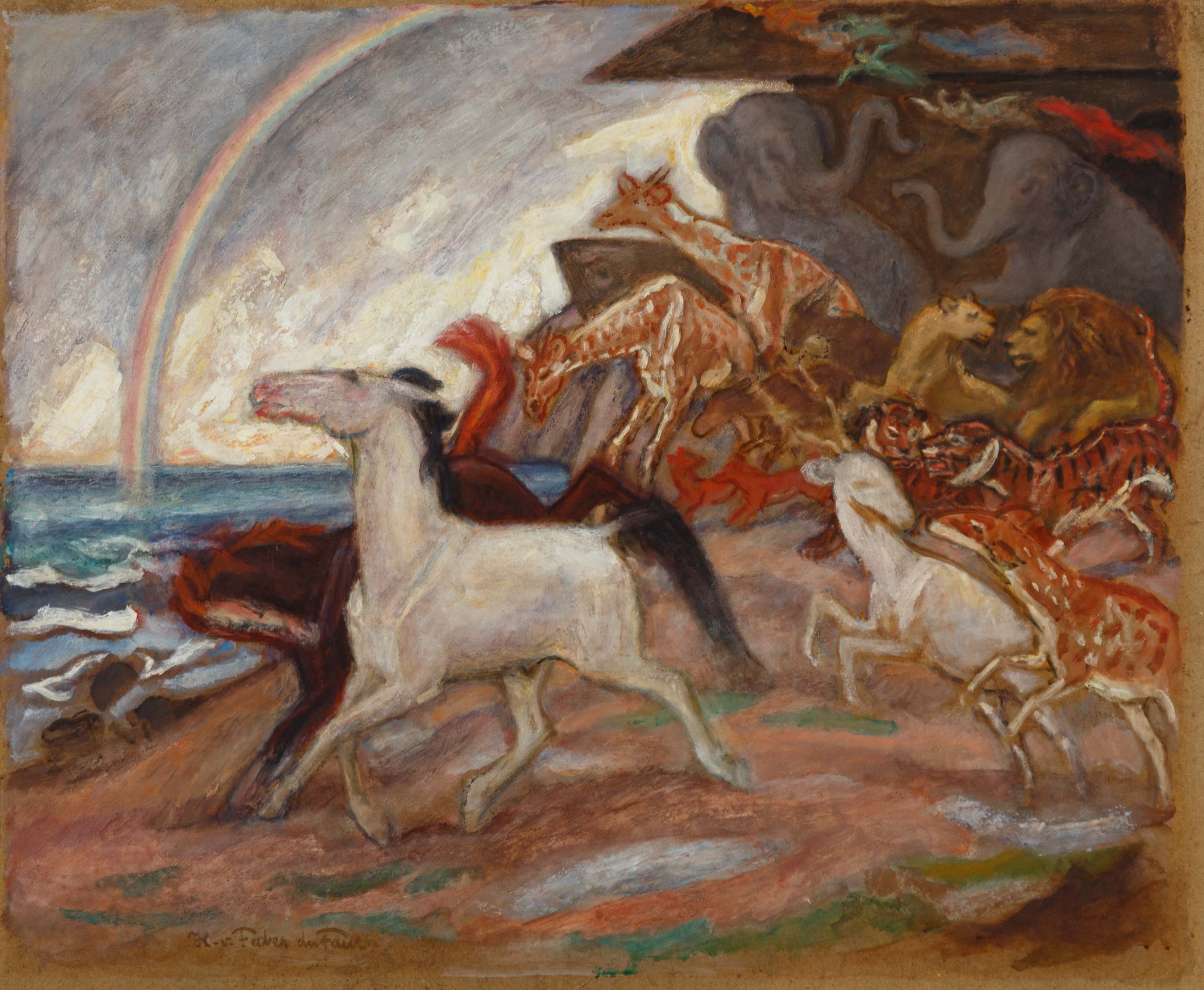
At ten years old, you would have found me with a kitten hidden in my bedroom closet, a pet rat perched on my shoulder, and a wounded sparrow that I was nursing back to health in a shoebox on my dresser. I spent most of my time around animals, finding everything about them to be enticing and fascinating. As a budding biologist from a very young age, the story of Noah’s ark was always my favorite. I have a beautiful hand-carved ark and set of animals from South Africa that I proudly display on my piano (and if I wasn’t embarrassed about getting caught, you might just see me acting out the epic tale with those little figurines). It is truly a magical story for someone like me, who finds joy in the fact that God thought to save the animals I love so much. But now, as a professional biologist, educator, and science communicator, the story of Noah has different meaning than what I had imagined as a child.
Before I explain, I want to discuss another important story that often comes to my mind when I discuss Noah’s Flood: the Tower of Babel. In a literal (i.e., plain reading) interpretation of this story, we would understand that due to wickedness, the Lord confounded the language of the people so that they could no longer understand each other. However, in recent years, I have watched the political divide widen in our country and have seen how language has been hijacked by one side or the other, such that the words we use on each side of the aisle no longer mean the same thing. The consequence has been that we are literally unable to communicate with one another. This has made me wonder whether there might be another meaning to this influential story. Perhaps our wickedness, our pride, and our use of language as a weapon have led to the same calamity that befell the inhabitants of Babylon, i.e., we can no longer understand each other.
Now let me translate this to my specific context. Through a series of experiences and inspiration, I have chosen to focus my academic research on reconciling science with religion. Most recently, I was a coeditor on a new book published by BYU’s College of Life Sciences, The Restored Gospel of Jesus Christ and Evolution. A free downloadable pdf of the book is available here. As I have tried to be a boundary spanner, opening lines of communication between my scientific colleagues and my religious friends, I have often found that our languages confound each other. This isn’t because we literally speak a different language. Rather, it is a result of pride on both sides, manifested in an unwillingness to even see a viewpoint other than our own. It is the animosity that has built up between us that has caused our language to diverge. We no longer speak the same language because we have set up a false dichotomy between disciplines, rather than seeing them as two lenses through which to look at the world, with the humility to admit that both perspectives are looking through a glass darkly (see 1 Corinthians 13:12).
Let me illustrate this with a recent experience (that I describe in more detail in a recent publication1). Long story short, I had the opportunity to tour the Ark Encounter in Williamstown, Kentucky. An amusement park of sorts, this attraction consists of an enormous, life-sized gopherwood ark complete with three stories of stuffed animals, bamboo cages, clay pots, ingenious (and sometimes outright ludicrous) watering and feeding apparatuses, infographics, and a host of wondrous fantasies. It was truly one of the most whimsical places I have visited, and it transported me back to my childhood, imagining what it might have been like to be on an ark with all of God’s creatures. But the glaring and plentiful scientific holes and pseudoscientific fallacies brought me back to the present with disappointing swiftness. By contrast, during that same trip, I presented research at a scientific conference in Tennessee with some of the greatest minds in evolutionary science, only to find that the science was amazing, but the misunderstanding and outright mocking of religion went well beyond—and disappointingly so—the bounds of what scientific epistemology can even claim. So, here we are, living in an era where the language of science and the language of religion are often confounded. This makes it difficult for many to understand the deep and meaningful spiritual lessons we learn from Noah’s ark without becoming preoccupied with the story’s implausibility from a scientific perspective on one hand, or insisting on the other hand that the story must be literally true for the spiritual truths to be legitimate from a religious perspective.
I will start by answering the most common question I get asked about Noah’s ark: Is it scientifically plausible for Noah to have had every creature on Earth aboard the ark and for the Flood to be a global catastrophe? I’ll briefly present the scientific evidence that leads me to answer this question in the negative.
Evidence 1: A literal reading would put the story of the ark around 2300 BC, roughly 4000 years ago. Thus, the formation of the basic topology of Earth (e.g., the Himalayas, the Wasatch Mountains, the Rockies) and the breaking of a supercontinent (i.e., Pangea) into the seven continents we now have, would all have to fit within that 4000 years. Robust and plentiful geological evidence demonstrates that the Earth formed over 4.5 billion years ago, that the continents split and drifted to their current positions roughly 200 million years ago, and that mountain ranges formed millions of years ago (for the Himalayas, it was 40 million years ago).
Evidence 2: Animal (and plant) diversification takes a long time. While it can differ widely between different types of organisms and speciation events, it generally takes between 500,000 and 5 million years.2 To differentiate from the original “kinds” that would have been on the ark to the diversity of species we see today would take on the order of millions of years, rather than the 4000 years since Noah.
Evidence 3: The human population has not experienced a bottleneck (i.e., down to a single family of eight) within the last ten thousand years. Multiple lines of evidence show a steady and continuous increase in the human population size from the order of a few million during the Holocene (10,000 years ago) to tens of millions around the time that biblical scholars would place the Flood (3–2000 BCE), to hundreds of millions after the Flood (around 1000 BCE), to the over 8 billion we see today.3
There are more scientific truths I could offer about animal dietary needs, animal breeding, ice ages and geological factors, the cause of human diversity and racial characteristics, etc., but that is not the point I want to make here.
Here is the point I want to make: Freeing myself of the requirement for Noah’s ark to be strictly literal or scientifically accurate, and loosening myself from “the confounding of languages” of pitting science against religion has allowed me to more fully appreciate the spiritual truths in this beautiful story. What was God trying to teach us? What are the eternal truths we should have learned? How do we apply it to our lives?
First, God loves us. I feel confident in God’s love, and this allows me to roll with everything mortality throws my way, including metaphorical catastrophic floods. Second, God speaks to us through living prophets. Thus, we had better take care to listen. Third, God rewards obedience. This life is about overcoming our mortal weaknesses and learning to bridle our passions, abandon our pride, and offer our whole hearts to God. And, lastly, God loves all his creatures and values the diversity of life on Earth. This gives me a sense of stewardship and responsibility to care for these creatures in a manner commensurate with God’s love. And with how much joy I already find in the beautiful animals and plants around me, this is an easy thing for me to do.
Dr. Jensen specializes in improving biology teaching through the use of evidence-based instructional practices and overcoming barriers at the intersection of science and religion through effective science communication strategies. She is also the mother of four handsome boys and loves reading, sewing, and dissecting.
Art by Hans von Faber du Faur (1863–1940).
The Old Testament Reflections series is published in collaboration with the Maxwell Institute: https://mi.byu.edu/old-testament-reflections.
KEEP READING


J. L. Jensen, S. Johanson, J.B. Sorensen, I. A. Woolley, & L. Meadows, “Using Stones for Bridges, Not Barriers: How Effective Dialogue Can Restore Harmony Between Religion and Evolution,” BioScience, (2025): 1–8, https://doi.org/10.1093/biosci/biaf202.
There are a few resources I would recommend to explore rare cases along with average estimates using robust scientific methods: C. Roux, C. Fraisse, J. Romiguier, Y. Anciaux, N. Galtier, N. Bierne, “Shedding Light on the Grey Zone of Speciation along a Continuum of Genomic Divergence,” PLOS Biology 14, no. 12 (2016): e2000234; A. P. Hendry, P. Nosil, L. H. Riesenberg, “The Speed of Ecological Speciation,” Functional Ecology 21, no. 3 (2007): 455–464; J. A. Coyne and H. A. Orr, Speciation (Sinauer Associates, 2004).
