


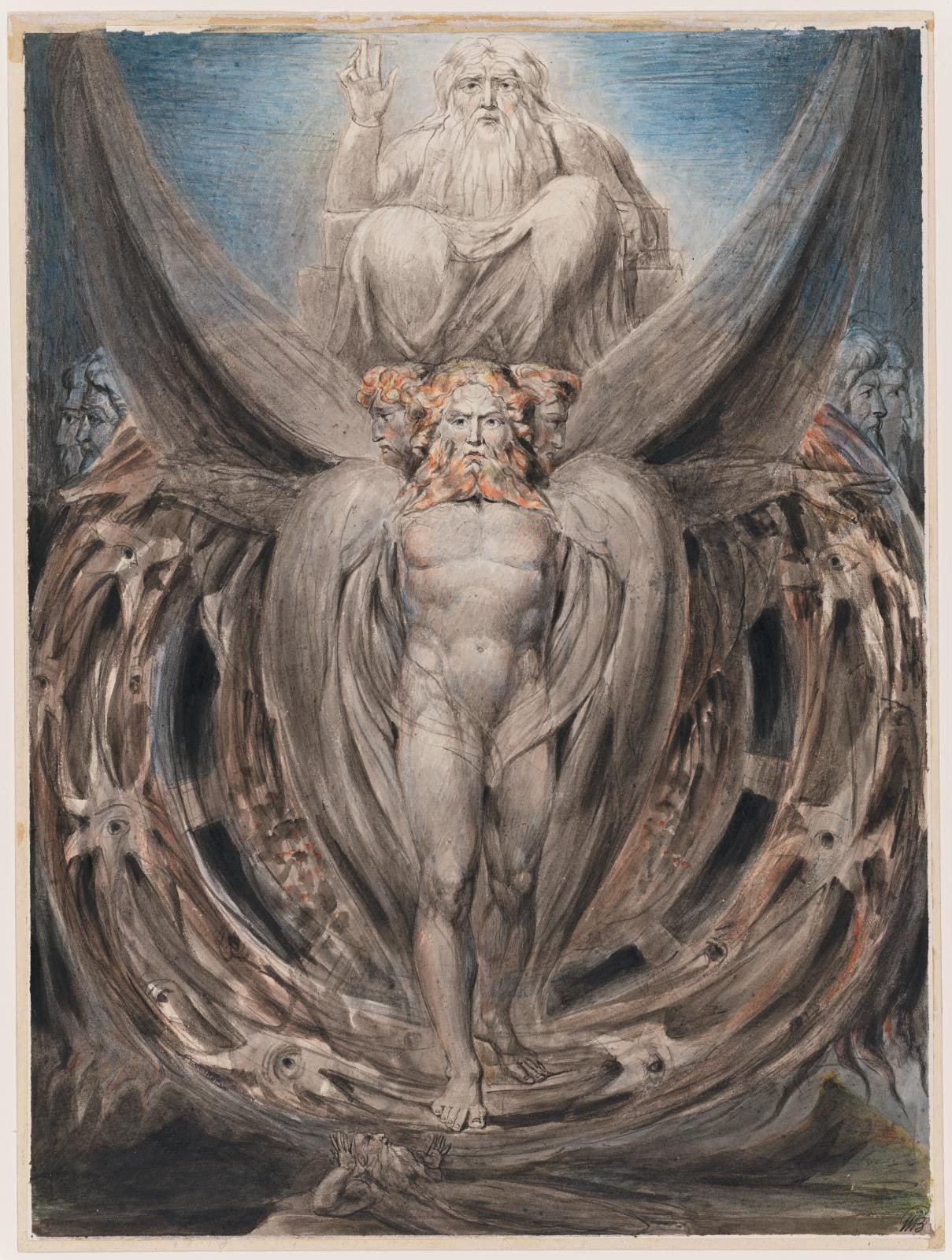
Twelve years after being taken captive to Babylon and seven years after being lifted to his feet by the spirit and beginning his prophetic ministry, Ezekiel learns that the city of Jerusalem has been destroyed, and Babylon has finally and completely conquered Judah. God tells the prophet that his fellow exiles will gather around him to “hear . . . the word that cometh forth from the Lord” (Ezekiel 33:30). They recognize Ezekiel as a pourer forth of divine truth. But God’s word will not move them (v. 31). Ezekiel will be to them like a song that entertains but does not transform. God says, “And, lo, thou art unto them as a very lovely song of one that hath a pleasant voice, and can play well on an instrument: for they hear thy words, but do them not” (v. 32). The people will listen to the melody, but they refuse to join the dance. Ezekiel’s words, behavior, and ministry can appear as incomprehensible and as transcendent as music. What should readers make of this strange man with his strange messages? Or, more importantly, what might his messages make of us?
Ezekiel’s bewildering and disorienting vision of God’s chariot—with its wheels within wheels full of eyes, its throne pulsating with the ineffable glory of God, its multi-winged and four-faced creatures—gave birth to folksongs and spirituals, to paintings and poems. It also gave rise to an early form of Jewish mysticism that sought to ascend to heaven even as it affirmed that heaven condescends to earth. Rabbinical schools would declare these words dangerous to the uninitiated, affirming the need for proven maturity before a student might dare read the text we call Ezekiel 1.1 There’s even a story of one young student of scripture catching fire while reading about the amber color of the divine “fire infolding itself” with its “brightness . . . about it” (Ezekiel 1:4).2
Ezekiel received this vision as an exile on the banks of the river Chebar, in Babylon. He had been taken with the first wave of captives in 597 BC, and as a former Jerusalem priest, he may have experienced dismay to witness the presence of God abandon the temple, a foreshadowing of the coming Babylonian destruction. But he was likely also stunned to learn that the presence of God could find him there in a foreign land, in a situation of such astonishing unholiness. The omnidirectional capacity of the visionary wheels affirmed that the presence of God cannot be restrained to a single location. God will move in unexpected ways.
Of all the prophets, of course it was Ezekiel who appeared to the mystical poet and artist William Blake when he was a young child, awakening the boy to a world on fire with God’s presence.3 Later, Blake published a poetic conversation he had with Ezekiel:
The Prophets Isaiah and Ezekiel dined with me, and I asked them how they dared so roundly to assert that God spoke to them . . . . I then asked Ezekiel why he ate [bread baked over] dung, and lay so long on his right and left side. He answered: “The desire of raising other men into a perception of the infinite.”4
Perhaps this is Ezekiel’s greatest work, then, to elevate his hearers to a sense of the transcendent presence of God even in their sometimes-debased circumstances. Ezekiel’s mystical vision is married with the undeniable earthiness of Ezekiel’s life. God calls the prophet “son of man” ninety-three times in the book. “Ben-adam” means earthling, mortal, maybe even mudling. Ezekiel’s this-worldliness might seem to contrast with God’s transcendent and ineffable glory. Yet, this is the mud-made prophet God visits, fills, lifts, calls, and inspires. His vision asserts that God meets humanity among the exiles, while we sit in the dirt, that holiness can be experienced in the most unlikely circumstances.
And Ezekiel’s experience affirms that when God shows up, it can in turn transform a person’s way of showing up in the world. The song ought to make the hearer move. After his encounter with the “the appearance of the likeness of the glory of the Lord” (1:28), Ezekiel is utterly committed to his prophetic task. He cannot hold back. Unlike his later listeners who will hear but not be moved, Ezekiel immediately begins to dance God’s radiance. The spirit sets him upon his feet, and he embodies the divine message. God asserts that Ezekiel himself “is a sign” unto his people (24:24). He is to enact the messages of God in surprising ways, startling people out of their weary worldviews.
Several Hebrew prophets engage in what scholars call “sign acts,” dramatic object lessons in which the prophet’s behavior rather than his words convey God’s message. Jeremiah shatters a pot to assert that apostate Israel will be scattered. Isaiah walks naked and barefoot to symbolize coming shame and captivity. But perhaps no one embodies God’s messages more vividly than Ezekiel. Beyond mere aural reception of God’s message, Ezekiel consumes a scroll with its divine missive, tasting its sweetness, metabolizing its meaning (2:1–4). One can only imagine the bafflement of his companions in exile when, rather than merely asserting that the Babylonian siege has not ended and will ultimately result in Judah’s exquisite distress, Ezekiel makes a map of Jerusalem on a tile, builds miniature siegeworks against it, then proceeds to lie on his left side next to the model city for three hundred and ninety days (4:1–5), eating defiled bread (v. 17). Oh, but how that audience astonishment must have increased when Ezekiel rises after over a year on one side, only to switch sides (4:6)!
Perhaps the greatest act in the drama of Ezekiel’s ministry comes in the form of a fascinating haircut. As a former punk rocker who found holiness in fast-circling mosh pits and in the souls of friends with interesting hairstyles, I have always loved the moment Ezekiel lights his beard on fire. To sear into the souls of his audience the striking reality that Jerusalem will ultimately fall to Babylon, Ezekiel shaves his head and beard and divides the hair into three parts. They watch breathlessly as he burns one part, slashes another with a sword, and scatters a third to the wild Babylonian winds (5:1–2, 11–12). What I would give to witness that moment, God’s light glinting in Ezekiel’s shining eyes, the smell of burnt hair rising. What more memorable way to convey that wickedness will never bring happiness, worlds without end, that our departure from the divine will only result in myriad flavors of misery? Ezekiel has become God’s warning of woe.
But Ezekiel’s visions go beyond his dramatic assertions that difficulty follows departures from God. Because he knows that the God of glory shines everywhere, the prophet utters some of the most stunning promises of restoration and provides provocative images of the hopeful holiness available to those with ears to hear and a willingness to be moved. A valley full of long-dry bones will witness a divine wind that brings bone to bone and restores the breath of life (37:1–14). A new temple will issue waters that flow down into the deepest and driest parts of existence, healing salty seas, and nurturing trees “whose leaf shall not fade” and whose fruit will nourish all nations (47:1–12). God will be the shepherd in our midst who will seek, gather, and feed our exhausted souls and “bind up that which was broken” (34:11–16). If we will internalize the song of God, and let it move us, God promises, “A new heart also will I give you, and a new spirit will I put within you” (36:26). Ezekiel’s mysticism invites us to see and experience God here and now, to trust that a better way comes when we live in the reality of God’s love. How might we hear this “very lovely song,” dance these images, and embody the radiant God revealed therein?
Robbie Taggart is a teacher and poet who delights in the holiness of the everyday.
Art by William Blake (1757–1827).
The Old Testament Reflections series is published in collaboration with the Maxwell Institute: https://mi.byu.edu/old-testament-reflections.
KEEP READING


Gershom Sholem, Jewish Gnosticism, Merkabah Mysticism, and Talmudic Tradition (Jewish Theological Seminary of America, 1960), 38, 40.
Babylonian Talmud, Hagigah 13a, https://sacred-texts.com/jud/t03/hgg03.html.
Tobias Churton, Jerusalem: The Real Life of William Blake (Watkins, 2020), 107.
William Blake, The Marriage of Heaven and Hell (John W. Luce, 1906), 22, 25. Blake concludes this section of the poem thus: “If the doors of perception were cleansed everything would appear to man as it is, infinite” (26).
