


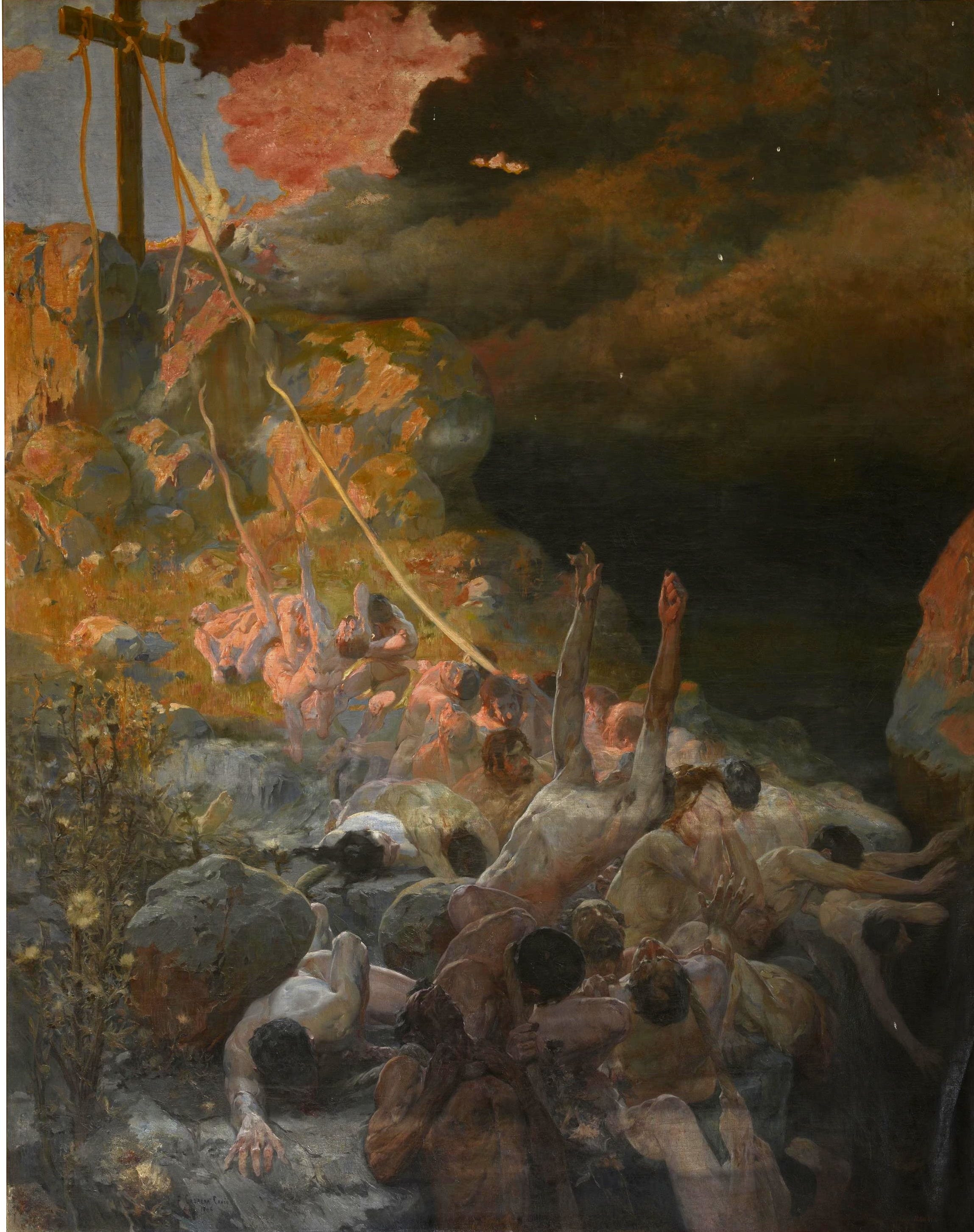
Hell was my favorite word as a tween. I loved it because adults forbade it as profanity, but the Bible couldn’t stop saying it, as far as I could tell. And catching adults in hypocrisy was my favorite sport—what could be funnier than God’s potty mouth?
Once I had discovered cruder words and cared less for the sanction of Christian scripture, I found hell absurd rather than scandalous. Not that I necessarily doubted its existence. Life was full of absurdity. Hell could exist for all I knew or cared. But the whole concept was outlandish nonsense. Suffering I got. Suffering I had. I knew that mortal life would bestow a surplus of pain. But shoveling suffering upon suffering, forever, with no final rehabilitation, as a punishment? What sense could that ever make? Especially if God is in control of the cosmos. What could eternal suffering possibly mean in a fundamentally good world? These problems were strange enough that I mostly dropped the question. And I didn’t care that much: the void of non-existence spooked me more than endless pain, and the disappointment of life with a psychologically devastated father was more acute for me than the hypothetical kingdom of a fallen angel named Lucifer.
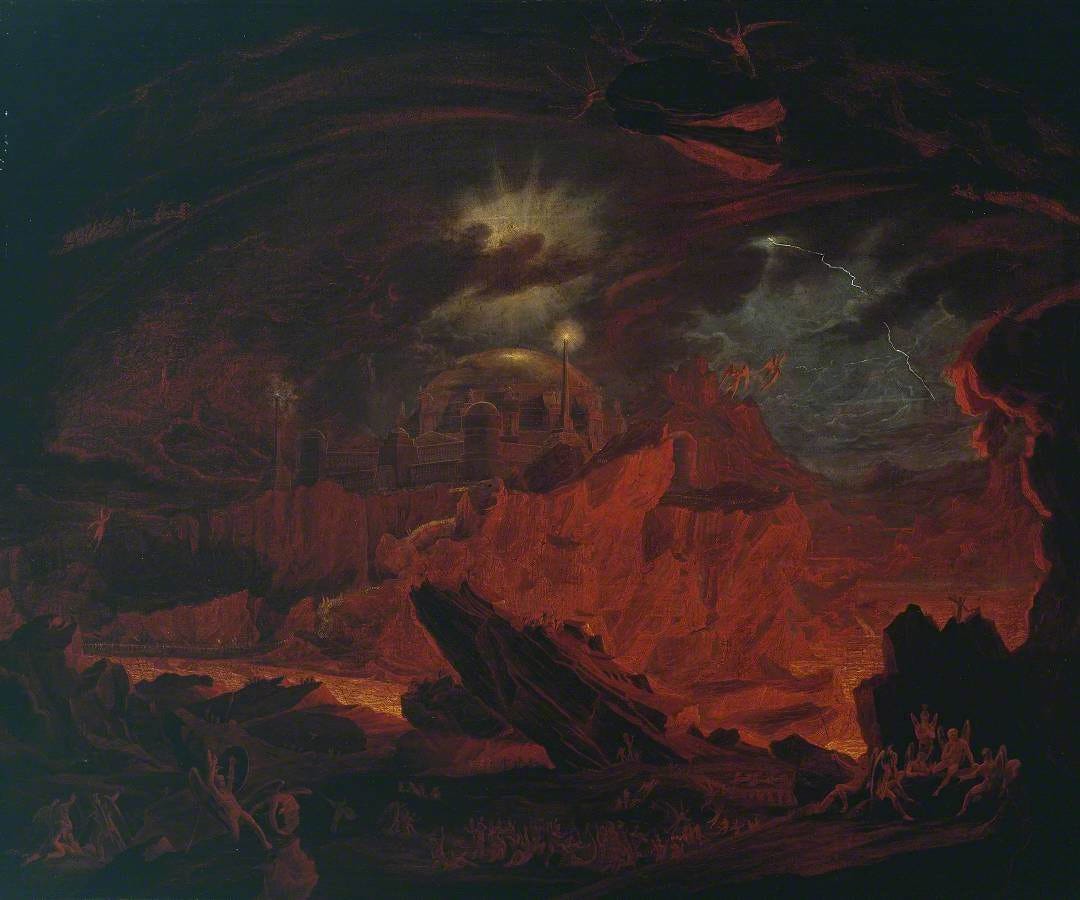
I’m not the only child to find hell absurd, judging from David Bentley Hart’s ardent assault on the Potemkin village of the Christian inferno, That All Shall Be Saved: Heaven, Hell, and Universal Salvation (Yale University Press, 2019). Hart carries a sledgehammer and a rucksack full of Molotov cocktails on his mission to destroy the ghoulish facades of that fake town. There’s a lot of bile simmered in vinegar in this book. Hart’s denouncement of his enemy (in this case, “infernalism”) is more aggressive and dismissive than his other popular books, even than his archly polemical Atheist Delusions.
Hart aims a cloud of fists at the infernalists, but at least a couple of interwoven themes emerge in his pugilism. The first is the most determinative: Hart’s visceral reaction to the image of a God who would willingly create a world in which some are consigned to a permanent torture from which no rehabilitation is possible. That cosmos seems abjectly cruel and paints a Creator God of unquenchable malignancy. Intimately related to this former point is Hart’s understanding that a mere mortal cannot commit a sin that would justly merit an infinite punishment. We are not, at least in our mortal form, beings with the kind of eternal decisional scope that could merit interminable suffering. (We can deserve heaps of transient suffering, no disagreement on that.) Any person who intentionally chose hell would be doing so for deeply pathological reasons, and mental pathology doesn’t feel fair as a reason for punishment. Or they could choose hell by accident, which doesn’t justify such punishment either. While such limits on culpability exist in possible tension with human moral agency—a topic where Hart’s arguments are least compelling—most of his myriad expatiations and bromides are variations on the basic theme: Eternal hell can’t possibly be fair.
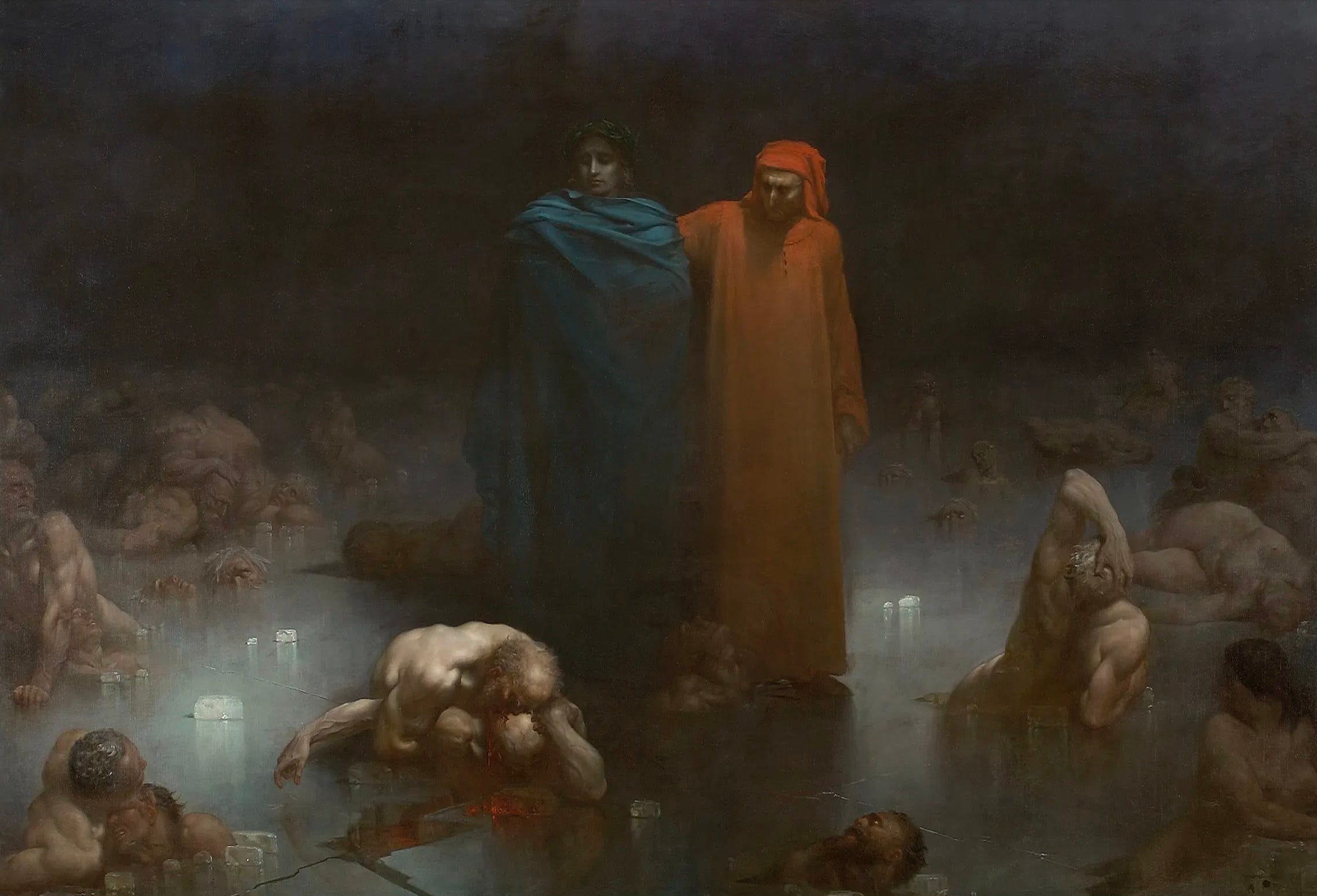
This book is so relentlessly polemical that it reads like a Reddit scrapbook. However buffoonish the polemics, though, Hart is not wrong when he claims that the three options for someone who actually, truly believes in the traditional hell are to be (1) a monster, (2) a madman, or (3) pathologically obsessed with saving as many souls as possible. We hear stories about diseased scrupulosity arising from religious intensity, but the worst scrupulosity does not even scratch the surface of the agitated pain that must come with the actual belief that any human soul could be truly forever lost.
That, in a sharpened nutshell, is Hart’s book. Latter-day Saint readers should be among the most receptive of audiences for a book denouncing the Protestant hell. But the story is not that simple.
We Latter-day Saints have never been very good at hell, queasily lurching from one foot to the other: sometimes we seem universalist, sometimes infernalist. I call us sacramental universalists because we believe that sacraments are necessary for heaven, and we perform those sacraments for absolutely everyone. Since becoming a believer almost forty years ago, I’ve consistently thought that we have the best of both worlds—meaningful rigor and infinite mercy—even if the temptation to be Protestant has sometimes seemed too powerful to resist.
The gravitational force of Protestantism can be enormously strong—we saints don’t often want to be embarrassed by how strange we are. At the time of the early Restoration, Christian universalists were seen as rebels against virtue: drunks, rakes, and rabble-rousers. The Saints would have been careful to avoid identification with universalists because they wanted to be good people. The idea of hell supposedly kept people civilized, decent, orderly. But the Saints were not their prophet: Sometime before the Church began in 1830, Joseph Smith proclaimed that hell’s eternal punishment was not in fact infinite in duration (D&C 19:11–12). By his account, the “eternal” in “eternal punishment” just meant that hell was God’s punishment rather than an endless human penal sentence. Eternal suffering didn’t last forever; it just came from God. That’s pretty darn universalist.
Smith followed this revelation and the Book of Mormon (which quibbled with its translator, particularly in the Nehor sequence of Alma) with the Vision of 1832 (D&C 76), which carved out something like a sparsely populated hell (the fate of the possibly forever-lost “sons of perdition”) but mostly revealed that even the nincompoops, miscreants, and monsters the American Protestants consigned to hell would inherit an afterlife of heavenly glory. One urban legend has it that Joseph Smith taught that this “telestial” kingdom was so glorious that a person would commit suicide to get there. Even though there’s no evidence he made that specific statement, it’s a pretty straightforward inference to draw from his teachings about the scope of heaven. But many in the Church revolted against the Vision, a mark of how intransigent hell is as an idea, even among the Saints.
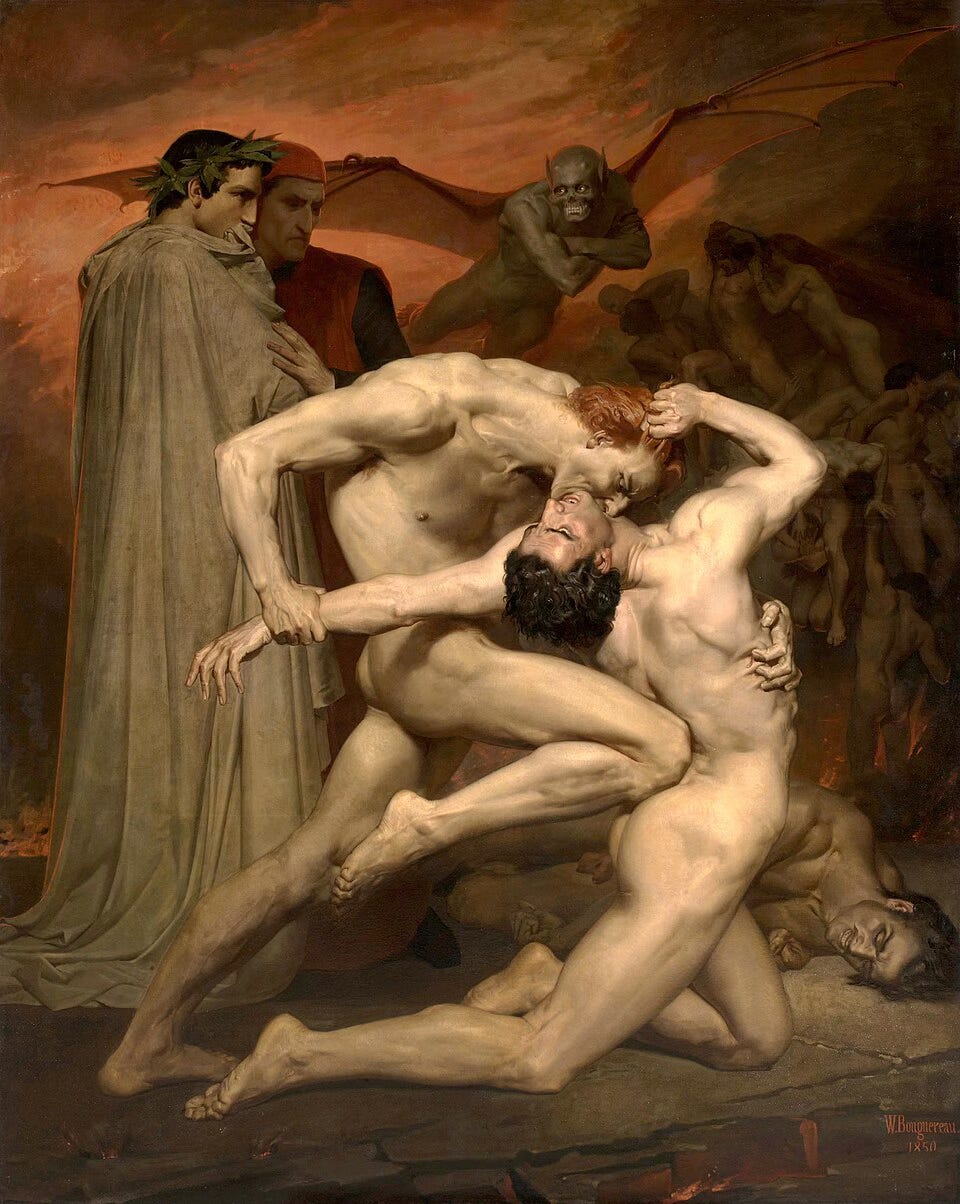
In the 1840s, Smith refined Mormon universalism as a temple antinomianism, which he informally described as carrying the saints to heaven on his back. Constantly mocking the austere God of Calvinism, Smith often taught that love and priesthood were enough to drag the whole lot of us to heaven. The twentieth-century church was rather less comfortable with antinomianism or universalism, settling on a more Protestant look and feel when it came to practical questions of afterlife disposition.
All that being said, other than some occasional references to the sons of perdition lurking in outer darkness, we as Latter-day Saints have pretty consistently been at least half-hearted universalists.
But the whole heart is a harder sell than half a heart. “Yes, yes,” we seem to say, there is no hell. But, honestly, only the Celestial Kingdom (and maybe not even all of it) is true heaven. Anything less than the celestial target may as well be a permanent hell, not least because—in one common teaching—those outside the celestial are torn from the people they have loved the most through life. Such views veer from half-hearted universalist to mostly infernalist theologies.
Here I think Hart can help us see our Restoration inheritance more clearly. Joseph Smith was adamant that we can never be saved alone. If there was anything Smith taught about salvation, it was this: We can only be saved together. Hart argues that because we are all essentially interconnected, we cannot be saved if anyone is damned unless we become generic. But if we are generic, then we cease to exist: “There is no way in which persons can be saved as persons except in and with all other persons.” Hart’s syntax is in a higher register than Smith’s, but the core message is the same. If anyone’s in hell, everyone is.
Here I pause to see in my mind’s eye the marvelous people in the ward I antagonized as an adolescent atheist. These are good saints, who saved my family in so many ways. I hear them criticizing, “This Hart guy is a shill for Satan’s plan. Satan said everyone would be saved no matter what. Satan wins if we say there is no hell.”
They wouldn’t be wrong to raise concerns—Hart is weakest when he considers agency, and all the bombast just makes his arguments seem weaker overall. At some point, if we are to be divine, surely our moral agency must be adequate to make a divine decision. If we can’t choose hell, how can we choose heaven? Didn’t the devil make just such a divine decision that led him to hell as the first ever damned intelligence?

Hart gets pretty elaborate, as is his wont, but his argument around agency boils down to this apothem—“As on the cross (John 12:32), so in the whole of being: God frees souls by dragging them to himself” (179). In other words, Hart argues that “free” will means that a human is liberated from incapacity rather than possessing a will that may arbitrarily choose as it sees fit. Just as God can never choose evil, so a truly free human can never choose evil in Hart’s view. He extends the argument from a kind of imitation of Christ—Jesus as wholly God and wholly human is someone who was not free to misbehave in any libertarian sense, but free he was. This line of argument may sound to many of us like an elegant dodge, familiar from the canard about Ernest Wilkinson’s favorite book, “Free Agency and How to Make People Use It Correctly.” The problem of agency will require thoughtful care for us Latter-day Saints to embrace universalism with our whole hearts.
There’s a false dichotomy that Hart exposes, and it’s worth staring at it: Rejecting hell does not mean abandoning consequences or even punishment. Latter-day Saint universalism does not require that sin, stupidity, and cruelty come free, that criminals bear no burden of their crime. It will always be true that sinning is stupider and more painful than doing good. On balance, the pain of sin will always be greater than the pleasure it bestows. It is never rational to sin. But none of that requires infinite, interminable punishment.
It will always, in a final accounting, be more painful to recover from sin than it was to sin in the first place. Nothing in that statement breaks any rules or requires bad theology (assuming at least that the suffering is either commensurate and/or useful to the affected soul). But a time-limited hell is vastly more like Catholic purgatory (or Mormon hell) than it is like the traditional hell of Western Christianity. I read Hart as arguing that the desire to frighten sinners into piety has led to a massive exaggeration of the scope of their future suffering. In other words, Hell is the biggest, weirdest exclamation point in history—like a 400-foot-tall plastic hamburger beside a highway in Nebraska. And maybe that image is the place to close this review (putting off to another day questions like whether Satan will one day go to heaven or whether anyone actually stays in telestial or terrestrial glory forever): the traditional hell of Western Christianity is a bizarre and distasteful distortion intended to scare people straight. We can and should do better.
Samuel Brown is a physician scientist who also wonders about bigger questions and writes books from time to time. He and his wife parent a blended family of seven children.

Sam, I'm a fan of your work. Thanks for giving me some things to chew on.
As a Hart fan, I often wish he’d dial back the polemics because the caustic rhetoric can get in the way of people actually engaging with his arguments. That said, if you truly believe that millions of sincere Christians are casually endorsing a doctrine of eternal torture, some heat in the prose feels at least proportionate to the stakes. It feels almost justified in this specific book (not necessarily all his books).
On the free will question, the standard objection "if we aren't free to choose hell, how can we be free to choose heaven?" begs the question. It treats heaven and hell like two equivalent items on a menu for a neutral, detached will to pick between. But Hart’s entire point is that the human will doesn't work that way.
If choosing hell requires a deeply pathological delusion, then that choice isn't a robust expression of freedom worth protecting; it’s a sickness. Critics often hold up the devil as proof that rational, divine beings can choose damnation, but a fundamentally pathological choice isn't "freedom" in any meaningful sense (you could, of course, heavily stipulate the LDS conception of free will with an acknowledgement of the always already given personhood that we do the best we can with (à la Adam Miller) but are not ultimately responsible for, even if we are responsible for our choices under the influence of that personhood, the disparity there being where the Lord steps in and universal salvation becomes a logical conclusion).
Hart’s analogy of Christ cuts right through this: Christ could not sin in a libertarian sense, yet no orthodox Christian argues that Christ lacked genuine freedom. Dismissing this as an "elegant dodge" is itself a bit of a dodge itself, never actually explaining why the analogy fails.
Finally, the position that Hart’s arguments are "least compelling" regarding human agency may be true under an LDS theological perspective. But Hart is his own brand of classical theist, and his conception of God as Satchitananda (being-consciousness-bliss) is not the God that Latter-Day Saints worship. Under his framework, his approach to human agency makes plenty of sense and I think is absolutely internally coherent. Failing to disclose that difference is a bit disingenuous.