


Every month, Latter-day Saint congregations participate in a fast and testimony meeting in which “there are no assigned speakers or special musical numbers. Instead, the person conducting . . . invites members of the congregation to bear their testimonies,” which are supposed to “be brief so that many people can participate.”
I find these less-structured meetings fascinating. The pulpit is open to anyone who wants to step up—young or old, man or woman, member or visitor. You never know from one speaker to the next which way things will go. Children may walk up, lose their nerve, and require parental assistance. Some people express faith while others share their struggles. Someone might break down in tears or perhaps tell a meandering story. People might bear witness to truths or express gratitude for blessings. I once saw a bearded, disheveled man stand up, confess that he was addicted to drugs, and then, seemingly unsure of what else to say, stumble back to his seat.
Although the beliefs, content, and delivery of the speakers vary, Latter-day Saint practice sacralizes each of their expressions by including them in our sacrament worship service, which President Dallin H. Oaks called “the most sacred and important meeting in the Church.” While individual congregants may be distracted by children or technology, as a group we give each and every speaker our time and consideration. Fast and testimony meeting honors each person’s unique journey and their right to explain it in their own way—whether their conclusions are correct or not.
What I love about this tradition is that it forces me to engage with people whose experiences are not my own. They share how they have encountered God and what they have come to understand through those experiences. Although these expressions may not always square with how I experience God, my own sense of God expands as I see him through the eyes of others.
I think about fast and testimony meetings as I study the Old Testament. This collection of thirty-nine books, written and edited by dozens of ancient Israelites over several centuries, is the most diverse body of texts in our scriptural canon. While some Christian traditions emphasize the Bible’s perceived doctrinal uniformity as a tenet of their faith, Latter-day Saints are more comfortable acknowledging what seems apparent from even a surface reading: Biblical authors understood the divine and made sense of the world in different ways.
Come, Follow Me invites Church members to remember how “inevitable” it is that different parts of the Old Testament “will reflect the perspective of the person or group of people writing it. This perspective includes the writers’ national or ethnic ties and their cultural norms and beliefs. Knowing this can help us understand that the writers and compilers . . . focused on certain details while leaving out others. They made assumptions that others would not have made. And they came to conclusions based on these details and assumptions. We can even see different perspectives across the books of the Bible (and sometimes within the same book).”
Thus, we find that one book calls upon Jewish men to divorce their non-Jewish wives (see Ezra 9–10), while another book highlights the blessings that came from marrying a foreign woman (see Ruth).
In one account of Creation, God simply speaks “Let there be!” and the universe obediently responds (see Genesis 1). Other depictions of Creation draw upon ancient Near Eastern images of God defeating a primordial sea monster representing the forces of chaos (see Psalm 74:12–17, Job 26:10–13, or Isaiah 27:1).
The Assyrian Empire was a hated military power that left death wherever its armies went. Was it appropriate to celebrate the Assyrians’ fall (see Nahum), or should the Israelites have remembered that God’s loving concern extends even to them (see Jonah)? Would the Assyrians be destroyed (see Isaiah 14:24–27), or would they one day be gathered to God along with the house of Israel (see Isaiah 19:24–25)?
As we read the Psalms, do we identify with poets declaring that God “is good: because his mercy [ḥesed] endureth for ever” (Psalm 118:1)? Or do we relate more to those questioning, “Is his mercy [ḥesed] clean gone for ever?” (Psalm 77:8).
As with the diverse individuals we listen to in fast and testimony meetings, the variety of perspectives in the Old Testament is an opportunity. Some may reaffirm our faith in God as we have come to understand him, while others may challenge us in uncomfortable ways. In both these meetings and in the scriptures, it may take some soul-searching and soul-stretching for us to decide how to react to a perspective we disagree with. Are they wrong? Or do they know something we need to learn?
We might look at the Old Testament, for example, and conclude that the allowance for slavery found in their legal codes was immoral—something the ancients practiced because they did not understand some truths that we know better.1 On the other hand, we might decide a self-critique is in order when we see the many laws and prophetic texts insisting that Israel take care of orphans, widows, the poor, and refugees. Are modern notions of individualism or nationalism blinding us to some truths the ancients better understood?2
As we study the Old Testament, let’s rejoice in the diversity we find and recognize that it is a sacred experience to give so many voices—even ones with different perspectives—their turn at the pulpit.
Joshua Sears grew up in Southern California and served in the Chile Osorno Mission. He received a BA in ancient Near Eastern studies from BYU, followed by an MA from The Ohio State University and a PhD in Hebrew Bible from The University of Texas at Austin. His research interests include biblical polygamy, the book of Isaiah, and Latter-day Saint translations and editions of the Bible. He has presented at regional and national meetings of the Society of Biblical Literature, BYU Education Week, the Sidney B. Sperry Symposium, and the Leonardo Museum Conference on the Dead Sea Scrolls. He is the author of A Modern Guide to an Old Testament (Deseret Book, 2025). His wife, Alice, is from Hong Kong and plays in Bells at Temple Square; they live in Lindon, Utah, with their five children.
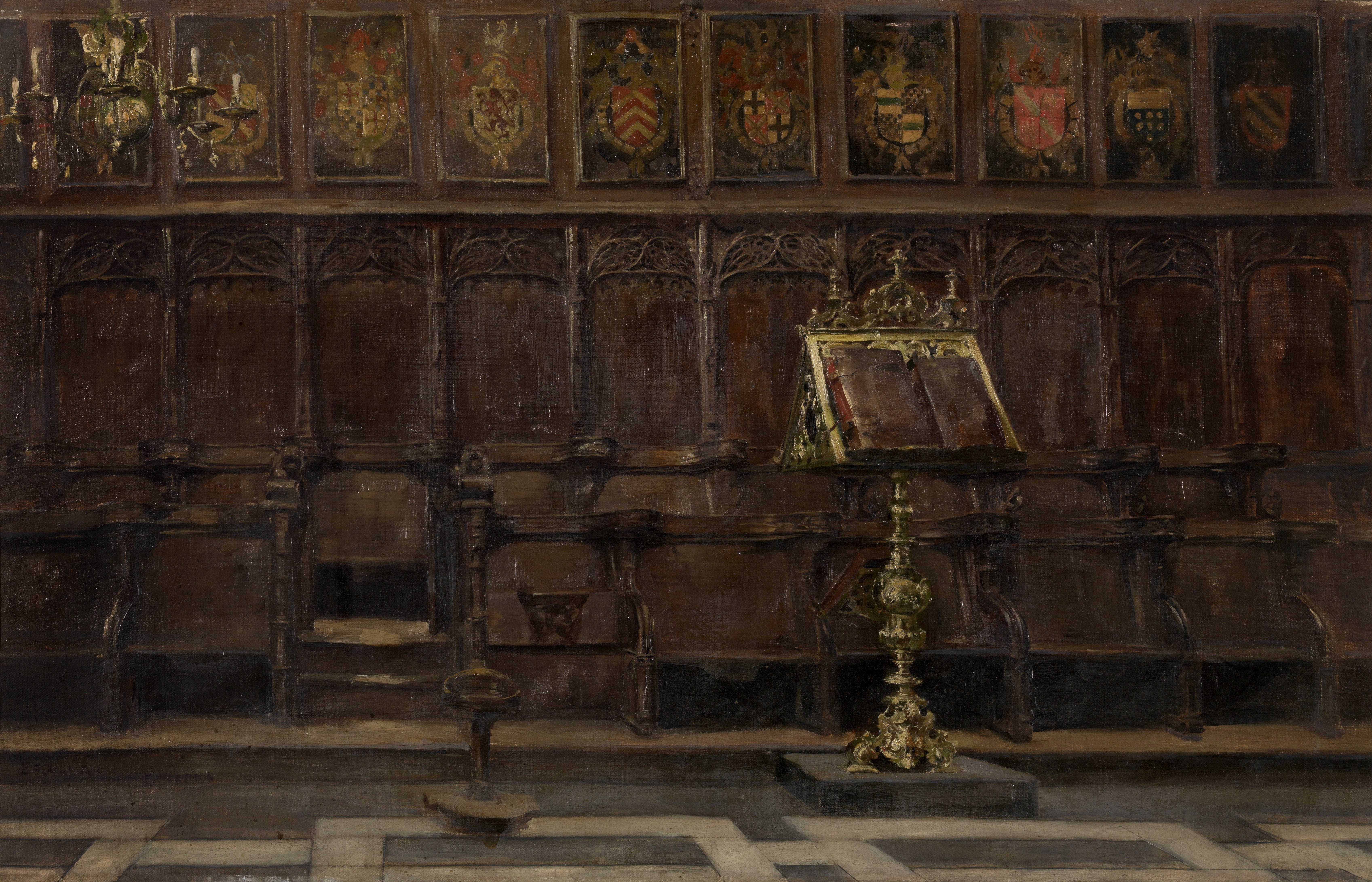
Choir Stalls in the Salvator Church in Bruges by Emile Vloors (1871–1952).
This series is published in collaboration with the Maxwell Institute: https://mi.byu.edu/old-testament-reflections.
See Joshua M. Sears, A Modern Guide to an Old Testament (Deseret Book, 2025), 116–18.
See Avram R. Shannon, Gaye Strathearn, George A. Pierce, and Joshua M. Sears, eds., Covenant of Compassion: Caring for the Marginalized and Disadvantaged in the Old Testament (Religious Studies Center, Brigham Young University; Deseret Book, 2021).
